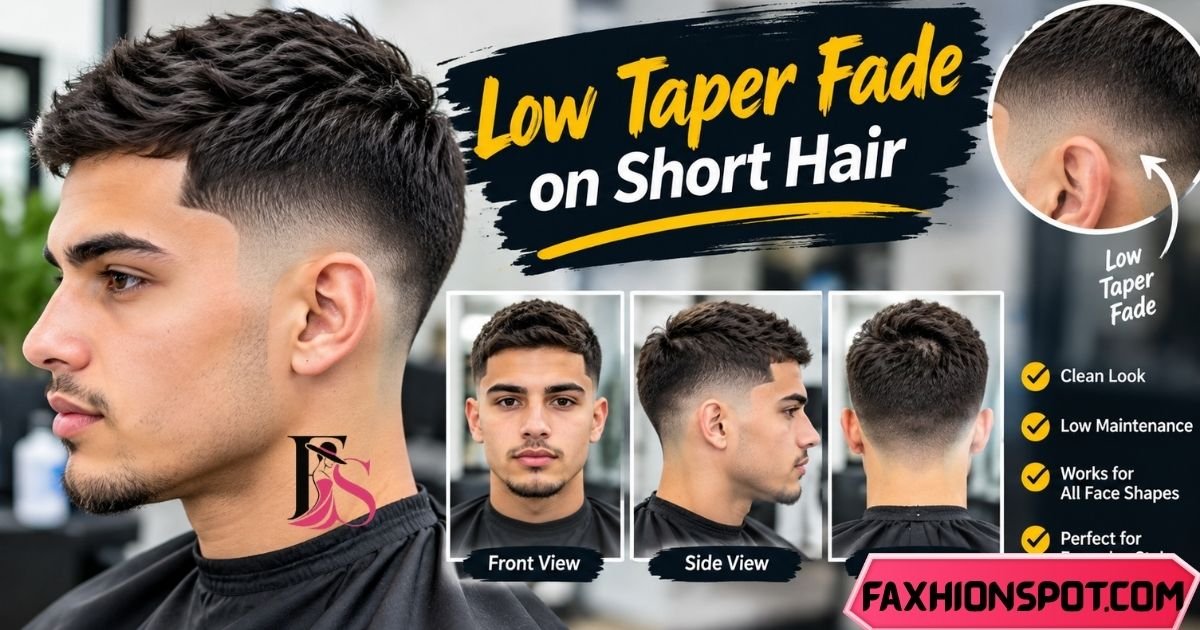
A low taper fade on short hair is one of the easiest men’s haircuts to customize in 2026. It keeps the sides and neckline progressively shorter while leaving enough length on top for a crop, fringe, crew cut, curls, waves, a side part, or a clean buzz cut.
What makes this haircut especially useful is its flexibility. A low taper can work with straight, wavy, curly, coily, thick, fine, or slightly thinning hair. It can also be adjusted to suit different face shapes, personal style, and maintenance preferences.
In this guide, you’ll find more than 20 short-hair variations, exact barber wording, styling advice, maintenance tips, U.S. price expectations, beard combinations, and answers to the most common questions.
What Is a Low Taper Fade on Short Hair and Why Is It So Popular?
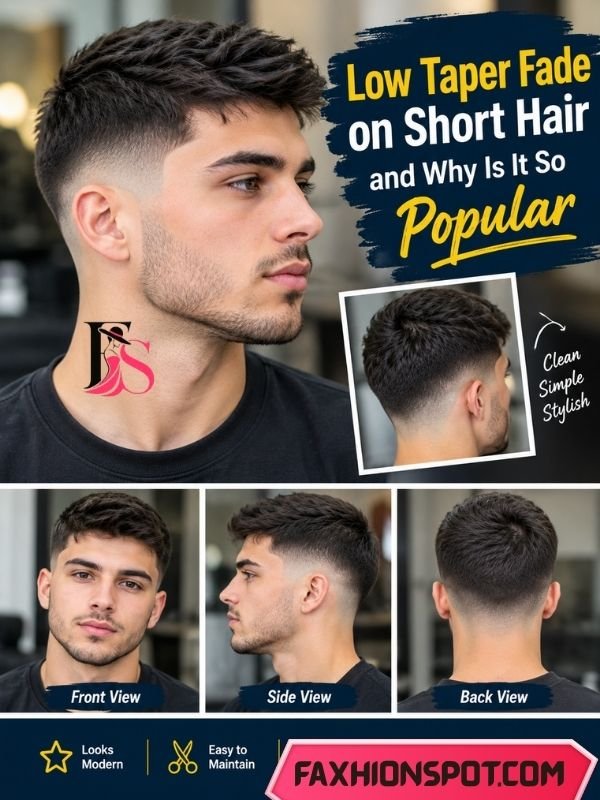
The style combines short hair on top with a gradual taper that begins relatively low around the ears, temples, sideburns, and neckline. Unlike a high fade, it preserves more visual weight on the sides.
That subtle placement is the main reason it has become so versatile. Current men’s haircut guides consistently describe the low taper as clean, adaptable, relatively low maintenance, and suitable for both traditional and modern hairstyles.
The look can be:
- Clean and professional
- Messy and textured
- Sporty and youthful
- Curly and natural
- Sharp with a lineup
- Relaxed with a soft taper
- Minimal with a buzz or crew cut
What Is a Low Taper Fade on Short Hair?
In simple terms, it is a short haircut where the hair gradually becomes shorter near the lower sides and neckline while the upper sides and top retain more length.
The word low describes where the taper begins. It does not necessarily mean the shortest area must reach completely to the skin. You can request a shadow taper, clipper taper, or skin-close finish depending on your preference.
A useful way to think about it is:
Longer top → gradual transition → shorter sideburns and neckline.
The exact guard numbers should be discussed with your barber because head shape, hair density, texture, and desired contrast all affect the best blend.
How Does a Low Taper Fade Compare to Other Fade Haircuts on Short Hair?
The biggest difference is where the transition begins.
| Style | Taper position | Overall contrast | Best for |
| Low taper | Around lower temples/ears and neckline | Low to moderate | Natural, versatile looks |
| Mid taper | Around temple/ear level | Moderate | Balanced modern styles |
| High taper | Higher on the sides | High | Bold, dramatic styles |
| Skin fade | Can be low, mid, or high | Very high | Crisp, exposed-scalp finish |
| Shadow taper | Short but not skin-close | Low | Soft grow-out |
A low taper generally leaves more side weight than a mid or high taper. That makes it particularly useful when you want definition without dramatically changing the silhouette.
What Are the Best Low Taper Fade Styles for Short Hair?
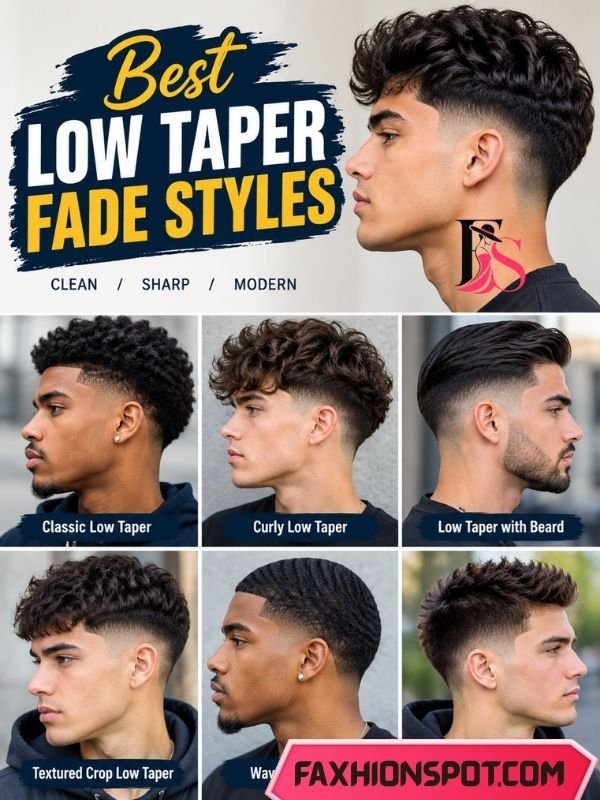
Here are 20+ practical variations, organized by hair type and styling preference.
Low Taper Fade Styles for Short Straight Hair
Straight hair makes the taper particularly easy to see because the hair naturally follows the shape of the cut.
Classic Textured Crop with Low Taper Fade
Keep the top short with choppy, point-cut texture and push it slightly forward. The low taper cleans the perimeter without taking away too much bulk.
Ask for: “Keep the top short and textured, with a low taper around the ears and neckline.”
Side Part with Low Taper Fade
A short side part gives you a traditional appearance while the taper prevents the haircut from looking dated.
It is a strong option for office environments, formal events, and men who prefer controlled styling.
Slick Back with Low Taper Fade
Leave enough length on top to brush backward. Use a lightweight styling cream for a natural finish or pomade for more shine.
This works best when the hair has enough density to hold the shape.
Short Messy Top with Low Taper Fade
Ask your barber for uneven texture through the top rather than a perfectly uniform finish.
A small amount of matte clay can create separation without making short hair look greasy.
Comb Over with Low Taper Fade
The comb over creates direction while the taper keeps the sides controlled.
For a contemporary version, avoid an overly sharp part and ask for natural texture.
Low Taper Fade Styles for Short Wavy Hair
Wavy hair already provides movement, so the haircut can focus on preserving natural texture.
Short Wavy Messy Top with Low Taper Fade
Let the waves remain slightly longer on top and use a lightweight curl or texture cream.
Avoid brushing the finished hair too aggressively because that can remove natural definition.
Short Wavy Textured Crop with Low Taper Fade
A textured crop gives wavy hair a compact shape while the taper cleans up the perimeter.
This is especially useful for men who want a style that looks good with minimal daily effort.
Low Taper Fade Styles for Short Curly Hair
Curly hair can create excellent contrast against a clean taper.
Short Curly Top with Low Taper Fade
Leave the curls long enough to maintain their natural pattern. Your barber can shape the perimeter without flattening the top.
For tighter curls, a curl cream followed by light finger definition usually works better than heavy wax.
Short Afro with Low Taper Fade
A short afro with a taper creates a clean outline while maintaining natural volume.
Ask for the taper to remain low if you want the sides to retain fullness.
Burst Fade with Short Curly Top
A burst fade is technically a different fade shape from a traditional low taper, but it is worth considering if you want the taper effect to curve more noticeably around the ear.
Low Taper Fade Styles for Short Coily Type 4 Hair
Coily hair can make a taper look particularly defined because the natural texture contrasts strongly with the shorter perimeter.
Short Coily Top with Low Taper Fade
Keep the top compact and shaped while tapering the sideburns and neckline.
A clean lineup can make the finished style more structured, although your natural hairline should remain the priority.
Short Coily Top with Highlights and Low Taper Fade
Subtle highlights can add dimension to dense coily texture.
Keep the color understated if you want a haircut that remains suitable for professional environments.
Low Taper Fade Styles for Short Thick Hair
Short Thick Textured Crop with Low Taper Fade
Thick hair benefits from internal texture because removing some bulk allows the top to sit naturally.
Tell your barber not to over-thin the hair. Excessive thinning can make dense hair look uneven as it grows.
Low Taper Fade Styles for Short, Thin, or Thinning Hair
Shadow Low Taper Fade for Thinning Short Hair
A shadow taper can be a smart choice when you want to avoid exposing too much scalp.
Keeping some density around the sides can make the haircut appear fuller. A textured crop or short Caesar can also direct attention toward the front rather than the temples.
What Is a Low Taper Fade Short on Top, and Which Styles Work Best?
A short-on-top version keeps the upper hair relatively compact instead of creating a dramatic difference between the top and sides.
The best options include:
Buzz Cut with Low Taper Fade
A buzz cut is simple, masculine, and extremely low maintenance. The taper adds shape around the ears and neckline.
Crew Cut with Low Taper Fade
A crew cut leaves slightly more length toward the front and gives you more styling flexibility than a traditional buzz cut.
French Crop with Low Taper Fade
A French crop uses a short forward fringe with texture through the top. It is particularly useful for men who want a compact hairstyle with some forehead coverage.
Caesar Cut with Low Taper Fade
The Caesar has a short, relatively even fringe and compact top. Pairing it with a taper creates a clean modern update.
Low Taper Fringe Haircut Guide: 12 Styles, Every Hair Type, and Exactly What to Tell Your Barber
A low taper fringe combines tapered sides with longer hair toward the front. The fringe can be blunt, textured, messy, curly, wavy, side-swept, or piecey.
Current hairstyle guides frequently recommend point-cutting and varied lengths when the goal is a textured fringe rather than a solid, straight-across edge.
Here are 12 variations:
- Textured fringe
- Choppy fringe
- Messy fringe
- Side-swept fringe
- Curly fringe
- Wavy fringe
- Blunt fringe
- Curtain fringe
- French crop fringe
- Edgar-inspired fringe
- Wispy fringe
- Piecey fringe
What to Tell Your Barber for a Textured Fringe
Try:
“Keep the sides low and gradually tapered. Leave enough length in front for a textured fringe, and point-cut the fringe so it looks separated rather than blunt.”
That wording gives your barber a better starting point than simply saying “give me a fringe.”
Blowout Taper for Curly Hair: What to Ask Your Barber and How to Style It
A blowout taper uses length and volume on top while the sides, temples, and neckline are gradually shortened.
Curly hair can work particularly well because the natural curl pattern creates volume. However, the cutting approach needs to account for shrinkage. One current barber guide recommends cutting curly hair dry or stretched because wet curls can appear considerably longer before they contract.
What to Ask Your Barber
Say:
“I want a curly blowout taper. Keep enough length on top for my curls to stay full, taper the sides and neckline gradually, and don’t remove too much weight from the curl pattern.”
If your hair is tightly coiled, also explain whether you want a rounded silhouette or more vertical height.
How to Style Curly Blowout Hair
- Start with damp hair.
- Apply curl cream or a lightweight leave-in.
- Use a diffuser if additional volume is needed.
- Lift the roots gently rather than aggressively brushing the curls.
- Finish with a small amount of lightweight styling product.
The aim is volume without destroying the curl pattern.
Blowout Taper Textured Fringe: Low, Mid and High
A blowout taper with textured fringe combines three visual elements: volume at the crown, a tapered perimeter, and a forward textured fringe.
Current haircut guides emphasize point-cutting and directional blow-drying as key parts of the look.
| Taper height | Look | Best for |
| Low | Subtle and natural | Conservative styling |
| Mid | Balanced and noticeable | Most face shapes |
| High | Bold and high contrast | Statement looks |
Low Blowout Taper with Textured Fringe
This keeps the sides relatively full and makes the fringe the main feature.
Ask for: “Low taper, longer crown, and a point-cut textured fringe that falls toward the eyebrows.”
Mid Blowout Taper with Textured Fringe
The mid version creates stronger contrast and gives the top more visual prominence.
Ask for: “Mid taper around the temple, three to four inches on top, and a piecey fringe cut with point-cutting.”
High Blowout Taper with Textured Fringe
The high version creates the strongest contrast.
A high blowout taper climbs higher toward the upper temple and requires more frequent maintenance because regrowth becomes visible sooner.
High Blowout Taper Haircut Guide: Low vs Mid vs High, Every Hair Type
Choosing taper height is largely a decision about contrast.
Straight hair can make the transition look sharper. Wavy hair softens the blend naturally. Curly and coily textures can create substantial volume above the taper.
For curly hair specifically, current guides generally describe low tapers as subtle, mid tapers as balanced, and high tapers as the most dramatic option.
Which Hair Type Works Best With Each Height?
Straight: Mid or high for stronger contrast.
Wavy: Low or mid for natural movement.
Curly: Low or mid for balanced volume.
Coily: Low or mid when you want to preserve side fullness.
Fine: Low or shadow taper to avoid excessive scalp exposure.
Thick: Any height, depending on how much bulk you want removed.
Which Face Shape Suits a Low Taper Fade Best for Short Hair?
An important advantage of this cut is that the height can be adjusted without completely changing the haircut.
| Face shape | Recommended approach |
| Oval | Almost any short style |
| Round | Add modest height on top |
| Square | Textured crops and clean short tops |
| Oblong | Avoid excessive height |
| Heart | Fringe can add useful forehead balance |
| Diamond | Preserve some side weight |
A round face often benefits from a little vertical texture. An oblong face may look better with less height and slightly more side fullness.
Does a Low Taper Fade on Short Hair Work for All Hair Types?
Yes. The cut can be adapted for straight, wavy, curly, coily, thick, and finer hair by changing the top length, taper intensity, and styling method.
Is a Low Taper Fade on Short Hair Suitable for All Ages?
Generally, yes. A conservative taper works for teenagers, young professionals, and older men. The key is choosing a top style and finish that fits the wearer’s lifestyle.
How Do You Ask Your Barber for a Low Taper Fade on Short Hair?
Don’t rely on the haircut name alone. Explain four things:
- Where you want the taper to begin
- How short you want the shortest area
- How much length you want on top
- How you normally style your hair
A reference photograph is also extremely useful because terminology can vary between barbers and shops. Current barber guidance similarly recommends showing front, side, and back references when possible.
Exact Barber Scripts for Each Short Hair Variation
Textured crop:
“Short textured crop on top, low taper around the ears and neckline, keep the blend soft and don’t take the taper too high.”
Curly top:
“Keep my curls full on top and create a low taper around the sideburns and neckline. Please preserve my natural curl pattern.”
Buzz cut:
“Short buzz on top with a low taper around the temples, sideburns, and neckline. Keep the transition soft.”
French crop:
“Short textured French crop with a low taper. Leave the front slightly longer so I can wear the fringe forward.”
Thin hair:
“Keep some side weight and give me a soft shadow taper rather than taking the sides completely to skin.”
What Words and Phrases Should You Avoid Telling Your Barber?
Avoid vague requests such as:
- “Just make it fade.”
- “Do whatever looks good.”
- “Make it like the picture” without showing the picture.
- “Take it really short.”
- “Make it high.”
- “Give me a taper fade.”
Instead, specify the height, shortest point, top length, fringe direction, and desired finish.
Can You Do a Low Taper Fade on Short Hair at Home?
You can maintain the neckline and sideburns at home, but creating a clean taper blend is considerably harder without professional experience.
The biggest problem is creating a smooth transition between different lengths. A beginner can easily create visible steps or remove too much hair.
For a first attempt, leave the actual taper to a barber and use a trimmer only for light cleanup between appointments.
How Do You Style a Low Taper Fade with Short Hair?
Styling depends on the top.
For textured hair, use a matte clay or paste. For curls, use curl cream or leave-in conditioner. For slick styles, a lightweight pomade works better.
What Products Work Best for a Low Taper Fade on Short Hair?
| Hair goal | Recommended product |
| Natural texture | Matte paste |
| Strong texture | Matte clay |
| Curls | Curl cream |
| Soft hold | Styling cream |
| Shine | Lightweight pomade |
| Volume | Sea salt or texture spray |
| Fine hair | Lightweight volumizing product |
Heavy products can flatten short fine hair, while excessive shine can make textured styles appear greasy.
What Is the Daily Styling Routine?
A five-minute routine is usually enough:
- Lightly dampen the hair.
- Apply a small amount of product.
- Work it through the top with your fingers.
- Push the hair into the desired direction.
- Pinch the ends for texture.
- Use a cool blow-dryer setting if you need extra volume.
For a fringe, dry the front forward. For a slick back, direct airflow backward.
How Do You Maintain a Low Taper Fade on Short Hair?
Most men should plan a cleanup roughly every two to four weeks, depending on how sharp they want the taper to remain.
Current guides commonly place the maintenance window around two to three weeks for a crisp finish, while softer tapers can often be stretched longer.
How Does a Low Taper Fade on Short Hair Grow Out?
The gradual transition tends to soften naturally as the hair grows.
| Time | Typical appearance |
| Week 1 | Fresh and sharply blended |
| Week 2 | Still clean |
| Week 3 | Blend begins softening |
| Week 4 | More natural taper appearance |
| Week 5 to 6 | Shape becomes noticeably grown out |
One reason the low taper is appealing is that the transition starts lower, so regrowth can appear less dramatic than with a high, skin-close fade.
How Much Does a Low Taper Fade on Short Hair Cost in the USA?
Prices vary by city, barber experience, shop type, and extra services.
A reasonable 2026 planning range is:
| Shop type | Typical price |
| Budget or chain shop | $20 to $35 |
| Independent barbershop | $35 to $55 |
| Premium barbershop | $55 to $100+ |
Recent U.S.-focused haircut guides report similar ranges, while major metropolitan areas and premium shops can charge more.
A beard blend, razor lineup, design, or specialty styling can increase the final price.
What Beard Styles Pair Best with a Low Taper Fade on Short Hair?
Good combinations include:
- Light stubble
- Short boxed beard
- Full beard
- Faded beard
- Goatee
- Clean-shaven finish
A short boxed beard works particularly well with structured crops, while stubble creates a more relaxed appearance.
Click Here To Read Another Topic
Which Celebrities Wear a Low Taper Fade on Short Hair?
Celebrity grooming trends frequently influence men’s haircut searches. Public figures including Drake and Michael B. Jordan have appeared in short tapered styles, although their exact cuts vary between appearances.
Rather than copying a celebrity haircut exactly, use the photo as a reference for the silhouette, taper height, top length, and texture.
What Is the Low Taper Fade Meme and Why Did It Go Viral?
The “low taper fade” became a major internet haircut meme because the phrase was repeatedly used in short-form videos, edits, and jokes around men’s grooming culture.
Its popularity also benefited from the haircut itself being highly recognizable. The low placement gives it a distinctive but relatively wearable silhouette, making it easy to exaggerate or reference in memes.
The important distinction is that the meme is internet culture, while the haircut is a genuine barbering technique that remains popular independently of the joke.
Frequently Asked Questions
Is a low taper fade good for short hair?
Yes. It adds clean definition around the perimeter while allowing short styles such as crops, crew cuts, curls, and buzz cuts to retain their shape.
How long does a low taper fade last?
A crisp finish generally lasts around two to three weeks, although a softer taper can remain presentable for longer.
Is a low taper better than a high fade?
It depends on your preference. A low taper gives a softer, more conservative appearance, while a high fade creates stronger contrast.
Does a low taper work with curly hair?
Yes. Curly and coily textures can pair especially well with a low taper because the natural volume contrasts with the cleaner perimeter.
Should I get a skin fade or shadow taper?
Choose a skin fade for maximum contrast and a very crisp finish. Choose a shadow taper if you prefer a softer transition and easier grow-out.
Can a low taper hide a receding hairline?
It can help visually balance a haircut, especially when paired with a textured crop or forward fringe, but it cannot change the underlying hairline.
What guard should I ask for?
There is no universal best guard. Ask your barber to choose the shortest guard based on your density, skin visibility, and desired contrast.
How often should I visit the barber?
For a consistently sharp appearance, every two to three weeks is common. A softer version can often be maintained every three to four weeks.
Is a low taper professional?
Yes. Its subtle transition makes it one of the easier modern fades to adapt to workplaces, schools, and formal settings.
Can I style it without hair products?
Yes. Short textured hair can often be shaped with a blow dryer and your fingers, particularly when the haircut has been cut to work with your natural texture.
Final Thoughts
The biggest advantage of a low taper fade on short hair is that it gives you structure without forcing you into one specific hairstyle. The same basic taper can support a textured crop, side part, curly top, French crop, crew cut, buzz cut, fringe, or messy finish.
The best result comes from matching the taper height to your hair texture, face shape, styling routine, and maintenance habits. If you prefer a subtle look, stay low and preserve some side weight. If you want stronger contrast, consider a mid or high taper.