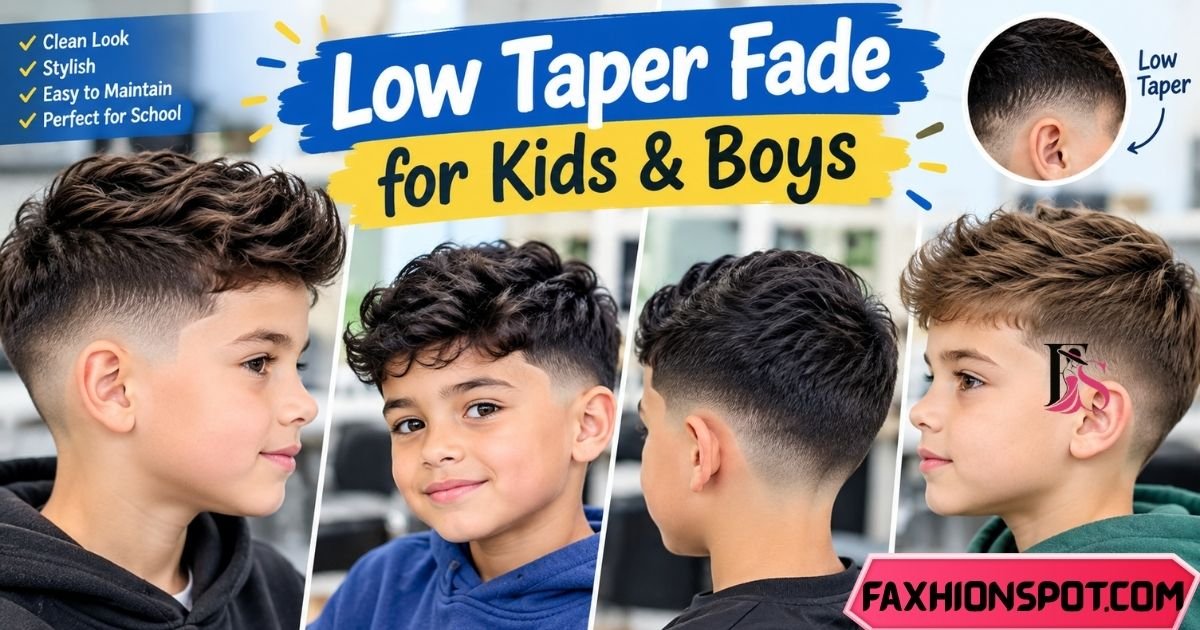
Choosing a haircut for a child sounds simple until you have to balance school rules, hair texture, age, maintenance, comfort, and your child’s personal style. A low taper fade can make that decision easier because it keeps the shortest area close to the ears, sideburns, and neckline while leaving more usable length on top.
The result is a clean haircut that can be adapted to curls, waves, straight hair, thick hair, fine hair, Afro-textured hair, and different face shapes. It can also be made very subtle for a young child or more fashion-forward for a teenager.
This complete 2026 guide covers 15 popular styles, age recommendations, hair-type ideas, barber scripts, school considerations, maintenance, pricing, products, sensory concerns, and practical parent tips.
What is a low taper fade for kids, and at what age can boys get one?
There is no universal minimum age for a taper or fade haircut. The right time depends more on the child’s comfort, ability to sit through a haircut, hair growth, family preference, and the barber’s experience with children.
For toddlers, a very soft taper is usually easier to manage than an extremely tight fade. Older school-age boys can handle more styling options, while teenagers may prefer sharper transitions and more defined finishes.
The most important consideration is comfort. If your child dislikes clippers, loud noises, or sitting still, start with a simple scissor-heavy haircut and gradually introduce clipper work.
What Is a Low Taper Fade for Kids & Boys?
A low taper fade gradually reduces hair length around the lower sides, temples, sideburns, and neckline while keeping considerably more length above the transition.
Unlike an all-over short haircut, the top can remain long enough for curls, texture, a side part, fringe, waves, or a simple natural finish.
The word “low” describes where the taper begins. Instead of climbing high toward the temples or upper sides of the head, the transition stays relatively close to the ears and neckline.
How Does a Low Taper Fade Actually Work?
A barber normally creates the transition with clippers using progressively shorter guards and blending techniques. The exact guard numbers depend on the child’s hair density, texture, desired contrast, and the barber’s method.
A typical process includes:
- Establishing the desired length on top.
- Cleaning around the ears and neckline.
- Creating a low transition.
- Blending the shorter sections into the longer hair.
- Checking both sides for symmetry.
- Finishing the neckline and sideburns.
- Styling the top according to the requested look.
The goal is a smooth transition rather than an obvious step between lengths.
What Is the Difference Between a Taper and a Fade?
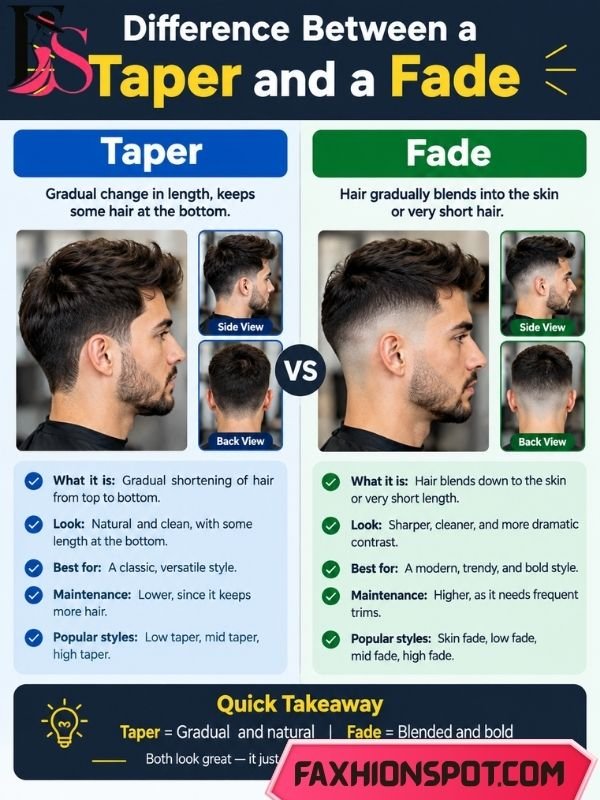
A taper usually focuses on gradually shortening hair around specific areas such as the sideburns and neckline. A fade can create a broader and sometimes more dramatic transition through the sides and back.
In everyday barbershop language, the terms can overlap, so parents should show a photo and explain how much length they want preserved.
If you want a conservative result, say that you want the transition low, soft, and natural.
What Makes the Low Taper Fade Different from Mid and High Fades?
The main difference is the height of the transition.
| Style | Transition area | Overall appearance | Parent-friendly starting point |
| Low taper | Around ears and neckline | Subtle and natural | Excellent |
| Mid fade | Around the middle of the sides | More noticeable | Depends on school |
| High fade | Higher toward temples | Strong contrast | Better for style-focused teens |
A low transition leaves more visual weight on the sides and usually creates a less dramatic appearance.
Why Is the Low Taper Fade So Popular for Boys Right Now?
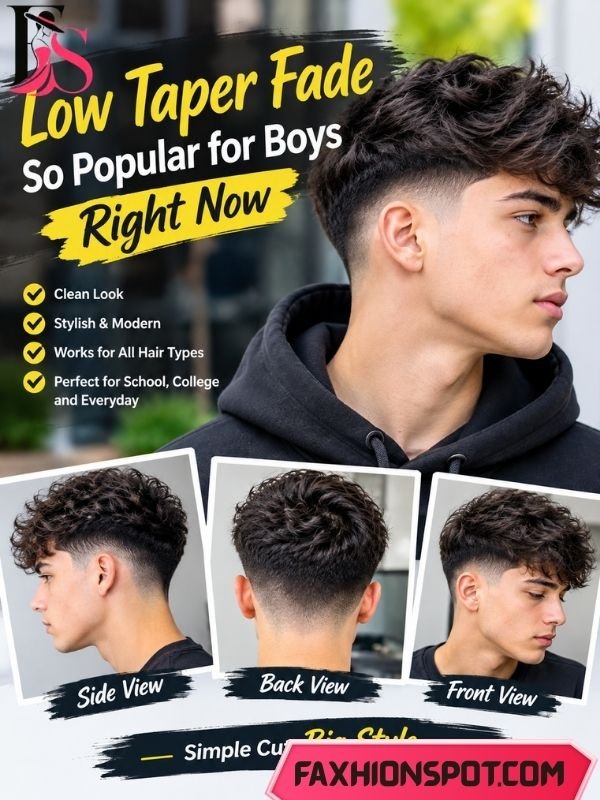
The popularity comes from its flexibility. Boys can keep a textured top, curls, waves, fringe, side part, crop, or even a simple short cut while keeping the lower edges tidy.
Parents also tend to appreciate the practical side. The haircut can look polished without requiring elaborate morning styling.
Search results across current hairstyle guides repeatedly emphasize the same advantages: versatility, school-friendly appearance, compatibility with multiple textures, and relatively simple maintenance.
The TikTok Effect: How a Viral Meme Made Every Kid Want This Haircut
The haircut itself existed long before social media, but the phrase became especially recognizable through a 2024 viral meme involving musician ericdoa and streamer Ninja.
The meme came from the phrase “imagine if Ninja got a low taper fade,” which spread on TikTok after appearing in an ericdoa freestyle. Ninja subsequently posted himself with the haircut, helping turn the phrase into a widely recognized internet reference.
That distinction matters: social media popularized the name and meme, but it did not invent the haircut.
Why Parents Love This Haircut Too
Parents often want three things from a boy’s haircut: a neat appearance, reasonable maintenance, and flexibility.
A low taper can provide all three when the barber keeps the transition conservative.
Common advantages include:
- Clean ears and neckline
- More length for styling
- Compatibility with many textures
- Easy morning grooming
- A softer appearance than a very high fade
- Flexible options for school and weekends
- A haircut that can grow out naturally
What Are the Best Low Taper Fade Styles for Kids & Boys in 2026?
There is no single perfect style for every child. The best option depends on hair texture, face shape, age, school policy, and how much daily styling your child actually wants to do.
Here are 15 versatile ideas.
1. Low Taper Fade with Textured Crop
A textured crop is one of the easiest choices for boys who want a modern haircut without spending much time styling it.
Keep the top short enough to remain manageable, then ask the barber for natural texture rather than a heavily sculpted finish.
This option works especially well for straight, slightly wavy, and thick hair.
2. Low Taper Fade with Curly Top
For naturally curly boys, leaving length on top lets the curls become the main feature.
The barber can taper the area around the ears and neckline while preserving the curl pattern above.
Avoid taking too much weight from the curly top unless your child specifically wants a shorter style.
3. Low Taper Fade with Comb Over
A comb-over creates a neat, classic appearance and can be adjusted for both younger boys and teenagers.
The top can be kept relatively short for easy school mornings or longer for a more noticeable side sweep.
A light styling cream is often enough for loose hair.
4. Low Taper Fade with Pompadour
A pompadour adds height and volume to the top while keeping the lower sides controlled.
For younger children, use a softer and shorter version rather than an exaggerated adult-style pompadour.
This is better suited to boys who enjoy styling their hair.
5. Low Taper Fade with Buzz Cut
A short top paired with a subtle taper is one of the lowest-maintenance combinations.
It works particularly well for active children involved in sports or outdoor activities.
Ask the barber to keep the taper soft if you want a conservative school appearance.
6. Low Taper Fade with French Crop
The French crop combines a short textured top with a forward fringe.
It is practical for boys who do not want to comb their hair every morning.
The fringe can be blunt, textured, or slightly irregular depending on the desired finish.
7. Low Taper Fade with Mohawk / Faux Hawk
A faux hawk creates more personality without requiring the dramatic sides of a traditional mohawk.
For school, keep the sides moderate and avoid an extreme shaved contrast.
A small amount of styling product can lift the middle section.
8. Low Taper Fade with Side Part
A side part is a classic option for school-age boys.
The haircut can be made neat enough for formal occasions while still looking modern.
Ask for a natural part instead of a hard shaved line if the school has strict grooming rules.
9. Low Taper Fade with Afro Top (for Black Kids)
An Afro-textured top paired with a carefully blended taper can create a balanced shape.
The barber should account for shrinkage, curl pattern, density, and natural growth direction rather than treating tightly coiled hair like straight hair.
For a younger child, a soft natural hairline may also be more practical than an extremely sharp edge-up.
10. Low Taper Fade with Broccoli Cut
The broccoli cut typically features a fuller, rounded, textured top.
Pairing that volume with a neat taper around the ears and neck creates contrast without necessarily making the haircut extreme.
This option is particularly popular with boys and teens who want a trend-focused appearance.
11. Low Taper Fade with Crew Cut
The crew cut is a dependable option for families who want something short and easy.
Keep the top slightly longer than the sides and let the taper clean up the lower perimeter.
It is especially convenient for athletic children.
12. Low Taper Fade with Slicked-Back Top
A slicked-back top works best when the hair naturally has enough length and density.
For children, choose a light styling cream instead of relying on a heavy, stiff product.
The style can be brushed backward for special events and worn naturally on regular school days.
13. Low Taper Fade with Spiky Top
A spiky top adds playful texture.
Instead of making every strand extremely stiff, use a small amount of lightweight styling product and create soft separation.
This can be particularly effective on straight or thick hair.
14. Low Taper Fade with Modern Mullet
A modern mullet combines shorter sides with extra length toward the back.
For children, the difference between the top, sides, and back can be kept relatively subtle.
Always check the school’s grooming rules before choosing a pronounced mullet.
15. Low Taper Fade with 360 Waves (for Black Boys)
Waves require consistent hair care and brushing rather than simply relying on the haircut.
The taper keeps the lower perimeter neat while the top remains long enough for the wave pattern.
Because wave routines can vary with hair texture and density, the barber should recommend a length that works with the child’s natural pattern.
Which Low Taper Fade Works Best for Your Child’s Hair Type?
Hair texture should influence both the haircut and the amount of maintenance required.
Low Taper Fade for Curly Hair Boys
Curly hair usually benefits from keeping enough length on top to preserve its natural pattern.
Tell the barber whether the curls are loose, medium, or tightly coiled and whether your child wants volume or a shorter shape.
Do not judge the final length while the hair is wet because curls can shrink considerably as they dry.
Low Taper Fade for Straight Hair Boys
Straight hair offers plenty of flexibility.
Textured crops, side parts, comb-overs, crew cuts, fringe styles, and slicked-back tops can all work.
If the hair is very fine, avoid removing too much density from the top because that can make the hair appear flatter.
Low Taper Fade for Wavy Hair Boys
Wavy hair is ideal for textured styles.
A barber can preserve natural movement while keeping the lower edges clean.
A small amount of lightweight cream can enhance the waves without making them look stiff.
Low Taper Fade for Thick Hair Boys
Thick hair gives the barber plenty of material to shape.
Ask whether removing internal bulk would make mornings easier. Sometimes reducing weight on top is more useful than making the sides extremely short.
Textured crops, side sweeps, curls, and messy tops are all good options.
Low Taper Fade for Fine Hair Boys
Fine hair usually benefits from preserving density.
Avoid excessive thinning and overly aggressive fading.
A textured crop, short side part, or crew cut can create the appearance of fuller hair without requiring heavy styling.
Low Taper Fade for Black Kids (Afro / 4C Hair)
For Afro-textured and 4C hair, the barber should understand shrinkage, curl density, hairline patterns, and the child’s natural texture.
The taper can be subtle or more defined, depending on preference.
Moisture and gentle detangling are usually more important than trying to force the hair into an unfamiliar shape.
What Is the Best Low Taper Fade for Each Age Group?
Age should guide the level of contrast, maintenance, and styling involved.
Baby Taper Fade: Is It Appropriate for Babies Under 2?
There is no need to give a baby a fade simply because it is fashionable.
For children under two, comfort should come first. If a haircut is necessary, a simple trim or very soft taper is generally easier than a detailed fade.
If your baby becomes distressed around clippers, stop rather than forcing the appointment.
Toddler Taper Fade (Ages 2–5): What Works Best?
For toddlers, keep the style simple.
A soft taper around the ears and neckline with a natural top can create a neat result without requiring daily styling.
Avoid complicated designs and long appointments unless your child is comfortable sitting through them.
Little Boy Taper Fade (Ages 5–7) Playful But Neat
Children in this age group can handle more variety.
Textured crops, curls, short side parts, crew cuts, and playful faux hawks can work well.
If school has strict grooming expectations, choose a natural finish without shaved designs.
School-Age Boys Taper Fade (Ages 8–12) The Core Audience
This is often the age when boys become more interested in hairstyle trends.
Let your child participate in choosing the top style while parents confirm that the finished haircut works with school requirements.
A low transition with a textured crop, curly top, side part, or short fringe offers plenty of flexibility.
Teen Taper Fade (Ages 13–17) Style-Driven Choices
Teenagers usually want more control over the final look.
They may prefer textured tops, broccoli cuts, mullets, waves, curls, pompadours, or more defined edges.
This is also the stage when school policy becomes especially important because some schools regulate designs, extreme contrasts, or hair length.
Quick Age Reference Guide
| Age | Suggested approach | Maintenance |
| Under 2 | Simple trim or very soft taper | Low |
| 2–5 | Soft taper with natural top | Low |
| 5–7 | Simple textured or short styles | Low to moderate |
| 8–12 | Wider range of school-friendly styles | Moderate |
| 13–17 | Personalized trend-focused styles | Moderate to high |
Which Low Taper Fade Suits Your Child’s Face Shape?
Face shape should not be treated as a strict rule. Hair texture, personality, school requirements, and personal preference matter too.
Low Taper Fade for Round Faces
A little height on top can visually lengthen the face.
Textured crops, side parts, and slightly elevated tops can work well.
Avoid creating excessive width at the sides if your goal is a more elongated appearance.
Low Taper Fade for Oval Faces
Oval faces are versatile.
Most top styles can work, including curls, crops, side parts, fringe, crew cuts, and textured looks.
The main consideration is usually hair texture and desired maintenance.
Low Taper Fade for Square Faces
A square face can handle structured styles.
A textured crop, crew cut, side part, or controlled quiff can emphasize the natural shape.
Keep the transition balanced rather than creating unnecessary bulk at one point.
Low Taper Fade for Heart-Shaped Faces
A heart-shaped face can benefit from balanced volume.
A textured fringe, side sweep, or medium-length top can help distribute visual weight.
Your barber can adjust the top according to the child’s forehead and jaw proportions.
How Do You Tell the Barber What Low Taper Fade You Want?
Showing a clear reference photo is often the easiest approach.
A phrase such as “low taper” can mean slightly different things from one barber to another, so combine the haircut name with details about length and finish.
The Complete Parents’ Barber Scripts
For a conservative school haircut:
“Please keep the taper low around the ears and neckline. I want a soft blend, not a high fade, and please leave enough length on top for school.”
For curly hair:
“Keep the curls natural on top and taper only around the ears, sideburns, and neckline. Please don’t remove too much volume.”
For straight hair:
“I want a low, gradual taper with enough length on top for a textured finish. Please keep the sides natural and avoid a high fade.”
For a toddler:
“Please keep this very soft and comfortable. I want a low taper around the ears and neck, but no aggressive skin fade or complicated design.”
For a teen:
“Keep the taper low and blend it smoothly. I want the top long enough for [crop/side part/curls/fringe] and keep the finish appropriate for school.”
Essential Questions to Ask the Barber Before the Cut
Ask:
- How short will the shortest area be?
- Will the taper reach the skin?
- How high will the transition go?
- How much length will remain on top?
- Will the style work with my child’s natural texture?
- How often should we return for maintenance?
- Can you keep the neckline natural?
- Is the requested style suitable for school?
What NOT to Say at the Barbershop
Avoid vague instructions such as:
- “Just make it look cool.”
- “Do whatever you want.”
- “Give him the fade from TikTok.”
Instead, show a reference photo and identify the important details.
How Do You Maintain a Low Taper Fade for Kids at Home?
Good maintenance does not mean constantly cutting the hair.
The goal is to keep the hair clean, moisturized when necessary, detangled, and styled appropriately for its texture.
The Complete Weekly Home Maintenance Routine
A simple routine can look like this:
Daily:
Brush or comb only as needed and style with minimal product.
Two or three times weekly:
Wash according to hair type and activity level.
As needed:
Moisturize curly or coily hair and gently detangle.
Every few weeks:
Check the neckline, sideburns, and overall shape.
Before school photos:
Schedule the barber appointment early enough to allow the haircut to settle naturally.
How to Do a Quick At-Home Touch-Up Between Barber Visits
Parents should be cautious about using clippers around the ears and hairline.
If you are experienced, a simple cleanup may involve removing stray hairs around the neckline. However, trying to recreate the complete fade can easily create uneven patches.
For most families, leaving the technical blending to a barber is safer and produces a cleaner result.
How to Keep Curly Hair Looking Fresh Between Trims
For curls:
- Avoid excessive brushing when dry.
- Detangle gently when appropriate.
- Use a lightweight curl product if needed.
- Avoid heavy buildup.
- Protect the hair from unnecessary friction.
- Refresh curls with water rather than repeatedly applying product.
The haircut should support the natural curl pattern rather than fight it.
Signs It Is Time for a Barber Visit
Look for:
- Hair covering the ears
- An overgrown neckline
- The taper losing its shape
- Excessive bulk around the lower sides
- The top becoming difficult to manage
- School or event deadlines approaching
Many current haircut guides place children’s taper maintenance roughly around every three to five weeks, although growth rate and desired sharpness can change that schedule.
How Much Does a Kid’s Low Taper Fade Haircut Cost?
Prices vary by city, barber experience, salon type, age, hair length, and whether extras such as designs or styling are included.
Current U.S. booking data puts many kids’ fade or taper appointments around $35 to $50, while basic children’s cuts can be less expensive.
Kids Taper Fade Price Breakdown
| Service | Typical U.S. planning range |
| Basic kids’ haircut | $15–$35 |
| Independent children’s haircut | $20–$45 |
| Kids’ taper/fade | $35–$50 |
| Detailed design | Often additional |
| Teen or complex cut | May approach adult pricing |
These are planning figures, not guaranteed prices. Published barber pricing data also shows substantial variation between markets and providers.
Smart Ways to Save Money on Kids’ Taper Fades
You can reduce costs by:
- Asking for a standard kids’ service
- Avoiding unnecessary designs
- Booking during slower periods
- Maintaining the haircut at home between visits
- Using a barber who regularly cuts children’s hair
- Asking about package or sibling pricing
- Confirming the price before the appointment
Is a Low Taper Fade Haircut School-Appropriate for Boys?
It can be, but there is no universal U.S. school rule that automatically approves every fade.
Dress codes vary by district and school. Some schools regulate hair length, designs, or styles, while others have more flexible policies. Government research has also documented that school dress codes frequently include hair-related rules and can affect different student groups differently.
What Most School Dress Codes Say About Fade Haircuts
Do not assume that “fade” automatically means school-approved or school-banned.
Read the actual student handbook.
Some schools focus on length, grooming, safety, or distracting designs. Others may have no specific haircut restrictions.
For example, New York City’s current DOE guidance addresses natural hairstyles and says dress codes should not prohibit natural hair or hairstyles closely associated with protected identities.
The Safest Low Taper Fade Choices for Strict Schools
If you are unsure about the rules, choose:
- Low transition
- Natural neckline
- Moderate top length
- No shaved designs
- No extreme contrast
- No unusual colors
- No oversized styling
- Neat sideburns
A simple textured crop or crew-style top is generally easier to explain to a school than an elaborate design.
School-Safe Fade Checklist for Parents
Before the haircut, check:
☐ Student handbook
☐ Hair-length rules
☐ Design restrictions
☐ Color restrictions
☐ Rules for sports or activities
☐ Photo-day expectations
☐ Religious or cultural hairstyle provisions
Never rely solely on what another parent says their school allows.
How Do You Prepare Your Child for Their First Taper Fade Haircut?
A positive first experience can make future haircuts much easier.
Step-by-Step First Barbershop Visit Preparation
1. Explain what will happen.
Tell your child that the barber will use scissors and possibly clippers.
2. Show pictures.
Use a few simple examples instead of overwhelming them with dozens.
3. Practice sitting still.
A short practice session at home can help younger children.
4. Bring comfort items if permitted.
A favorite toy or familiar object may reduce anxiety.
5. Choose a child-friendly barber.
Experience with children can make a major difference.
6. Avoid rushing.
Schedule enough time for breaks.
7. Praise cooperation.
Focus on the experience rather than demanding perfect stillness.
Low Taper Fade for Kids with Sensory Sensitivity
Some children strongly dislike buzzing sounds, neck brushes, loose hair, mirrors, or the sensation of clippers.
In that case:
- Tell the barber about the sensitivity beforehand.
- Ask whether scissors can be used for part of the haircut.
- Request short breaks.
- Let the child see the tools first.
- Avoid making the first appointment unnecessarily complicated.
- Consider a quieter appointment time.
A child should not be forced through a distressing grooming experience simply to achieve a particular trend.
What Are the Best Styling Products for a Kids’ Low Taper Fade?
Children generally do not need a complicated collection of styling products.
The product should match the hair type and desired finish.
Product Recommendations by Hair Type
| Hair type | Useful product category | Goal |
| Straight | Lightweight cream | Control |
| Wavy | Light styling cream | Definition |
| Curly | Curl cream | Moisture and shape |
| Coily/4C | Moisturizing leave-in | Hydration |
| Thick | Light matte paste | Texture |
| Fine | Lightweight volumizing product | Body |
Start with a small amount.
If the hair looks greasy, stiff, or weighed down, reduce the quantity rather than automatically switching to a stronger product.
Products to Always Avoid for Kids’ Hair
Avoid unnecessary products that are extremely heavy, irritating, or difficult to wash out.
Be especially cautious with:
- Excessively strong hold products
- Heavy wax buildup
- Strong fragrances if the child is sensitive
- Products that irritate the scalp
- Excessive amounts of gel
- Adult styling routines that require repeated heat
If your child has scalp irritation or a known sensitivity, ask a qualified healthcare professional for appropriate guidance.
What Are the Best Father-Son Matching Low Taper Fade Ideas?
Matching does not have to mean identical.
A father and son can share the same basic haircut concept while adapting the length to age, hair texture, and lifestyle.
Ideas include:
- Father: low taper with textured top; son: short textured crop
- Father: low taper with curls; son: curly taper
- Father: side part; son: mini side part
- Father: crew cut with taper; son: shorter crew cut
- Father: waves; son: short natural textured top
The goal is coordinated style rather than forcing identical haircuts.
Click Here To Read Another Topic
What Is the Best Low Taper Fade for Each Season?
Hair needs and styling preferences can change with the weather.
Spring:
Textured crops, side parts, and natural curls work well as temperatures rise.
Summer:
Shorter tops and simple tapers are practical for active children and sports.
Fall:
Medium-length textured styles provide more styling flexibility.
Winter:
A little extra length can make the haircut feel softer and reduce the need for frequent aggressive trimming.
Season should influence convenience, not dictate the haircut.
Frequently Asked Questions
Is a low taper fade good for kids?
Yes. It can be adapted to many ages and hair textures, especially when the transition is kept soft and the top remains age-appropriate.
What age can a boy get a taper fade?
There is no universal minimum age. Comfort, hair growth, ability to sit through the haircut, and parental preference matter more than a specific number.
Is a low taper fade school-safe?
It can be, but school rules vary. Check the current student handbook before choosing designs, extreme contrasts, or unusual styling.
How often should a boy get a taper fade?
Many boys need a trim about every three to five weeks, although faster growth and sharper preferences may require more frequent visits.
Can toddlers get a taper fade?
Yes, but a soft and simple version is generally more practical than an elaborate fade for a toddler.
Is a taper different from a fade?
A taper usually focuses on gradually shortening specific perimeter areas, while a fade can involve a broader transition through the sides and back.
What is the best haircut for curly-haired boys?
A curly top with a controlled low taper is a versatile option because it preserves the natural curl pattern while keeping the lower edges neat.
Can Black boys get a low taper fade?
Yes. The haircut can work with Afro-textured and tightly coiled hair when the barber understands shrinkage, density, curl pattern, and natural hair growth.
Does a low taper fade have to reach the skin?
No. You can request a shadow taper or a softer transition if you do not want the shortest area to look completely shaved.
What should I tell the barber?
Show a reference photo and say where you want the taper to begin, how much length you want on top, and whether the result needs to meet a school dress code.
How much does a kids’ taper fade cost?
Current U.S. booking data commonly places kids’ taper/fade appointments around $35 to $50, although local pricing can be significantly different.
Is a low taper fade easy to maintain?
Yes. The lower perimeter stays neat while the top can usually be styled according to the child’s natural texture.
Can a low taper work with straight hair?
Yes. Straight hair works especially well with textured crops, side parts, comb-overs, crew cuts, and short fringe styles.
Can a low taper work with wavy hair?
Yes. A soft taper lets the natural movement remain visible while keeping the ears and neckline clean.
What products should parents use?
Choose lightweight products appropriate for the child’s hair texture and use as little as necessary to achieve the desired finish.
Should parents cut the fade at home?
Simple neckline cleanup may be possible for experienced parents, but professional blending is difficult. A barber is usually the safer choice for the actual taper.
What is the safest first fade for a child?
A conservative low taper with a natural neckline, moderate top length, and no shaved design is a straightforward starting point.
Can a child have a taper if they dislike clippers?
Yes, but discuss the sensitivity with the barber first. A scissor-based or very gradual haircut may be a better introduction.
Is the low taper fade still popular in 2026?
Yes, it remains a prominent haircut request across current boys’ hairstyle guides, while its recognizable name was also amplified by the viral 2024 internet meme.
Final Thoughts
The best children’s haircut is not necessarily the most dramatic one. It is the style that fits the child’s hair, age, personality, comfort level, school environment, and family’s maintenance routine.
A low taper gives parents and boys plenty of room to customize the top without making the entire haircut extremely short. Younger children can keep it soft and natural, school-age boys can choose textured or classic tops, and teenagers can experiment with curls, waves, fringes, mullets, or other modern finishes.
Before booking, check your school’s current rules, choose a barber who is comfortable working with children, and bring a clear reference photo. Most importantly, let your child have some say in the final look. A haircut is easier to maintain when the person wearing it actually likes it.