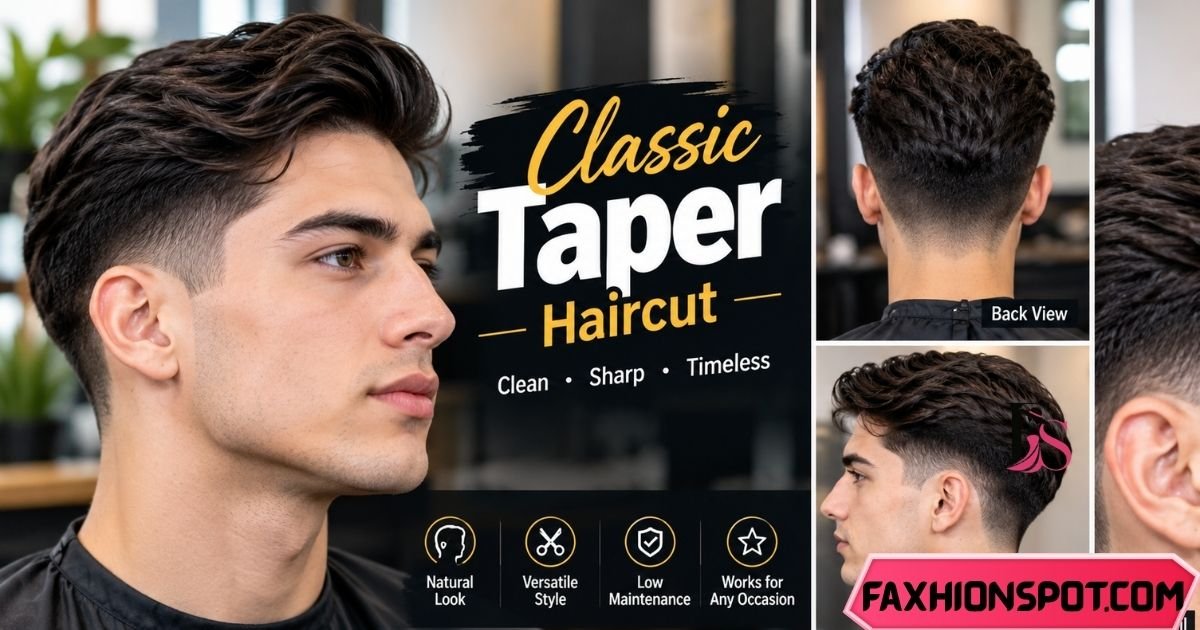
A timeless men’s haircut does not need a dramatic fade, complicated design, or hours of styling. The classic taper haircut remains popular because it gives you clean sides, a natural neckline, and enough length on top to create different looks. It can be dressed up for an office, styled casually for weekends, or adapted to textured, curly, thick, or fine hair.
The modern barbering world offers countless variations, but the basic taper remains remarkably versatile. Understanding taper height, top length, face shape, hair texture, clipper guards, and styling techniques makes it much easier to choose the right version.
This guide covers more than 60 style ideas along with barber instructions, maintenance advice, face-shape recommendations, hair-type guidance, and professional styling tips for 2026.
What Is a Classic Taper Haircut and Is It Still Worth Getting in 2026?
Yes. The style remains relevant because it offers something many highly aggressive fades do not: flexibility. The sides become progressively shorter toward the ears and neckline while the hairline remains natural rather than being completely shaved away.
Current haircut guides continue to describe the taper as a versatile option for professional, casual, and formal settings. Its ability to grow out gradually also makes it practical for men who do not want frequent barber appointments.
A few reasons men continue choosing it include:
- Natural-looking graduation
- Easy styling
- Professional appearance
- Compatibility with many face shapes
- Adaptability to different hair textures
- Better grow-out than many skin fades
- Numerous options for the top
If you want a haircut that can move from a job interview to a dinner date without looking out of place, this remains a strong option.
What is a classic taper haircut?
A classic taper haircut gradually reduces hair length around the sides, sideburns, and neckline while leaving noticeably more length on top.
The top can generally be cut with scissors or clippers depending on the desired style. The sides are blended through several lengths rather than making one dramatic jump from long hair to bare skin.
The important characteristics are:
- Longer hair on top
- Progressive shortening around the sides
- A controlled neckline
- A natural-looking transition
- No large area of exposed scalp
Traditional barbering references describe a taper as a gradual reduction toward the hairline, with the lowest section remaining short rather than completely disappearing.
What does “classic” mean in the classic taper?
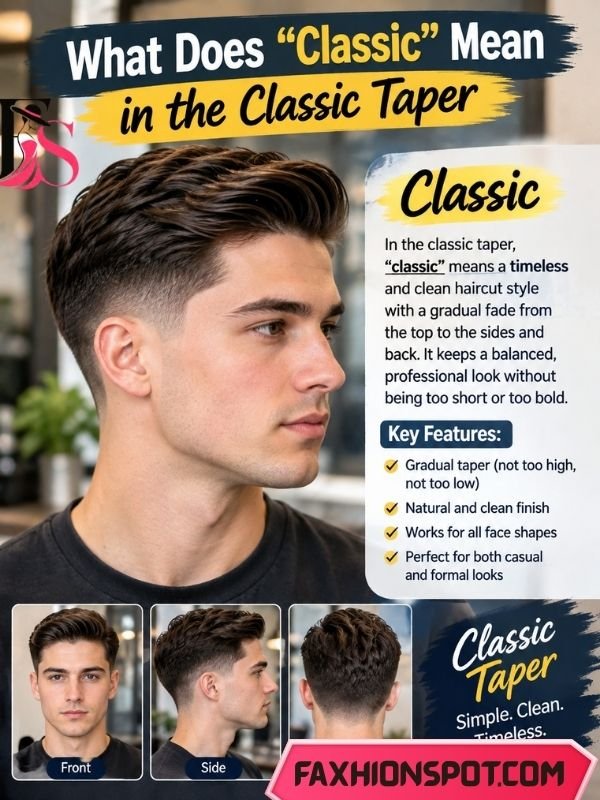
“Classic” describes the overall approach rather than one exact clipper number.
A traditional version usually emphasizes:
- Moderate top length
- Soft blending
- Natural edges
- Balanced proportions
- Limited contrast
- No elaborate shaved designs
Think side part, comb over, Ivy League, textured top, short pompadour, or neat brushed-back hair rather than an extremely high skin fade.
The idea is simple: the haircut should look polished without depending on a short-lived trend.
Is a regular taper the same as a classic taper?
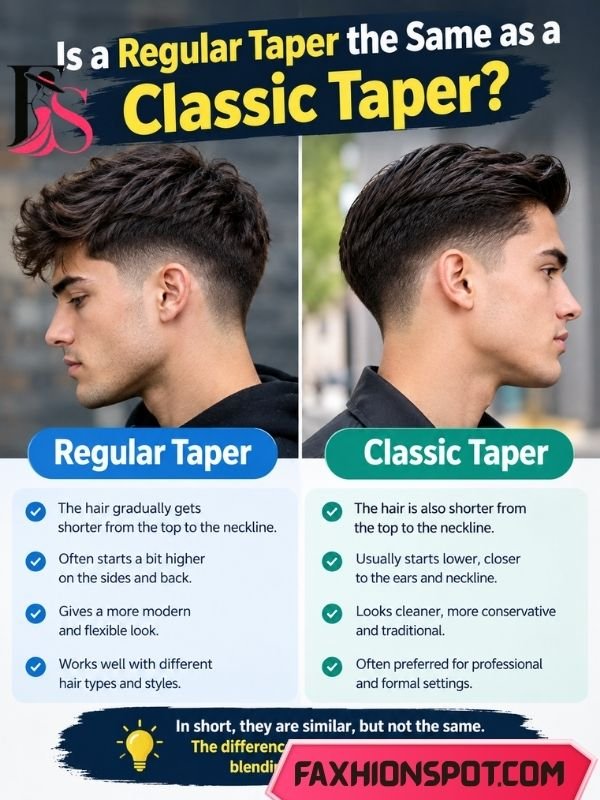
In many barbershops, “regular taper,” “traditional taper,” and “classic taper” are used to describe essentially the same basic concept.
However, terminology can vary from barber to barber. A client asking for a “regular taper” should still explain the desired height and lowest length because one barber may interpret the request more conservatively than another.
For clarity, say exactly where you want the taper and whether you want the neckline to remain natural or become very short.
Classic taper vs. fade vs. taper fade: Key differences explained
These three terms are often confused, but the difference mainly concerns how short the hair becomes and how broadly the transition is carried.
| Feature | Classic Taper | Taper Fade | Skin/Bald Fade |
| Overall look | Traditional | Modern hybrid | High contrast |
| Hairline | Usually preserved | More blended | Can reach skin |
| Skin exposure | Minimal or none | Possible at edges | Yes |
| Contrast | Low | Medium | Medium to high |
| Grow-out | Gradual | More noticeable | Usually faster |
| Styling | Highly versatile | Highly versatile | Modern/trendy |
| Professional use | Excellent | Good | Depends on workplace |
The core difference
The simplest distinction is this:
A taper gets progressively shorter around specific perimeter areas, while a fade creates a more complete transition that can reach skin.
A taper generally preserves more density around the sides. A fade can remove substantially more hair and create a stronger contrast.
Professional barbering resources make the same basic distinction between a standard taper and a taper fade.
What is a classic taper fade?
A classic taper fade combines traditional tapering with a more faded finish around the lowest sections.
Instead of maintaining as much visible hair at the bottom, the barber blends the lower portion much closer to the skin. The result sits between a conservative taper and a stronger fade.
It is useful for someone who likes the traditional silhouette but wants sharper definition around the ears and neckline.
For an understated result, ask for a low taper fade rather than a high skin fade.
The history of the classic taper haircut: Why it has lasted over 100 years
Tapering techniques have roots in early 20th-century military and barbershop grooming, when practical, controlled hairstyles were valued for cleanliness and function. Over time, barbers refined the approach through clipper work, scissors, and blending techniques.
The style later became associated with traditional American barbering and professional men’s grooming. Side parts, Ivy League cuts, crew cuts, and business hairstyles frequently used tapered sides as their foundation. Modern barbering continues to build on that same principle.
Its longevity comes from adaptability. The top can change dramatically while the tapered foundation stays familiar.
60+ classic taper haircut styles for men
There is no single way to wear a taper. You can change the taper height, top length, texture, part, fringe, beard connection, or finish.
Here are more than 60 practical variations to consider.
Low classic taper haircut styles
- Low taper with side part
- Low taper with comb over
- Low taper with textured top
- Low taper with brushed-back hair
- Low taper with short pompadour
- Low taper with Ivy League top
- Low taper with natural waves
- Low taper with curly top
- Low taper with hard part
- Low taper with short fringe
A low placement keeps most of the side density intact and produces one of the most conservative versions.
Mid classic taper haircut styles (Medium taper)
- Medium taper with side part
- Medium taper with comb over
- Medium taper with textured crop
- Medium taper with quiff
- Medium taper with slick back
- Medium taper with natural waves
- Medium taper with curly top
- Medium taper with disconnected part
- Medium taper with brushed-up front
- Medium taper with short pompadour
A mid taper gives more visible shape while remaining relatively conservative.
High classic taper haircut styles
- High taper with side part
- High taper with textured top
- High taper with slick back
- High taper with quiff
- High taper with curly top
- High taper with messy texture
- High taper with long fringe
- High taper with pompadour
A high placement creates greater contrast and works particularly well when the wearer wants a more defined silhouette.
Short classic taper haircut
- Short taper with crew cut
- Short taper with buzz-style top
- Short taper with Caesar-inspired fringe
- Short taper with textured crop
- Short taper with clean side part
- Short taper with short comb over
These options require little daily styling and are useful for men who prefer practical grooming.
Long classic taper haircut
- Long taper with side part
- Long taper with slick back
- Long taper with loose quiff
- Long taper with brushed-back texture
- Long taper with pompadour
- Long taper with natural waves
- Long taper with curtains
Keeping extra length on top creates significantly more styling flexibility.
Classic taper fade styles
- Low taper fade
- Mid taper fade
- Temple taper fade
- Taper fade with side part
- Taper fade with textured crop
- Taper fade with curls
- Taper fade with waves
- Drop taper fade
- Taper fade with hard part
A taper fade is useful when you want cleaner perimeter definition and a more modern finish.
Classic taper haircut with beard
- Taper with short boxed beard
- Taper with faded beard
- Taper with full beard
- Taper with stubble
- Taper with connected sideburns
- Taper with natural beard blend
Ask the barber to consider the sideburn-to-beard transition when cutting the sides. A well-connected transition can make the entire haircut look more intentional.
Classic taper for Black men
- Taper with waves
- Taper with short coils
- Taper with sponge curls
- Taper with twists
- Taper with afro-textured top
- Taper with lineup
- Taper with curly sponge top
- Taper with beard
For tightly textured hair, the barber can preserve the natural character of the top while carefully controlling the temples and neckline.
Additional classic taper variations
- Taper with Ivy League
- Taper with French crop
- Taper with messy top
- Taper with side-swept fringe
- Taper with middle part
- Taper with natural texture
- Taper with subtle hard part
- Taper with silver hair
The large number of combinations is one reason traditional tapering remains useful. Style guides commonly organize taper options by height, top length, texture, and finishing technique.
Classic taper haircut for every face shape: Which style is right for you?
Face shape should influence the top length and volume more than the taper itself. The goal is to create balanced proportions rather than blindly copying a reference photo.
Classic taper for a round face
Choose extra height and avoid excessive width at the sides.
Good options include:
- Textured quiff
- Side part
- Pompadour
- High-volume brushed top
A slightly taller top can create a more elongated visual effect.
Classic taper for square face
Square faces already have strong jaw definition. A moderate taper with natural texture usually complements that structure.
Try a side part, textured crop, short quiff, or brushed-back top.
Classic taper for oval face
Oval faces can handle a wide range of lengths and taper placements.
You can experiment with:
- Low taper
- Mid taper
- High taper
- Side part
- Slick back
- Crop
- Quiff
- Curly top
Classic taper for diamond face
A diamond face typically has prominent cheekbones with a narrower forehead and jaw.
A little volume around the forehead can help balance the proportions. Avoid making the sides excessively tight if doing so emphasizes narrow areas.
Classic taper for a heart-shaped face
A slightly fuller top combined with moderate side length can balance a narrower chin.
Side-swept styles and textured fringes are useful choices.
Classic taper for oblong/long face
Avoid excessive height if your face is already long.
Instead, consider:
- Medium-length textured tops
- Side parts
- Side-swept styles
- Moderate fringe
The goal is to create horizontal balance rather than adding unnecessary vertical height.
Classic taper haircut for every hair type
Classic taper for straight hair
Straight hair makes tapering relatively easy to see because the graduation remains clear.
Good combinations include side parts, slick backs, comb overs, textured crops, and Ivy League styles.
Classic taper for wavy hair
Waves add movement without requiring much product.
Leave enough length on top to let the natural wave pattern develop. A medium taper paired with a textured top is especially versatile.
Classic taper for curly hair
Curly hair requires attention to shrinkage and volume.
Do not judge the required top length only while the hair is wet. A barber should account for how much the curls contract after drying.
Classic taper for thick hair
Thick hair provides plenty of styling possibilities but can become bulky around the sides.
A good taper removes unnecessary weight while keeping enough density to avoid an overly hollow appearance.
Classic taper for fine/thin hair
Fine hair often benefits from strategic texture rather than simply cutting everything shorter.
A point-cut top, side-swept style, or textured crop can create the appearance of more movement and density. A barber should avoid removing too much weight from already fine areas.
Business classic taper haircut: The professional man’s guide
Why the classic taper is the ultimate business haircut
The traditional taper works especially well in professional environments because it is clean without looking overly aggressive.
It pairs naturally with:
- Business suits
- Dress shirts
- Polo shirts
- Smart-casual clothing
- Formal events
- Interviews
The ability to style the top differently also means the same haircut can look polished on Monday and relaxed on Saturday.
Business classic taper vs. business casual taper
A business taper is generally more conservative.
| Feature | Business Taper | Business-Casual Taper |
| Top | Controlled | More textured |
| Sides | Conservative | Slightly stronger contrast |
| Part | Often defined | Optional |
| Finish | Polished | Natural |
| Best setting | Formal workplace | Flexible workplace |
If your workplace has conservative grooming expectations, choose moderate tapering and avoid extreme skin exposure.
How to style the business classic taper for a job interview
- Start with clean, slightly damp hair.
- Create a natural or defined side part.
- Use a small amount of low-shine styling product.
- Comb the sides neatly.
- Direct the front slightly upward or sideways.
- Check the neckline and sideburns before leaving.
The goal is controlled, not overly glossy.
Why the classic taper is the best low-maintenance haircut for men
The main maintenance advantage is the gradual grow-out.
Because the style does not depend entirely on an ultra-short skin line, a few weeks of growth can still look intentional.
Maintenance comparison table
| Style | Typical refresh interval* | Grow-out |
| Classic taper | 4–6 weeks | Gradual |
| Taper fade | 3–5 weeks | Moderate |
| Skin fade | 2–3 weeks | More noticeable |
| Buzz cut | 2–4 weeks | Even |
| Long layered style | 6–10 weeks | Slow |
*Timing varies according to hair growth, desired sharpness, and personal preference. Current haircut guides commonly place traditional tapers around the four-to-six-week range.
How long does a classic taper last?
For many men, approximately four to six weeks is a practical interval before a full haircut is needed. If you prefer extremely crisp edges, you may want a cleanup sooner.
At-home maintenance between barbershop visits
You can keep the haircut looking presentable by:
- Washing according to your hair type
- Conditioning regularly
- Combing the top into shape
- Cleaning stray hairs around the ears
- Avoiding aggressive DIY fading
- Using a small amount of appropriate styling product
If you are not experienced with clippers, avoid trying to recreate the taper yourself. One uneven line can require significant correction.
How to make your classic taper last longer
Ask your barber for a slightly more conservative taper if you want a longer grow-out period.
You can also:
- Keep the neckline natural
- Avoid extremely tight edge work
- Choose a moderate taper height
- Maintain the top with regular trims
- Schedule a quick cleanup before the next full cut
How to ask your barber for a classic taper haircut
A good barber request should describe height, length, neckline, top, and finish.
Step-by-step: How to ask for a classic taper
Use this simple script:
“I want a traditional taper around the sideburns and neckline. Keep the top about [your preferred length], leave the sides natural, and blend everything gradually. I don’t want a skin fade.”
Then specify:
- Low, medium, or high taper
- Top length
- Side length
- Natural or sharper neckline
- Side part or no part
- Beard connection if applicable
Bring a reference photo whenever possible. Terminology differs between barbers, so a visual example removes much of the ambiguity.
Classic taper clipper guard reference table
Clipper guards vary slightly by manufacturer, but these approximate lengths are useful for communication.
| Guard | Approx. length | Typical use |
| #0 | About 1/16 inch | Very close perimeter |
| #1 | About 1/8 inch | Lower taper |
| #2 | About 1/4 inch | Transition |
| #3 | About 3/8 inch | Upper transition |
| #4 | About 1/2 inch | Longer side area |
| #5–#6 | About 5/8–3/4 inch | Longer clipper work |
The barber may use multiple guards, lever positions, scissors, and clipper-over-comb techniques rather than relying on one guard from top to bottom.
How to style a classic taper haircut: Step-by-step
The taper itself does not determine how you style the top. Your top length and texture should guide the product and technique.
Step-by-step styling guide
- Wash or lightly dampen your hair.
- Towel-dry until it is damp rather than soaking wet.
- Apply a small amount of product.
- Spread the product evenly through your hands.
- Work from the back toward the front.
- Use a comb for a polished look or fingers for texture.
- Blow-dry if additional volume or control is needed.
- Finish with a light amount of product.
- Check the sides and neckline in the mirror.
Do not overload the hair with product. Too much pomade, wax, or clay can make a naturally clean haircut appear heavy.
Best styling products for a classic taper (by finish type)
| Desired finish | Product | Best for |
| High shine | Pomade | Side parts, slick backs |
| Medium shine | Styling cream | Natural business styles |
| Matte | Clay | Textured tops |
| Light hold | Paste | Casual styles |
| Flexible | Wax | Restyling during the day |
| Natural | Sea salt spray | Wavy or textured hair |
For fine hair, lightweight products are usually easier to manage. Thick hair can often tolerate stronger-hold products.
Classic taper haircut: Celebrity inspiration and reference guide
Celebrity hairstyles can provide useful visual references, but your barber should adapt the cut to your own hair density, texture, head shape, and desired maintenance level.
Ryan Gosling: Classic low taper + side part
A low taper paired with a controlled side part creates a polished appearance without excessive contrast.
David Beckham: Classic mid taper + slick back
The combination of a medium taper and longer top demonstrates how traditional sides can support a more styled finish.
Click Here To Read Another Topic
Chris Evans: Classic low taper + textured matte top
A textured top makes the haircut less formal while retaining clean perimeter work.
Brad Pitt: Classic mid taper + natural texture
Natural texture paired with moderate tapering is a useful reference for men who want a relaxed but refined appearance.
George Clooney: Classic low taper (silver hair)
Silver or gray hair can look particularly polished with controlled sides and a natural top. A low taper avoids making the haircut look unnecessarily severe.
Frequently Asked Questions
Is a classic taper good for men of all ages?
Yes. Its conservative structure can be adapted for teenagers, young professionals, and older men.
Is a classic taper better than a fade?
They serve different preferences. A taper is more natural and conservative, while a fade usually creates stronger contrast.
Does a classic taper expose skin?
A traditional taper does not need to expose large areas of skin; the lowest section can remain visibly short.
How often should I get a taper haircut?
Many men can wait about four to six weeks, although faster-growing hair may need earlier cleanup.
What is the best taper height?
Low, medium, and high placements all work; the right choice depends on your desired contrast, face shape, hair density, and workplace.
Can I get a taper with curly hair?
Yes. Curly and coily textures work well with tapered sides when the barber accounts for curl shrinkage and volume.
Can I combine a taper with a beard?
Yes. The taper can transition naturally into the sideburn and beard for a connected appearance.
Is a taper good for thin hair?
Yes, provided the barber avoids removing excessive density and uses texture strategically on top.
What should I tell my barber if I do not want a fade?
Say that you want a traditional taper, want to preserve visible hair around the lower sides, and do not want the blend taken down to skin.
What is the difference between a low and high taper?
A low taper concentrates the shortening near the ears and neckline, while a high taper carries the shorter section farther upward.
Can a taper work with a long top?
Absolutely. Long tops can be paired with side parts, slick backs, quiffs, waves, curls, and other styles.
Is a taper suitable for an office job?
Yes. A conservative taper is one of the easiest men’s haircut structures to adapt to professional environments.
What clipper guard should I ask for?
There is no universal number because the desired result and barber technique matter. Guards #1 through #4 are commonly used in progressive blending, with longer guards used higher when appropriate.
Can I style a taper without product?
Yes. A good cut can often be shaped with a comb, brush, or blow dryer alone, especially when the hair has natural texture.
Final Thoughts
The lasting appeal of this haircut comes from its balance. It is clean without being extreme, traditional without being outdated, and flexible enough to support dozens of top styles.
Whether you choose a low, medium, or high version, the best result comes from matching the taper to your hair texture, face shape, lifestyle, and preferred maintenance schedule. A skilled barber can then adjust the top, neckline, sideburns, and texture to create a cut that looks natural as it grows.