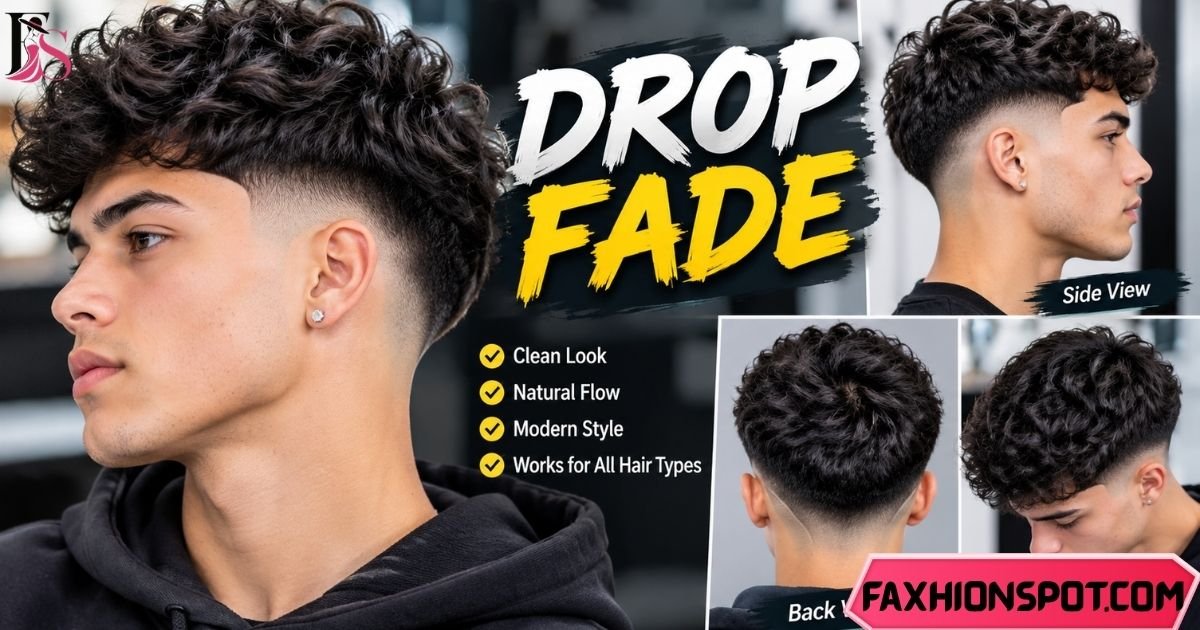
A drop fade is a modern haircut defined by a curved fade line that dips behind the ear and follows the natural shape of the head toward the neckline.
Unlike a traditional fade that generally maintains a more level path, this design creates a smoother, more sculpted silhouette.
The style can be adapted to straight, wavy, curly, coily, and textured hair, making it a versatile choice for many men.
Current barbering guides consistently emphasize three decisions when choosing a fade: height, shortest length, and top length. Low, mid, and high describe where the transition sits, while skin, zero, 0.5, or #1 describe how short the lowest section becomes.
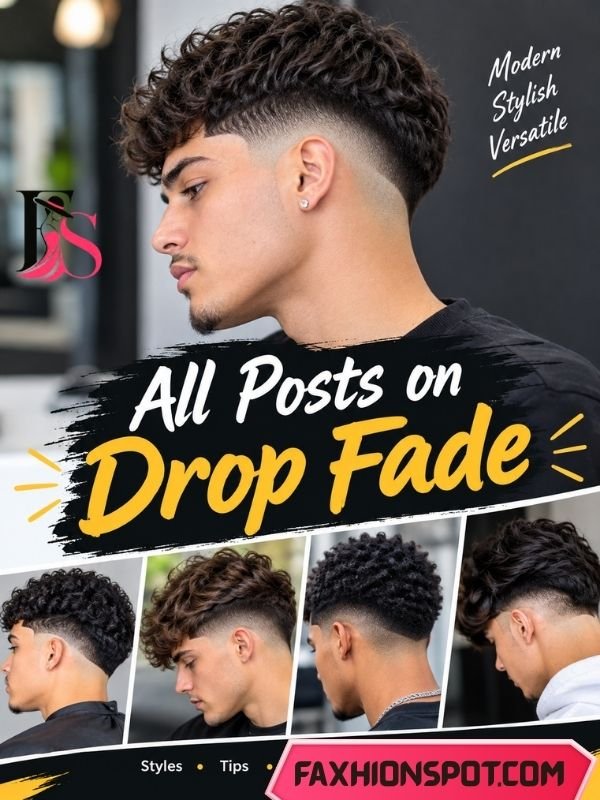
All Posts on Drop Fade
Low Taper vs Drop Fade: Which One Looks Better on You?
A low taper keeps the shortening concentrated around the temples, sideburns, and neckline, while a drop fade creates a more visible blended transition that curves behind the ear. Your choice depends on the amount of contrast, maintenance, and side coverage you prefer.
Viral Fade Styles: The Coolest Haircuts Right Now
Popular fade variations include low, mid, high, skin, burst, and drop designs. The biggest difference is not simply how short the sides become, but where the transition begins and what shape it follows.
Low vs Mid vs High Taper Fade: Which One Should You Choose?
Low fades generally retain more side weight, mid fades create balanced contrast, and high fades remove more weight from the upper sides. Your hairstyle on top should also influence the decision.
Barber Terminology for Beginners: Simple Haircut Terms Explained
Knowing terms such as fade, taper, blend, guideline, guard, bald fade, neckline, parietal ridge, and texture can make a barber consultation much easier. Clear terminology reduces the chance of receiving a haircut that differs from your reference photo.
Drop Fade Haircut Guide: Low, Mid & High Styles & Barber Tips
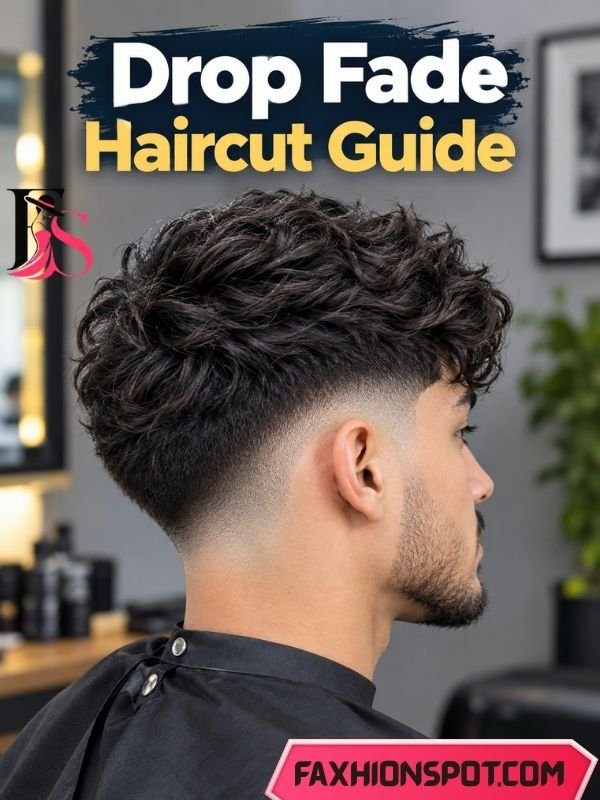
The defining feature of a drop fade is its downward curve behind the ear. The fade does not simply travel horizontally around the head. Instead, the blend drops toward the nape before connecting with the opposite side.
The style can be customized by combining its shape with different heights and base lengths.
| Variation | General appearance | Best suited to |
| Low | Subtle, close to the ear | Conservative or natural looks |
| Mid | Balanced definition | Versatile everyday styles |
| High | Strong contrast | Bold, modern hairstyles |
| Skin | Very clean lower section | Sharp, high-contrast finishes |
| 0.5/1 | Softer than skin | Easier grow-out |
The height and shortest length should be discussed separately. A low skin fade and a low #1 fade may have the same transition height but produce noticeably different visual results. Current barber guides repeatedly make this distinction.
For a first appointment, a conservative starting point can be useful. Once hair grows back, you can ask your barber to raise the fade at the next visit if you want additional contrast.
Historical Evolution and Cultural Context
Fade haircuts have developed through several eras of men’s grooming, military-influenced short cuts, Black barbering traditions, streetwear, music culture, and contemporary salon and barbershop techniques.
The modern fade became especially influential through Black barbershops, where precision blending, lineups, texture management, and individualized shapes became important parts of men’s grooming. Over time, fades became mainstream across different hair types and style communities.
The modern drop fade is best understood as an evolution of the traditional fade rather than a completely separate cutting technique. Its distinctive feature is the curved path of the blend.
Today, the style appears with textured crops, curls, waves, buzz cuts, pompadours, quiffs, slick backs, mullets, and longer tops. Contemporary guides also emphasize adapting the curve to the client’s head shape instead of treating every haircut as an identical template.
Key Styles, Cut Anatomy, and Variations
Understanding the anatomy makes it easier to choose a variation.
Low version: The blend remains close to the ear and lower neckline. More weight stays around the upper sides.
Mid version: The transition moves farther upward, producing a noticeable but balanced contrast.
High version: The short area climbs higher toward the temples and upper sides, producing a stronger separation from the top.
Skin version: The lowest area is reduced to a bare-looking finish.
Curly version: The textured top contrasts with a clean curved transition, allowing natural curls to become the focal point.
Textured crop version: A short, irregular top adds a contemporary finish while keeping the sides controlled.
Buzz-cut version: A very short top exposes the shape of the blend more clearly, so symmetry becomes particularly important.
The important principle is that the shape of the fade and the height of the fade are different decisions. A barber can create a low, mid, or high variation while still following the same curved design.
Face Shape and Hair Texture Compatibility Matrix
Face shape should guide the haircut, but it should not be treated as a rigid rule. Head shape, density, hairline, and personal styling preferences also matter.
| Face shape / texture | Useful approach | Styling consideration |
| Oval | Most heights can work | Match top volume to preference |
| Round | Mid or moderately high | Add controlled height on top |
| Square | Low to mid | Preserve some natural structure |
| Oblong | Low to mid | Avoid excessive vertical height |
| Heart | Low to mid | Balance forehead with controlled fringe |
| Straight hair | Any height | Precision of the blend is highly visible |
| Wavy hair | Low or mid | Let natural movement remain on top |
| Curly hair | Low, mid, or high | Keep curls defined and avoid over-removing weight |
| Coily hair | Customized height | Density and shrinkage must be considered |
A drop fade can work across many face shapes because the curved transition follows the head instead of creating one rigid horizontal line. Still, the height should be adjusted to the individual’s proportions.
Step-by-Step Styling and Barber Execution Protocol
A professional haircut begins with consultation rather than immediately turning on the clippers.
1. Establish the desired height
Tell your barber whether you want low, mid, or high. Avoid saying only “make it short.”
2. Decide the shortest length
Specify skin, zero, 0.5, #1, or another preferred guard length.
3. Mark the curved shape
The barber should establish how far the fade will drop behind each ear. This is particularly important because removing too much height cannot be reversed during the same appointment.
4. Build the guidelines
Clippers are generally used to create controlled sections before progressively removing visible lines.
5. Blend progressively
The barber works through guard lengths and lever positions to soften the transition between very short and longer hair.
6. Connect the top
The sides should flow naturally into the desired top shape rather than appearing disconnected unless a deliberate contrast is requested.
7. Detail the perimeter
The final stage includes the sideburns, neckline, temples, and visible edges.
8. Check both sides
Symmetry should be assessed from the front, side, and rear. A reference photograph showing the back is especially helpful.
Essential Products, Formulations, and Styling Tools
The correct styling product depends on the hair texture and desired finish.
- Matte clay: Useful for textured, natural-looking styles.
- Matte paste: Provides flexible control without excessive shine.
- Pomade: Better for polished styles requiring definition or shine.
- Curl cream: Helps control and define curly hair.
- Light styling cream: Suitable for softer, natural movement.
- Texture spray: Can add grip and separation to suitable hair types.
- Hair dryer: Useful for directing volume and controlling the top.
- Wide-tooth comb: Helpful for curls and longer textured hair.
- Brush: Useful for straight hair, quiffs, and controlled volume.
A drop fade itself does not determine which styling product you need. The product should be selected according to the hair remaining on top.
For example, a textured crop may work well with a matte paste, while a slick-back style may need stronger control. Curly hair generally benefits from products designed to preserve moisture and definition rather than making the curls stiff.
Professional Barbershop Secrets and Edge Precision
Good fade work depends on controlling transitions rather than simply cutting the sides extremely short.
One important professional principle is preserving weight where it improves the silhouette. Removing too much hair around the parietal ridge can make the haircut look hollow or disconnected.
Another is working with the client’s natural growth pattern. Cowlicks, uneven density, scars, hairline variations, and differences between the left and right sides can influence the final result.
For a sharp finish, the barber should also inspect:
- Temple symmetry
- Sideburn length
- Around-ear blending
- Neckline shape
- Crown transition
- Occipital area
- Top-to-side connection
- Hairline definition
A reference image is useful, but it should be treated as a communication tool rather than an exact template. Your barber needs to adapt the design to your own head and hair.
Common Haircut Mistakes and How to Avoid Them
Some problems happen because the client and barber use different meanings for the same terminology.
Asking only for “a fade”
This leaves the height and shortest length open to interpretation.
Better: Say “mid, #1” or “low skin,” then explain the desired top length.
Taking the fade too high
Once the transition is raised, there is no immediate way to put the removed hair back.
Better: Start conservatively if you are uncertain.
Ignoring the back of the haircut
A front-facing reference can hide the most important feature of this particular design.
Better: Bring front, side, and rear references.
Removing too much weight
Aggressive blending can make the top appear disconnected.
Better: Ask the barber to preserve appropriate weight where needed.
Forgetting hair texture
Straight, wavy, curly, and coily hair respond differently to the same guard sequence.
Better: Ask how your natural texture will affect the final silhouette.
Seasonal Care and Maintenance Cadences
Hair grows continuously, but the visible sharpness of a fade changes at different rates depending on its shortest length and contrast.
A skin finish generally shows regrowth faster than a #1 or #2 finish. Several current haircut guides place typical sharp-maintenance visits around two to three weeks, although individual growth rates vary.
Summer
Sweat, humidity, and frequent washing can affect styling. Keep the scalp clean and avoid excessive product buildup.
Winter
Cold, dry conditions can make the hair and scalp feel drier. A suitable moisturizing routine can help maintain comfort.
Spring and fall
These are useful periods to experiment with changes in length, texture, or fade height because you may be transitioning between styling routines.
Instead of following a rigid calendar, book your next appointment based on when the transition stops looking intentional.
Barbershop Communication, Terminology, and Consultation Guide for Drop Fade
The simplest consultation formula is:
Height + shortest length + drop placement + top length + finish.
For example:
“I want a mid drop fade, #1 at the bottom, dropping behind the ears, with about three inches left on top and a textured finish.”
That statement gives the barber significantly more information than “give me a fade.”
You can also discuss whether you want:
- Natural or sharp edges
- A rounded or squared neckline
- A beard connection
- More or less weight at the temples
- A defined or natural hairline
- Texture on top
- A hard part
- A fringe
- Curly or wavy volume
Current barber resources strongly recommend communicating the transition height and shortest length separately.
Blow-Drying Mechanics, Directional Airflow, and Pre-Styling Chemistry
Blow-drying is mainly about controlling the longer hair on top because the fade itself requires little daily styling.
For volume, direct warm airflow toward the roots while lifting the hair with a brush or fingers. For a flatter finish, direct the airflow in the direction you want the hair to lie.
Basic process
- Start with towel-dried hair.
- Apply a suitable pre-styler if needed.
- Direct airflow toward the desired shape.
- Use your fingers for a natural texture or a brush for greater control.
- Finish with the appropriate styling product.
- Use cooler air briefly to help set the shape.
Avoid holding very hot airflow against one section for too long. Excessive heat can contribute to dryness and damage.
Click Here To Read Another Topic
Scalp Health, Follicular Longevity, and Trimming Schedules
A haircut does not replace basic scalp care. Regular washing should match your scalp’s oil production, activity level, and product use.
Keep clippers and personal grooming tools clean, particularly when maintaining the haircut at home. Avoid aggressive scratching or repeatedly irritating the skin around freshly shaved areas.
If you experience persistent redness, scaling, painful bumps, or unusual hair shedding, consider discussing the issue with a qualified healthcare professional rather than attempting to solve it solely through grooming products.
For appearance maintenance, many people refresh a sharp fade every two to three weeks, while a softer guard length can remain presentable longer.
Summary and Personal Aesthetic Philosophy
The best haircut is not necessarily the shortest, highest, or most dramatic option. A successful drop fade should work with your hair density, natural growth pattern, face shape, lifestyle, and preferred amount of maintenance.
Think about the haircut as a complete silhouette. The sides create the frame, the curved transition shapes the back, and the top establishes the personality of the style. Once those elements work together, the haircut can look intentional from every angle.
If you are unsure, communicate conservatively. It is easier to make a fade shorter during a future appointment than to recover length that has already been removed.
Frequently Asked Questions
What is a drop fade haircut?
A drop fade is a fade in which the transition curves downward behind the ear and toward the neckline, following the natural contour of the head.
What is the difference between a regular fade and a drop fade?
A regular fade generally follows a more level path, while a drop fade curves downward behind the ear before connecting with the neckline.
Why is a drop fade so popular?
Its curved shape creates a customized silhouette and works with many top styles, including curls, waves, crops, buzz cuts, and longer textured hairstyles.
What face shapes look best with a drop fade?
Oval, round, square, oblong, and heart-shaped faces can all work with the style when the height, top length, and amount of side weight are adjusted appropriately.
How often should you get a drop fade refreshed?
Many people maintain a crisp fade every two to three weeks, although growth speed, shortest length, and preferred appearance can change that schedule.
Can you get a drop fade with curly hair?
Yes. Curly and coily textures can create strong contrast between the textured top and carefully blended sides, although the barber should account for shrinkage and density.
Is a drop fade the same as a drop taper?
No. A drop fade normally removes more side weight, while a drop taper is generally more concentrated around the perimeter. The terminology can vary between barbershops, so describing the exact shape and length is helpful.