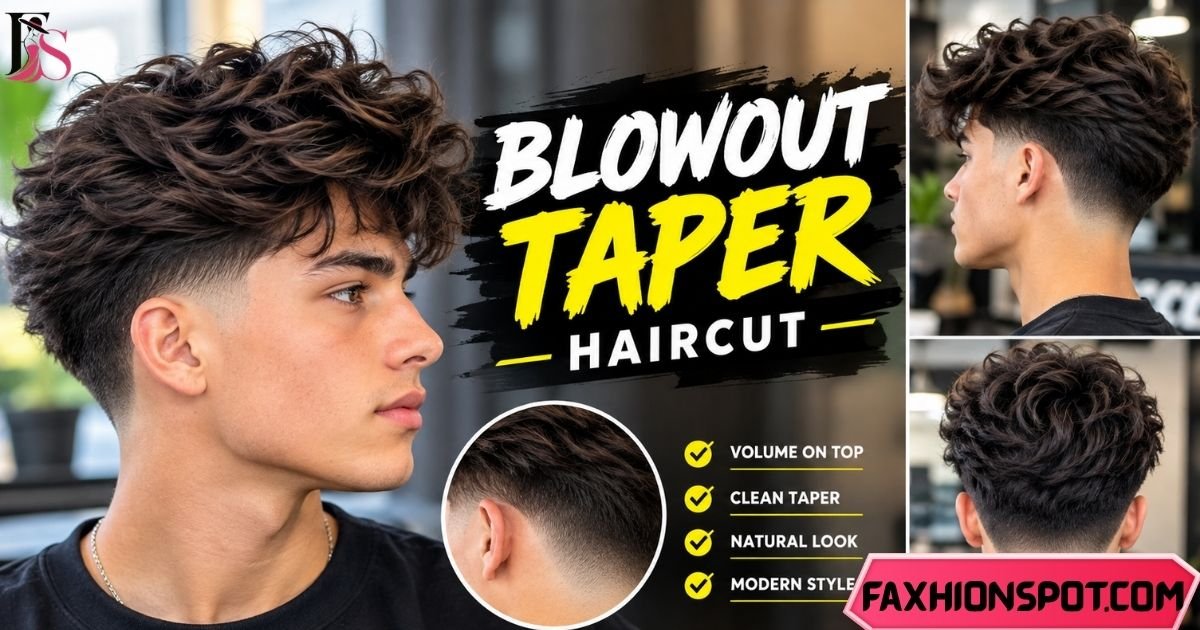
A blowout taper haircut combines two ideas that work surprisingly well together: gradually shortened sides and a fuller, lifted top. The taper keeps the temples, sideburns, and neckline clean, while the blowout styling creates height, movement, and a rounded silhouette through the longer hair above.
Current barber guides generally describe the style as a combination of a tapered perimeter and a voluminous top rather than one rigid cutting formula. That distinction matters because taper height, top length, texture, and styling direction can all be customized.
What Is a Blowout Taper? The Two-Part Haircut Explained
At its simplest, a blowout taper has two main components:
- The taper: Hair gradually becomes shorter around the temples, sideburns, and neckline.
- The blowout: Longer hair on top is styled upward, backward, outward, forward, or according to its natural texture to create volume.
The taper controls the outline of the haircut. The blowout controls the personality.
A barber can therefore create dramatically different results without completely changing the foundation. A low taper produces a softer silhouette, while a high taper exposes more of the sides and creates stronger contrast.
What is a blowout taper haircut, and who should get it?
A blowout taper haircut is a men’s style with gradually tapered sides and neckline combined with a longer, volumized top.
It is particularly suitable for someone who wants:
- Noticeable volume without completely shaving the sides
- A modern haircut that can be customized
- A style that works with several hair textures
- A clean perimeter with a fuller top
- Multiple styling options from the same haircut
You should also consider your daily routine. If you dislike blow-drying or styling products, a naturally wavy or curly version may be easier than a highly lifted straight-hair version.
Blowout Taper vs. Other Cuts
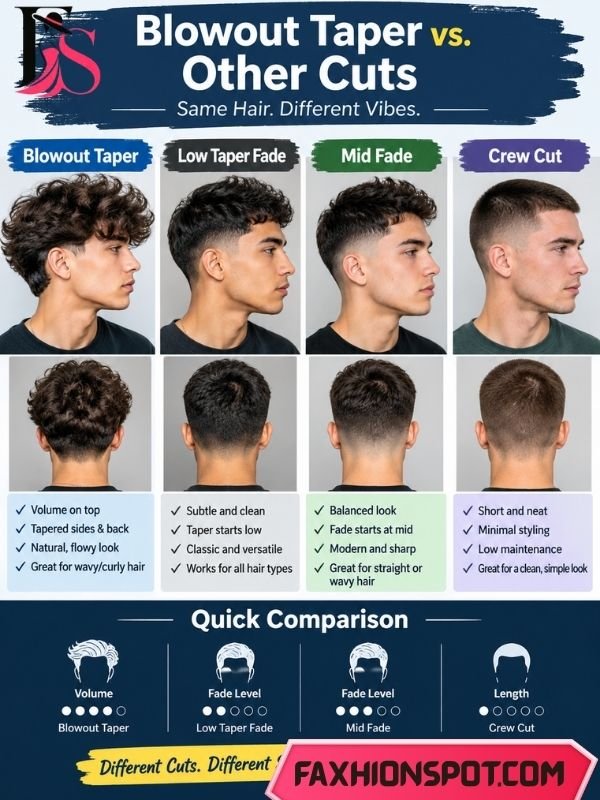
A taper and a fade are related but not identical.
A traditional taper gradually reduces length around specific areas while retaining more surrounding hair. A fade generally creates a stronger transition and may reach very short or skin-level lengths.
The style can also resemble a quiff, pompadour, textured crop, or curly high-top from certain angles. The difference is that the defining foundation remains the tapered perimeter paired with volume or texture on top.
Historical Context
The modern style draws from several older men’s haircut traditions.
Blow-dried volume became especially prominent through classic barbershop shapes such as pompadours and quiffs. Tapering, meanwhile, has long been used to create clean edges without removing all the hair around the sides.
Modern social media trends have combined these ideas with textured crops, curls, fringe styles, and contemporary taper techniques. The result is a much broader family of styles rather than a single standardized haircut.
The 5 Main Blowout Taper Styles: Low, Mid, High, Textured Fringe & Beyond
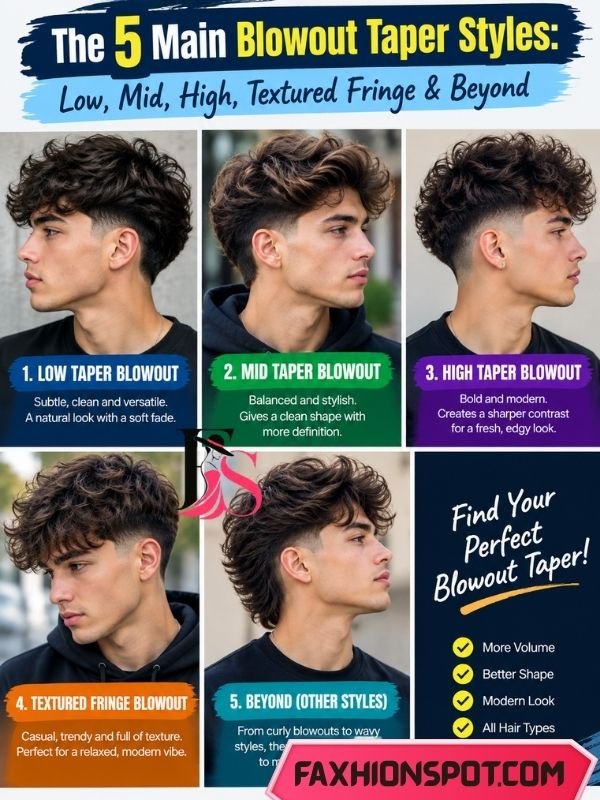
The biggest visual difference between variations is where the taper sits and how the top is shaped.
Low versions preserve more side weight. Mid versions create a balanced transition. High versions produce greater contrast. Textured fringe versions direct the front forward, while curly and permed versions allow natural texture to become the main feature.
Low Blowout Taper: The Easiest Entry Point
A low blowout taper keeps the taper close to the ears, sideburns, and lower neckline. More weight remains around the sides, so the overall appearance is softer.
This is often a practical starting point for first-timers. It also works well in settings where an extremely aggressive fade would feel too dramatic.
Best suited for:
- First-time taper clients
- Straight or wavy hair
- Curly hair needing balanced proportions
- Conservative workplaces
- Longer tops
- People who prefer softer grow-out
The lower transition can also make regrowth less visually obvious than a very high taper.
Mid Blowout Taper: The Balanced Sweet Spot
The mid version raises the taper toward the temple area, producing more contrast while retaining plenty of top length.
It is a versatile option because it does not look as understated as a low taper or as dramatic as a high version.
For many people, the mid height is a useful compromise between visual impact and maintenance.
Best for:
- Medium-to-thick hair
- Wavy textures
- Textured tops
- Everyday styling
- People who want noticeable definition
High Blowout Taper: The Bold Statement
A high taper moves the transition farther upward toward the crown. This leaves less weight on the sides and makes the top appear even more prominent.
The result can look sharp and dramatic, particularly when paired with thick hair and substantial volume.
The trade-off is maintenance. As the sides grow, the contrast can become noticeable sooner than with a low taper.
Textured Fringe Blowout Taper: The Viral TikTok Version
This variation combines tapered sides with a forward-moving, piecey fringe.
Instead of brushing every strand into a polished shape, the top is cut and styled to create separation and movement. Straight and wavy hair can be particularly effective because the fringe can be directed forward while the roots are lifted.
A lightweight mousse, sea salt spray, or texture product can help create separation without making the front look greasy or stiff. Current hairstyle guides commonly describe this version as a combination of tapered edges, textured length, and a forward fringe.
Blowout Taper Perm or Curly Variant: For Natural Curl
Curly and permed hair can give the style a completely different personality.
Instead of forcing the top straight, the goal is usually to preserve curl definition while creating controlled volume. A diffuser can dry curls while minimizing unnecessary disruption to the curl pattern.
Curl cream, mousse, or a lightweight leave-in product is generally more appropriate than a heavy pomade.
For tighter textures, a pick can help lift the roots while maintaining the rounded shape.
Variant Comparison Table
| Variant | Taper Position | Visual Effect | Styling Effort | Best For |
| Low | Near ears and neckline | Soft and subtle | Low-Medium | Beginners, professionals |
| Mid | Temple area | Balanced contrast | Medium | Most hair types |
| High | Higher toward crown | Bold contrast | Medium-High | Thick hair, statement looks |
| Textured Fringe | Usually low or mid | Forward, piecey texture | Medium | Straight and wavy hair |
| Curly/Perm | Usually low or mid | Natural volume and definition | Medium | Curly and coily textures |
Does a Blowout Taper Work for My Hair? A Guide by Hair Type
Hair texture affects both the haircut and the styling routine.
The same taper can look completely different on straight hair compared with tightly coiled hair. Your barber should therefore consider density, curl pattern, shrinkage, length, and the direction your hair naturally grows.
Straight Hair: This Requires the Most Styling Effort
Straight hair can produce excellent height, but it may not naturally hold the rounded shape.
The solution is root-directed blow-drying. Lift the hair from the roots instead of simply blasting air over the ends.
A lightweight mousse or volumizing spray can provide support without making the hair stiff.
Straight hair is also a strong match for textured fringe versions because point-cutting and directional styling can create movement that the natural texture does not provide.
Wavy Hair: The Goldilocks Texture
Wavy hair often needs less work because it already has movement.
A small amount of mousse or sea salt spray can enhance the natural pattern. You can then use a blow-dryer to lift the roots or simply allow the hair to air-dry.
Avoid overworking the waves. Excessive brushing can remove the natural texture that makes this version look relaxed.
Curly Hair: Maximize Natural Volume
Curly hair already has volume, so the goal is usually definition and shape rather than forcing additional height.
Use a diffuser on low or medium airflow. Move the diffuser around the head instead of aggressively brushing through the curls.
A low or mid taper often keeps the proportions balanced, although the right height depends on density, face shape, and personal preference.
Afro/Coily Hair: The Confidence Cut
Afro-textured hair can create an especially strong silhouette because of its natural density and volume.
The barber should account for shrinkage and the way the hair expands after drying. Cutting the top while considering its dry shape can help avoid unexpected proportions.
An afro pick can lift the roots, while mousse or a suitable curl product can help maintain definition.
Hair-Type Styling Comparison Table
| Hair Type | Natural Volume | Styling Priority | Useful Tool | Product Direction |
| Straight | Low-Medium | Root lift | Round brush | Mousse/volumizer |
| Wavy | Medium | Enhance movement | Fingers/dryer | Light mousse/spray |
| Curly | High | Definition | Diffuser | Curl cream/mousse |
| Coily | High | Shape and lift | Afro pick | Mousse/curl product |
Which Taper Height Works Best for Your Face Shape? A Decision Framework
Face shape should influence the silhouette, but it should not be treated as a strict rule.
Think about where you want visual weight. More height can make a face appear longer, while additional side width can create a broader appearance.
Round Faces: Go Mid or High to Add Vertical Length
A mid or high taper can reduce some visual width around the sides while allowing height on top.
The key is not simply cutting the sides extremely short. The top needs enough volume to create a taller overall silhouette.
Square Faces: Low or Mid Taper with Soft Texture
Square faces already have strong angles.
A low or mid taper with textured volume can preserve those features without making the haircut unnecessarily severe.
Soft waves or a textured fringe can also reduce the overly rigid appearance of a highly structured style.
Oval Faces: Any Height Works; Pick by Maintenance
Oval faces generally offer considerable flexibility.
Low, mid, and high versions can all work depending on hair density and styling preference. Your decision can therefore focus more on lifestyle and desired contrast.
Long Faces: Stay Low or Mid; Keep Some Width
If your face appears noticeably long, keeping some side weight can help maintain balance.
A low or mid taper may therefore be preferable if you want a fuller side profile. Avoid automatically maximizing top height if your goal is to minimize additional visual length.
What to Tell Your Barber: 5 Blowout Taper Scripts by Height & Hair Type
The name alone may not communicate exactly what you want. Current barber guides repeatedly recommend using a reference photo and specifying taper height, top length, fringe direction, and desired volume.
Essential Communication Elements
Tell your barber:
- Taper height
- Top length
- Desired volume
- Fringe direction
- Natural or polished finish
- How short you want the neckline and sideburns
- Whether you want skin exposure
Barber Scripts by Variant
Low:
“I want a low blowout taper. Keep the taper close to the ears and neckline, leave plenty of length on top, and give me natural volume.”
Mid:
“I want a mid blowout taper with noticeable but smooth contrast. Keep enough length on top for a rounded blowout.”
High:
“I want a high blowout taper with a clean transition and strong volume on top. Keep the blend smooth without creating a harsh shelf.”
Textured fringe:
“I want a low or mid taper with a textured fringe. Keep the front piecey and natural, with enough length to style forward.”
Curly:
“I want a low or mid taper with my curls kept full on top. Please preserve the curl pattern and shape the top around my natural texture.”
Reference Photo Guidance
Bring a photo showing the haircut from at least two angles.
Ideally, choose:
- Front view
- Side view
- Back view
- Similar hair texture
- Similar top length
- Similar taper height
A photo communicates shape more accurately than a haircut name alone.
Optional Clipper Guard Reference
Guard numbers vary by barbering technique and equipment, so do not rely on them as the only instruction.
Instead of saying only “give me a number two,” explain where you want the taper and how much length you want preserved.
What NOT to Say
Avoid vague requests such as:
- “Just make it like the picture.”
- “Give me a fade.”
- “Make it short.”
- “Make the top big.”
- “Do whatever you think looks good.”
These phrases leave important decisions open to interpretation.
How to Style a Blowout Taper at Home: Step-by-Step Blow-Dry Guide
The haircut provides the foundation, but styling creates much of the recognizable volume.
General Blow-Dry Principles (All Hair Types)
Start with clean, towel-dried hair.
Then:
- Apply a lightweight styling product.
- Begin at the roots.
- Direct airflow in the desired direction.
- Lift sections rather than flattening them.
- Finish with cool air if your dryer offers it.
- Add a small amount of finishing product only where necessary.
The most important principle is root direction. Simply drying the ends does not create the same lift.
Straight Hair: 5-Step Blow-Dry for Maximum Lift
Step 1: Towel-dry until the hair is damp rather than soaking wet.
Step 2: Apply a small amount of volumizing mousse.
Step 3: Use a round brush to lift the roots while directing airflow upward.
Step 4: Shape the front and crown according to your preferred direction.
Step 5: Finish with cool air and a lightweight texture product.
Do not overload the hair with pomade. Heavy products can quickly collapse fine or straight hair.
Wavy Hair: 2-Minute Blow-Dry (or Skip It)
Apply a small amount of mousse or sea salt spray.
Use your fingers to lift the roots while drying for approximately two minutes. Stop once the shape looks controlled.
If your waves already provide enough volume, air-drying may be the better choice.
Curly Hair: Diffuser Technique to Preserve Definition
Apply curl cream or mousse to damp hair.
Attach a diffuser and use low or medium airflow. Cup sections of curls and move gradually around the head.
Avoid constantly touching the hair while it dries. Excessive manipulation can increase frizz and disrupt curl definition.
Afro/Coily Hair: Pick & Mousse Method
Start with damp, conditioned hair.
Apply a suitable lightweight styling product, then use an afro pick to lift the roots. Work around the head gradually rather than repeatedly combing the same area.
The objective is controlled volume, not maximum expansion.
Styling Troubleshooting Reference
| Problem | Likely Cause | Solution |
| Hair falls flat | Weak root lift | Blow-dry from roots |
| Hair feels greasy | Too much product | Use less |
| Waves disappear | Over-brushing | Use fingers |
| Curls become frizzy | Too much manipulation | Diffuse gently |
| Top looks bulky | Poor shape control | Remove weight strategically |
| Fringe looks stiff | Heavy product | Switch to lighter texture product |
How Long Does a Blowout Taper Stay Fresh? The 4-Week Timeline
There is no universal expiration date for the haircut. Hair growth speed, density, taper height, and personal expectations all influence the timing.
Day 1–3: Fresh & Sharp
The taper has its cleanest contrast, and the top is easiest to shape.
Week 1: Still Sharp
Most versions remain close to the original silhouette.
This is usually when the haircut requires the least correction.
Week 2: Edges Start Softening
The neckline and sideburn area begin losing some crispness.
For people who prefer extremely sharp edges, this can be the point for a touch-up.
Week 3: Visible Softening
The taper begins looking less defined.
Low versions may still look intentionally natural, while higher versions can show regrowth more clearly.
Week 4: Blend-Out / Time for Full Refresh
For many people, four weeks is a reasonable point to consider another full haircut.
However, those who prefer very sharp edges may return sooner. Current guides commonly place low versions around a three-to-four-week acceptable grow-out window, while higher and more precise styles may need earlier attention.
Touch-Up vs Full Cut: Quick Reference
Touch-up:
Best when the top still has the right length but the neckline, temples, or sideburns need cleaning.
Full cut:
Best when the taper has lost its intended position or the top has become difficult to shape.
Regional & Personal Factors
Maintenance can vary because of:
- Hair growth speed
- Hair density
- Climate
- Humidity
- Sweat
- Daily hat use
- Styling routine
- Personal preference
Humidity can also change how straight and wavy hair behaves, while curl patterns may expand or shrink depending on moisture.
Common Maintenance Mistakes
Avoid:
- Waiting until the taper is completely grown out
- Overusing strong products
- Ignoring the neckline
- Cutting the top too frequently
- Brushing curly hair excessively
- Treating every hair texture identically
Putting It All Together: Choose Your Blowout Taper by Hair Type AND Face Shape
The best choice comes from combining several variables rather than following one trend.
Master Decision Matrix
| Hair Type | Face Shape | Suggested Height | Top Direction | Styling Level |
| Straight | Round | Mid/High | Up and back | Medium-High |
| Straight | Long | Low/Mid | Moderate lift | Medium |
| Wavy | Oval | Any | Natural movement | Low-Medium |
| Wavy | Square | Low/Mid | Textured | Medium |
| Curly | Round | Low/Mid | Defined volume | Medium |
| Curly | Oval | Any | Natural curls | Low-Medium |
| Coily | Long | Low/Mid | Controlled width | Medium |
| Coily | Square | Mid | Rounded volume | Medium |
Example Personas: Decision Stories
The office professional:
A low taper with moderate volume and a controlled top provides a cleaner silhouette without excessive contrast.
The student with wavy hair:
A mid taper with a textured fringe can use the natural wave while keeping the sides defined.
The curly-haired client:
A low or mid taper with natural curls preserves texture while creating a cleaner frame around the face.
The bold trend seeker:
A high taper with substantial top volume creates stronger contrast and requires more frequent maintenance.
Your 5-Step Decision Process
- Identify your natural hair texture.
- Consider your face shape.
- Decide how much side contrast you want.
- Estimate how often you can visit a barber.
- Show your barber a reference photo and explain the desired top shape.
Is a Blowout Taper OK for Work? A Quick Guide by Variant & Industry
Workplace expectations vary widely.
A haircut that looks conservative in one office may appear noticeably fashion-forward in another. The safest approach is to consider both taper height and top styling.
Acceptability by Variant & Setting
| Variant | Traditional Office | Casual Workplace | Creative Workplace |
| Low | Usually adaptable | Easy | Easy |
| Mid | Often adaptable | Easy | Easy |
| High | Depends on dress code | Commonly workable | Strong fit |
| Textured Fringe | Depends on styling | Easy | Strong fit |
| Curly | Usually adaptable | Easy | Easy |
Variant Assessments
A low version is generally the easiest to make understated.
A mid version can be professional when the top is controlled.
A high version creates stronger visual contrast and may be more noticeable.
A textured fringe can remain polished when the texture is controlled rather than deliberately messy.
Curly versions can look professional when the curls are defined and the taper is clean.
Industry-Specific Guidance
For conservative finance, law, or corporate environments, consider lower contrast and controlled volume.
For technology, retail, media, design, hospitality, or other relaxed workplaces, there may be more room for textured or higher-contrast variations.
Always follow the actual grooming policy of your employer rather than assuming an industry-wide rule.
5 Blowout Taper Mistakes (And How to Avoid Them)
Mistake 1: Not Enough Length on Top to Begin With
The top needs sufficient length to create meaningful volume.
Some current guides suggest roughly two to three inches as a useful starting range, although the required length varies by texture and desired shape.
Fix: Tell your barber how you plan to style the top before asking for significant length removal.
Mistake 2: Taper Taken Too High Without Intent
A high taper changes the entire silhouette.
If you wanted a subtle appearance but accidentally request too much height, the result can feel much more dramatic than expected.
Fix: State the taper height clearly and show a reference image.
Mistake 3: Wrong Product for Your Hair Type
Heavy pomades can flatten fine hair.
Strong manipulation can disrupt curls.
Salt sprays may provide useful texture for some straight or wavy hair but may not be ideal for every curl pattern.
Fix: Choose products according to texture and desired finish.
Mistake 4: Skipping Daily Blow-Dry and Expecting the Cut to Carry Itself
The haircut creates the foundation, but the “blowout” effect is partly a styling technique.
Straight hair often needs directional drying to reproduce the intended lift.
Fix: Learn the basic root-lifting technique rather than relying entirely on the haircut.
Mistake 5: Not Scheduling Maintenance Ahead
Even a well-cut taper eventually loses its definition.
Fix: Decide whether you want a two-week touch-up, three-week refresh, or longer natural grow-out before leaving the barbershop.
Frequently Asked Questions
Is a blowout taper the same as a fade?
No. A taper gradually shortens specific areas, while a fade generally creates a stronger transition and may reach skin level.
How long should the top be for a blowout?
Around two to three inches can provide a useful starting point, but the ideal length depends on hair texture, density, and desired volume.
Does this haircut work with straight hair?
Yes. Straight hair can create a clean, lifted shape, although it usually benefits from blow-drying and lightweight volumizing products.
Is it good for wavy hair?
Yes. Wavy hair often needs less styling because natural movement already contributes texture and volume.
Can curly hair get a blowout taper?
Yes. Curly versions can preserve natural curl definition while using a diffuser and curl-friendly products.
Can coily hair get this style?
Yes. Coily hair can use its natural density and volume, with the barber adjusting the taper and top shape for shrinkage and texture.
Which taper height is easiest to maintain?
A low taper generally offers the softest grow-out, while a high taper usually shows regrowth more quickly.
Is a mid taper suitable for most face shapes?
A mid taper is highly adaptable, but the ideal result still depends on top length, hair density, and how the volume is positioned.
Does a textured fringe work with curls?
Yes. Curly hair can create a naturally textured fringe as long as enough length is retained to preserve the curl pattern.
Can you style it without a blow-dryer?
Yes. Wavy and curly hair can often air-dry successfully, although a blow-dryer provides greater control over root lift and direction.
How often should you get it cut?
Many people refresh the style around every three to four weeks, while clients who want very sharp edges may prefer earlier touch-ups.
Is it professional enough for work?
It can be. A low or controlled mid version is generally easier to adapt to conservative settings than a highly dramatic high taper.
Final Thoughts
A blowout taper haircut is less about following one fixed formula and more about building a haircut around your hair texture, face shape, preferred volume, and maintenance routine.
Straight hair can benefit from root-focused blow-drying. Wavy hair can emphasize natural movement. Curly and coily hair can make natural texture the centerpiece of the look.
4 thoughts on “BLOWOUT TAPER HAIRCUT: COMPLETE GUIDE TO 5 STYLES BY HAIR TYPE”