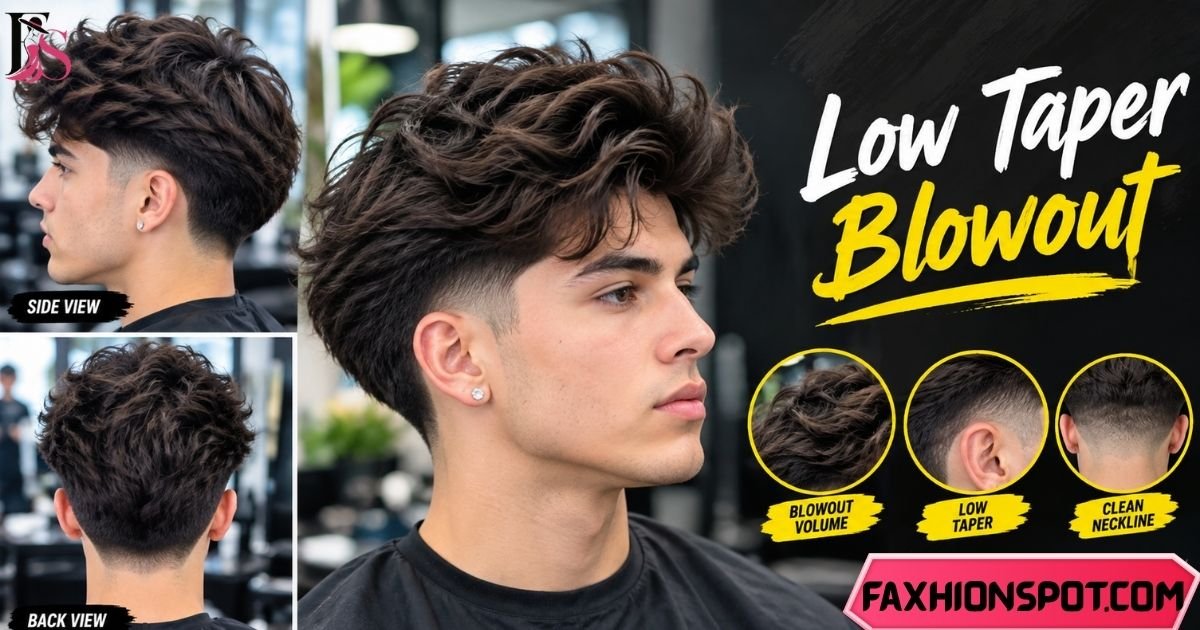
A low taper blowout combines a subtle taper around the ears and neckline with a fuller, lifted top created through blow-drying and styling. The result is clean around the edges without taking away the natural weight of the sides.
Unlike a skin fade, this style does not need dramatic exposure around the temples. That makes it easier to adapt to school, work, casual settings, and different personal styles.
What is a low taper blowout?
A low taper blowout is a men’s haircut that keeps the taper close to the sideburns, ears, and neckline while leaving enough length on top to create volume with a blow dryer.
The taper handles the perimeter. The blowout handles the shape.
In a traditional version, the sides are gradually shortened near the natural hairline instead of being taken aggressively high. The top is then dried upward, backward, or outward to create lift.
The basic formula looks like this:
- Low taper: Shortens the hair around the sideburns, ears, and neckline.
- Longer top: Provides enough length for styling.
- Blowout: Uses controlled airflow to create lift and movement.
- Texture: Adds separation so the finished style does not look flat.
- Natural sides: Keeps more weight compared with a higher fade.
The exact guard sequence can vary from barber to barber because head shape, density, and existing length all affect the blend.
What Is a Low Taper Blowout?
At its simplest, a low taper blowout has two separate components.
The first is the haircut. The barber gradually reduces the length around the lower sides and neckline. The second is the styling process. Hair on top is dried with direction so the roots lift and the finished shape looks fuller.
This distinction matters because “blowout” does not describe one exact haircut. It describes the way the top is shaped. The taper determines where the sides become shorter.
| Element | What it does | Typical result |
| Taper | Reduces perimeter length | Clean ears and neckline |
| Top length | Provides styling material | Height and movement |
| Blow-drying | Lifts roots | Fuller silhouette |
| Texture | Separates strands | Less flat or bulky appearance |
| Finish | Controls shine and hold | Natural, polished, or defined |
The low placement is what keeps the haircut relatively understated. Most of the side hair remains intact, while the cleanest work is concentrated around the ears and neck.
For many people, this is a useful starting point if they want volume without committing to a much higher fade.
What Does a Low Taper Blowout Look Like?
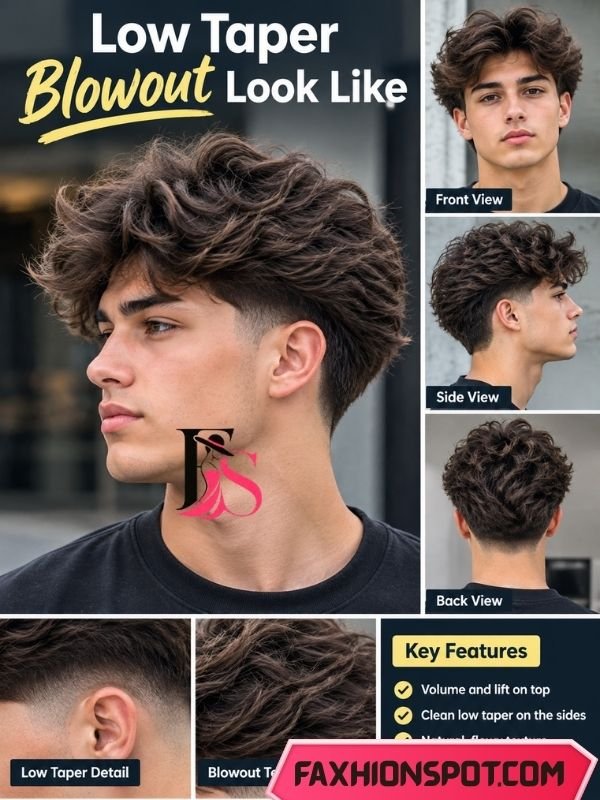
Visually, a low taper blowout has a fuller top and a cleaner perimeter.
From the front, the eye usually notices the volume first. The top may be pushed upward and back, styled forward into a fringe, or shaped according to the natural texture.
From the side, the taper is visible mainly around the ear and sideburn area. It should transition gradually rather than creating a large shaved section.
From the back, the neckline is cleaned and narrowed while the upper hair retains its natural density.
The finished shape can change significantly depending on texture:
- Straight hair: Smooth volume with directional movement.
- Wavy hair: Softer lift with natural bends.
- Curly hair: Defined volume and visible curl separation.
- Coily hair: Strong density and a rounded or structured silhouette.
The top does not necessarily need to be extremely tall. A controlled blowout can have moderate height while still looking airy and full.
Low Taper Blowout vs. Low Taper Fade: What Is the Real Difference?
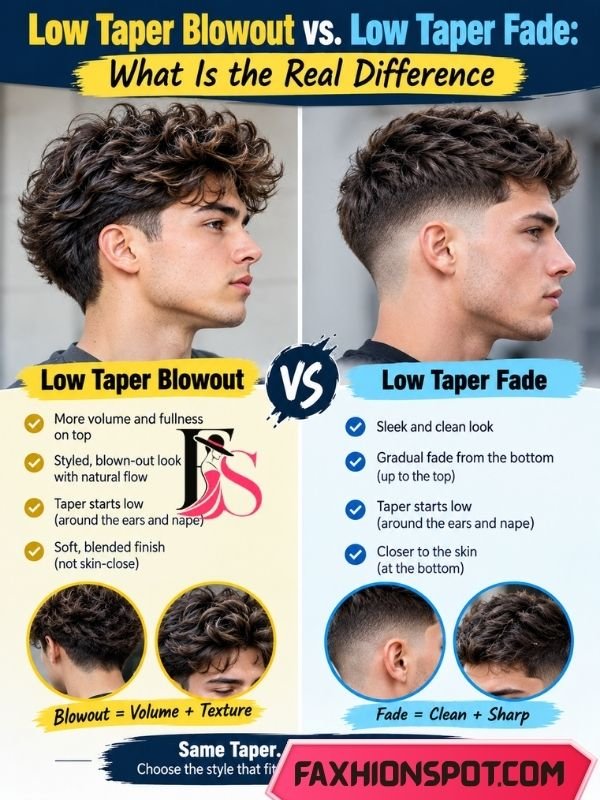
The difference is primarily how short the perimeter becomes.
A taper gradually reduces length around a limited area. A fade generally creates a stronger transition and may reach very short or skin-level length at the base.
| Feature | Low Taper Blowout | Low Taper Fade |
| Perimeter | Softly tapered | More visibly faded |
| Skin exposure | Usually minimal or none | May reach skin |
| Side length | More retained | More removed |
| Contrast | Subtle | Stronger |
| Top | Voluminous | Can use any style |
| Grow-out | Generally soft | More visible as it grows |
| Overall appearance | Natural and blended | Sharper and higher contrast |
There is some terminology overlap in barbershops, so the words alone are not always enough. A reference photograph remains the safest way to communicate the desired result.
Is a Low Taper Blowout the Same as a Low Taper Fade?
No. They can look similar, but they are not necessarily the same haircut.
A low taper focuses on a smaller area around the natural edges. A low fade generally removes more hair and can transition toward the skin.
The “blowout” portion is separate from both terms. It describes the top styling technique rather than the perimeter cutting method.
If you want the softer version, tell your barber you want the taper kept low and subtle. If you want visible skin or a stronger contrast, specifically ask whether a low fade is what you mean.
That small clarification can prevent a major difference in the final haircut.
Does a Low Taper Blowout Work With Your Hair Type?
Yes, but the styling method should change according to your texture and density.
Straight hair usually needs more help from airflow, a brush, and lightweight styling products. Wavy hair already has movement, so the goal is often to enhance it instead of forcing a perfectly rounded shape.
Curly and coily textures naturally provide substantial volume. In those cases, the barber and stylist should work with the curl pattern rather than treating textured hair like straight hair.
Hair density matters too. Thick hair can create volume naturally but may need internal weight removed. Fine hair can benefit from careful layering and lightweight volumizing products so it does not become weighed down.
Straight Hair: How to Get Real Volume Without the Mushroom Effect
Straight hair can produce a clean and dramatic blowout, but it has one common problem: excessive width.
If the barber leaves too much weight around the sides while the top is lifted aggressively, the silhouette can become round and bulky.
The goal is controlled vertical movement.
Ask for enough top length to create lift, then have the barber remove unnecessary bulk where needed without destroying the structure. During styling, direct the airflow from the roots upward and slightly backward.
A round brush can help create tension and shape, while a lightweight mousse or volumizing spray can give fine straight hair more support.
For thicker straight hair, matte clay or molding paste can separate the finished shape without making it greasy.
Wavy Hair: The Path of Least Resistance
Wavy hair is naturally suited to a voluminous hairstyle because the texture already creates movement.
Instead of completely straightening the waves, use the blow dryer to guide them into a consistent direction. A diffuser or low-heat airflow can preserve natural texture when you want a softer finish.
For a casual appearance:
- Start with damp hair.
- Apply a small amount of lightweight styling product.
- Blow-dry the roots while lifting them.
- Let the natural wave pattern remain visible.
- Finish with a small amount of matte product if additional control is needed.
The result is less rigid than a straight blowout and often requires less manipulation.
Curly Hair: The Most Visual Payoff of Any Texture
Curly hair can make the top appear extremely full because the curl pattern creates natural lift and separation.
The key is avoiding unnecessary disruption of the curl pattern. Instead of brushing the curls aggressively, use a diffuser and curl cream or mousse.
A barber may also need to consider how much the curls shrink when dry. Cutting curly hair while it is wet can make the final length look very different after drying.
For a defined finish, ask for the taper to stay low while preserving the natural curl shape above it. The top can then be diffused upward to create volume without turning the curls into a frizzy mass.
Coily / Afro Hair: Volume Built In, Shape Is the Job
Coily and afro-textured hair already has substantial volume potential, so the main challenge is usually shape.
The low taper should clean the sideburns, ears, and neckline without cutting too deeply into the natural crown.
A barber may use clippers, shears, a pick, or other shaping techniques depending on the desired silhouette.
The top can remain rounded, slightly squared, or naturally irregular. A pick can add lift, while a diffuser can help expand the texture without excessive manipulation.
For tightly coiled hair, always discuss the desired dry length and shape before cutting. Shrinkage can make a major difference between the length you see wet and the length you see dry.
What Face Shapes and Lifestyles Does It Suit?
The style is adaptable because the barber can change the top height, direction, fringe, and amount of side weight.
| Face shape | Styling approach |
| Oval | Most top shapes can work |
| Round | More controlled height can add vertical emphasis |
| Square | Textured volume can complement strong angles |
| Long | Avoid excessive vertical height |
| Heart | A softer fringe or moderate volume can balance proportions |
| Diamond | Controlled side weight and textured top can work well |
Lifestyle matters just as much as face shape.
If you enjoy styling your hair each morning, the blowout element gives you plenty of room to experiment. If you want a completely wash-and-go haircut, the style may require more effort than you prefer.
It is also useful for people who want a clean perimeter without maintaining a very short fade every week.
How Do You Ask Your Barber for a Low Taper Blowout?
Communication is one of the most important parts of getting the haircut right.
Instead of saying only “give me a taper,” describe four things: height, perimeter, top length, and styling direction.
A useful barber script is:
“I want a low taper around the sideburns, ears, and neckline. Keep the sides fairly full and do not take the taper high. Leave enough length on top for a blowout and keep the shape textured and natural. I want the volume going up and slightly back.”
Then show your barber a reference photo.
Also tell them:
- How much length you want on top.
- Whether you want a fringe.
- Whether you prefer visible texture or a smoother finish.
- Whether you style your hair daily.
- Whether you want the neckline natural or sharply cleaned.
- Whether you want the taper connected to your beard.
For curly or coily hair, mention your preferred dry shape and shrinkage.
Guard Numbers for a Low Taper Blowout: What Do They Mean?
Clipper guard numbers indicate how much hair is left behind. Lower numbers generally mean shorter lengths.
Common references include:
| Guard | Approximate length | General use |
| #0 | Around 1/16 inch | Very close cutting |
| #1 | Around 1/8 inch | Short perimeter work |
| #2 | Around 1/4 inch | Soft short taper |
| #3 | Around 3/8 inch | Transition area |
| #4 | Around 1/2 inch | Longer blending |
These measurements can vary slightly between clipper systems and techniques.
Do not assume that saying “use a #2” completely explains the haircut. The barber also needs to know where the taper should sit.
For a softer result, say something like, “Keep the lowest point around a #2 and blend naturally upward.”
If you want the perimeter closer, discuss a #1 or another shorter starting point. A pure taper and a skin fade are different requests, so clarify whether you want skin exposure.
How Do You Style a Low Taper Blowout at Home?
The styling process determines whether the haircut actually looks like a blowout.
You do not need a complicated routine. Start with damp hair and build the shape from the roots.
Simple five-step routine
- Towel-dry the hair. Leave it damp rather than soaking wet.
- Apply a lightweight product. Use volumizing mousse for fine or straight hair, or curl cream for textured hair.
- Lift the roots. Use a round brush, fingers, or diffuser while directing airflow upward.
- Set the direction. Push the hair up, back, or outward according to the desired shape.
- Finish lightly. Use matte clay, paste, or flexible hairspray if you need extra hold.
For straight hair, a concentrator nozzle can make the airflow more precise. For curly or coily hair, a diffuser is often gentler on the natural pattern.
Avoid dumping a large amount of heavy pomade onto damp hair. Too much product can flatten the roots you just spent time lifting.
How Often Does a Low Taper Blowout Need a Trim?
Most people can refresh the haircut approximately every 3 to 4 weeks, although growth rate and personal preference matter.
The neckline and sideburns usually show growth before the longer top becomes a problem. Someone who wants very crisp edges may prefer a small cleanup between full appointments.
The advantage of keeping the taper low is that growth can look relatively gradual because there is less dramatic contrast at the perimeter.
A practical schedule might look like:
| Time | What to do |
| Week 1 | Full shape and styling |
| Week 2 | Usually no major maintenance |
| Week 3 | Optional neckline or sideburn cleanup |
| Week 4 | Consider a full trim |
| Week 5+ | Reshape if the perimeter has become bulky |
Your own growth rate should determine the exact schedule.
Low Taper Blowout Variations: Which Style Fits You?
The basic structure can be modified without changing the low placement.
Popular variations include:
- Textured fringe
- Blunt or Edgar fringe
- Longer grown-out top
- Curly afro
- Perm-enhanced texture
- Side part
- Slicked-back finish
- Messy textured top
- Beard-connected version
The best variation depends on how much styling you want to do and how your natural hair behaves.
Textured Fringe Low Taper Blowout
A textured fringe moves some of the volume toward the forehead rather than sending everything backward.
The fringe should usually have separation instead of looking like one solid block of hair. Point cutting or light texturizing can help create movement.
This option works especially well when you want a softer, youthful appearance. Wavy and curly hair can make the fringe look naturally piecey, while straight hair may need texture spray or matte paste.
For styling, direct the front slightly forward and the crown upward.
Edgar / Blunt Fringe Low Taper Blowout
The Edgar-inspired version creates a much more defined horizontal fringe.
Instead of feathering the front, the barber creates a noticeable straight edge across the forehead. The contrast between that sharp fringe and the softer sides gives the haircut its character.
This variation tends to work particularly well with dense, straight, or slightly wavy hair that can hold a defined front line.
The main consideration is maintenance. A blunt fringe becomes noticeable quickly when it grows, so regular trimming may be more important than with a textured fringe.
Grown-Out / Longer Top Low Taper Blowout
A longer top gives you more styling possibilities.
You can push the hair backward, create a loose flow, build a larger blowout, or allow waves and curls to fall naturally.
However, more length also means more weight. If your hair is very thick, excessive weight can pull the roots down and make the top collapse.
Instead of simply cutting everything shorter, ask your barber whether internal weight should be removed while preserving the overall length.
This is a particularly useful option for someone who wants a relaxed haircut between shorter appointments.
Curly Afro Low Taper Blowout
A curly afro version emphasizes natural density rather than trying to flatten or straighten the texture.
The sides remain controlled while the top keeps its rounded shape. A diffuser can expand the curls, while a pick can lift the roots once the hair is mostly dry.
The most important point is shape. The top should look intentional from the front, side, and back.
If you have tight coils, tell the barber how much shrinkage you experience. The dry result is more important than the wet measurement.
Perm Low Taper Blowout
A perm can introduce waves or curls to naturally straight hair, giving the top more texture and making volume easier to create.
The taper itself does not change because the hair has been permed. What changes is the behavior of the top.
If you are considering a perm, talk to a qualified stylist about your hair’s current condition first. Previously bleached, heavily colored, or chemically processed hair may require additional consideration before another chemical service.
After a perm, use products designed for textured hair and avoid excessive heat. A diffuser on a gentle setting can help preserve the pattern.
What You Need Before Getting a Low Taper Blowout
Preparation can make the barber appointment much easier.
Bring a clear reference image that resembles your own hair texture. A photo of someone with completely different density or curl pattern may create unrealistic expectations.
Before sitting in the chair, know:
- Your preferred top length.
- Whether you want a fringe or swept-back front.
- How low you want the taper.
- Whether you want skin exposed.
- How often you can visit the barber.
- How much time you are willing to spend styling.
- Whether you want your beard connected to the haircut.
You should also be realistic about your natural hair. A photo showing extremely thick hair will not automatically translate to fine hair, and a curly reference will not behave like straight hair.
The haircut can be adapted, but the underlying texture still matters.
Frequently Asked Questions
Is a low taper blowout good for straight hair?
Yes. Straight hair can create a smooth, lifted finish, although it may need a round brush, volumizing product, and controlled blow-drying.
Is a low taper blowout good for curly hair?
Yes. Curly hair naturally creates volume and texture, while the low taper keeps the perimeter neat.
How long should the top be?
Around 2 to 4 inches can provide workable styling length, but the ideal amount depends on density, texture, and the desired shape.
Does a low taper blowout require daily styling?
Usually, yes, if you want a pronounced blowout shape. The taper itself needs little daily work, but the top benefits from blow-drying.
How often should I get it trimmed?
Around every 3 to 4 weeks works for many people, with occasional neckline or sideburn cleanups between full appointments.
Is it the same as a skin fade?
No. A taper can leave more hair at the base, while a skin fade removes hair down to the skin in the faded area.
Can I get this haircut with an afro?
Yes. The technique should preserve the natural density and shape of the coily or afro-textured top.
Can I combine it with an Edgar?
Yes. A blunt fringe can be combined with the soft perimeter for a sharper, more geometric top.
Can I get it with a perm?
Yes. A perm can add wave or curl to the top, giving naturally straight hair more texture and volume.
What should I show my barber?
Bring one or two clear reference photos and explain the taper height, desired top length, fringe direction, and amount of volume you want.
Conclusion
A low taper blowout is essentially a balance between controlled edges and expressive volume. The taper keeps the ears, sideburns, and neckline clean without necessarily removing large sections of hair, while the top provides the personality through lift, texture, curls, waves, or a fringe.
When the cut, hair texture, styling routine, and maintenance schedule all work together, the result is a versatile men’s hairstyle that can look polished, textured, relaxed, or bold without changing its basic foundation.
4 thoughts on “Low Taper Blowout: What It Is, Who It Suits, and How to Ask Your Barber”