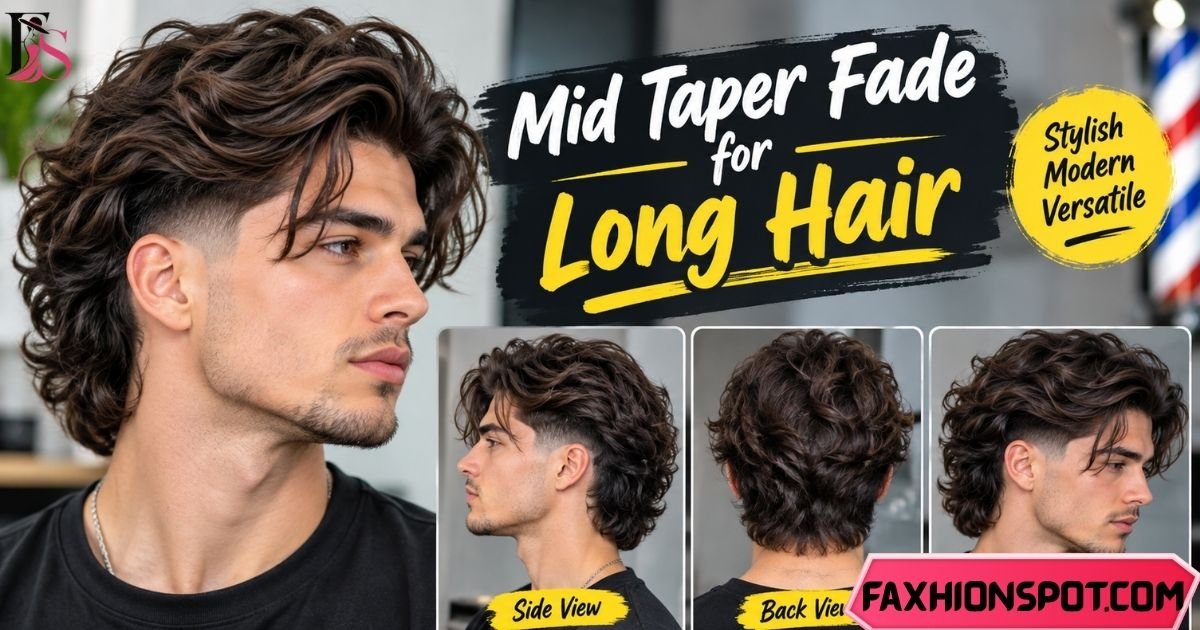
Long hair does not have to look unstructured or difficult to maintain. A mid taper fade for long hair creates a cleaner outline around the temples, sideburns, and neckline while allowing the length on top to remain the main feature.The result is a modern haircut with contrast, movement, and plenty of styling options.
In this guide, you will find 28 style ideas, hair-type recommendations, face-shape advice, clipper information, an exact barber script, styling instructions, maintenance tips, and answers to common questions.
What is a mid-taper fade for long hair, and how long should the top be?
A mid taper fade for long hair keeps the top substantially longer than the tapered areas around the temples, sideburns, and neckline. The taper generally begins around the middle of the temple or upper ear area and gradually becomes shorter toward the perimeter.
For the top, there is no universal minimum length. Around 4 to 6 inches gives you enough freedom for curtains, slick backs, textured flow, ponytails, and some tied styles. Longer hair provides even more styling flexibility.
| Feature | Typical approach |
| Top | About 4–6+ inches for versatile long styles |
| Temples | Mid-height gradual taper |
| Sideburns | Blended shorter |
| Neckline | Clean tapered finish |
| Side bulk | Mostly retained |
| Styling | Loose, parted, swept, braided, or tied |
The exact length should depend on your current haircut, hair density, texture, and desired final style.
What Is a Mid Taper Fade for Long Hair?
A mid taper fade for long hair combines a longer top with a localized taper around the temples, sideburns, and nape. The top is not necessarily faded down like it would be with a conventional mid fade.
This distinction matters. A mid fade removes more weight through the side panel, while a mid taper generally keeps more darkness and length around the sides. Barber terminology can vary, so describing the placement and retained weight is often more useful than simply naming the haircut.
The result is a haircut that looks clean from the side without making your long hair disappear.
Where Does the Mid Taper Start on the Head?
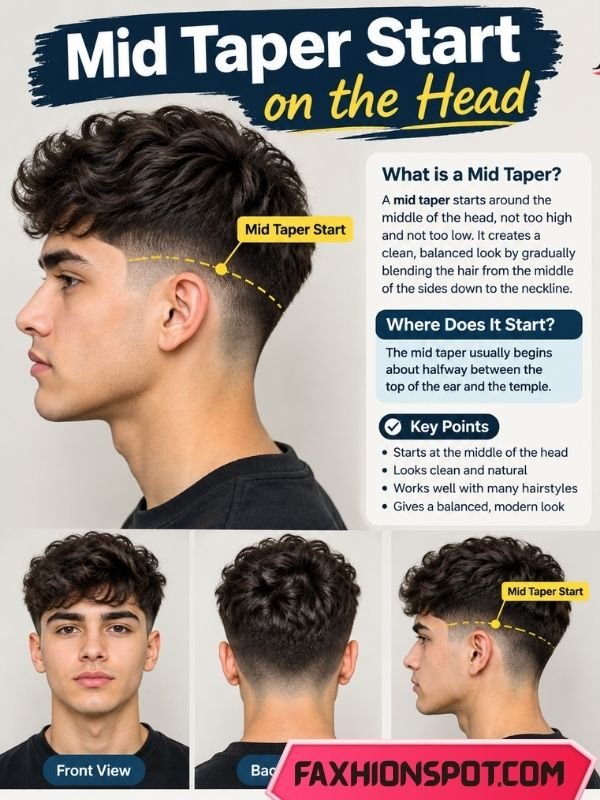
The taper usually begins around the temple or mid-ear region, although the precise position varies according to head shape and barber technique.
“Mid” describes the placement of the graduation, not one universally measured line. A reference photo is useful because different barbers may interpret the same terminology slightly differently.
Mid Taper vs Low Taper for Long Hair
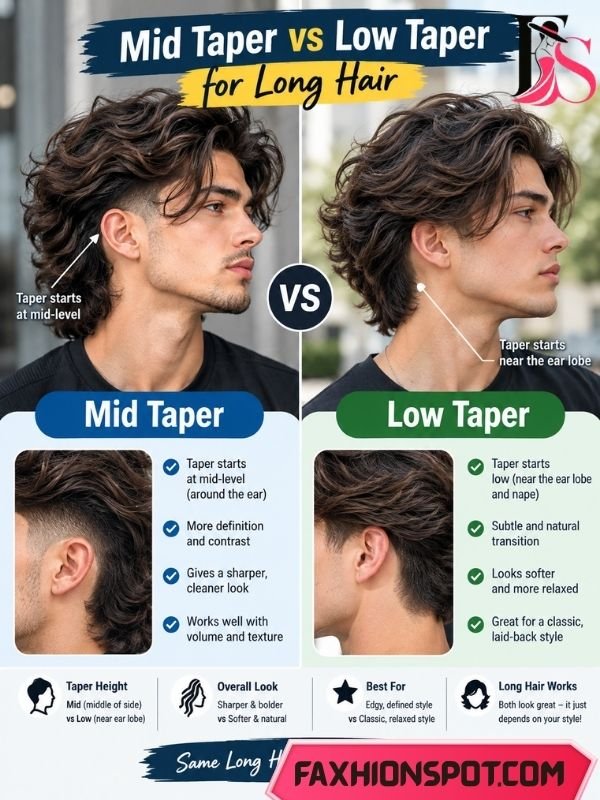
A low taper starts closer to the ear and neckline, creating a softer and more conservative transition. A mid taper begins higher, producing more visible definition around the temple.
| Feature | Low Taper | Mid Taper |
| Starting point | Lower | Mid-temple/ear area |
| Contrast | Subtle | Moderate |
| Side weight | More retained | Moderately reduced |
| Visual impact | Softer | More defined |
| Long-hair compatibility | Excellent | Excellent |
| Maintenance | Relatively easy | Moderate |
If you want the long hair to remain visually dominant, a low taper can be very subtle. If you want a cleaner, more noticeable frame, the mid placement provides greater definition.
Why the Mid Taper Fade Works Specifically for Long Hair
Long hair creates volume and movement, but excess weight around the temples and neckline can make the haircut appear untidy. A taper solves that problem without requiring a major reduction in top length.
1. Bulk Reduction Without Length Loss
One of the biggest advantages of a mid taper fade for long hair is targeted bulk removal. Your barber can clean the areas that become messy while preserving the length you have spent months growing.
2. Visual Frame and Focus
A clean taper creates a visual frame around the face. The longer top becomes more noticeable because the perimeter has been refined.
3. Scalp Health and Airflow
Removing some density around the ears and neckline can make those areas feel lighter and less congested. It does not replace proper washing or scalp care, but it can make long hair feel easier to manage.
4. Maximum Styling Flexibility
The top can be worn down, parted, pushed backward, tied into a bun, placed into a ponytail, or styled with texture.
How Long Does Your Hair Need to Be on Top?
For maximum versatility, aim for roughly 4 to 6 inches or more on top. However, the right length depends on your desired hairstyle.
- Curtains: approximately 4–6 inches
- Slick back: approximately 5–7 inches
- Man bun: usually 6–10+ inches
- Ponytail: generally 6–10+ inches
- Long flow: 5–8+ inches
- Braids or locs: length varies significantly by technique
The longer the top, the more options you have, but longer hair also requires more conditioning, detangling, and styling control.
28 Mid Taper Fade Long Hair Styles for Men in 2026
1. Mid Taper Fade with Curtain Hair
Curtain hair gives long locks a relaxed center-parted appearance. Keep enough length in the front for both sections to fall naturally around the face. The taper cleans the temples and neckline while leaving the curtain shape untouched.
2. Mid Taper Fade with Slick Back
A slick back works particularly well when the top is long enough to move backward without springing forward. Use a blow dryer to direct the roots and finish with a light pomade or styling cream.
3. Mid Taper Fade with Man Bun
A man bun paired with a clean taper creates a strong contrast between tied-up length and neat edges. The longer the hair, the larger and more flexible the bun can become.
4. Mid Taper Fade with Wavy Long Hair Flow
Natural waves create movement without requiring complicated styling. Ask your barber to preserve the natural wave pattern and remove unnecessary perimeter bulk instead of over-thinning the top.
5. Mid Taper Fade with Curly Long Hair
Curly hair can create impressive volume above a clean taper. The key is maintaining enough length for the curls to form properly. A curl cream or lightweight leave-in conditioner can help define the pattern.
6. Mid Taper Fade with Ponytail
A ponytail keeps long hair practical while the taper gives the haircut a cleaner outline. This is particularly useful for men who want long hair but prefer keeping it away from the face during work or exercise.
7. Mid Taper Fade Mullet (Modern Mullet)
A modern mullet combines shorter sides with length toward the back. The taper gives the temples and sideburns a controlled appearance while the rear length remains prominent.
8. Mid Taper Fade with Middle Part
The middle part is one of the easiest ways to showcase long hair. The taper keeps the perimeter neat while the center separation creates symmetry.
9. Mid Taper Fade with Side Part
A side part gives long hair a more structured appearance. It works especially well with straight or slightly wavy textures and can be styled casually or formally.
10. Mid Taper Fade with Long Textured Fringe
A long textured fringe brings the front forward instead of pushing it backward. Ask for point-cut texture rather than excessive thinning if you want movement without losing too much density.
11. Mid Taper Fade with Quiff
A long quiff adds height at the front while the taper provides a cleaner foundation. Blow-drying the roots upward and backward creates the necessary volume.
12. Mid Taper Fade with Pompadour
A long pompadour requires substantial length and control at the front. The taper keeps the sides visually disciplined, allowing the elevated top to become the focal point.
13. Mid Taper Fade with Messy Textured Flow
This version is ideal if you prefer a relaxed finish. Use sea salt spray or a lightweight texture product, scrunch the hair, and allow it to dry with its natural movement.
14. Mid-Taper Fade with Comb-Over
A comb-over can look modern rather than formal when paired with long textured hair. Leave enough length to sweep across naturally instead of forcing the hair into a rigid shape.
15. Mid Taper Fade with Dreadlocks (Locs)
Locs can be combined with a taper to create a cleaner perimeter while preserving the length and structure of the locs. Your barber should understand how much tension and weight your locs place around the sides.
16. Mid Taper Fade with Box Braids
Box braids and a tapered perimeter create a sharp contrast. Keep the taper controlled around the temples and neckline so it complements rather than competes with the braid pattern.
17. Mid Taper Fade with Long Afro
A long afro can benefit from a carefully tapered perimeter. The shape remains full while the temples and neckline receive cleaner definition.
18. Mid Taper Fade with Blow Back
Blow-back styling directs long hair away from the face while preserving natural volume. A round brush and blow dryer can help establish the direction before finishing with a flexible product.
19. Mid Taper Fade with Faux Hawk
A long faux hawk brings the center upward while keeping the outer sections controlled. It is a more expressive option for men who want strong texture and height.
20. Mid Taper Fade with Half-Up Style
The half-up style ties only part of the hair while leaving the rest flowing. It works particularly well during the growing-out stage because you can control the front without sacrificing visible length.
21. Mid Taper Fade with Side Swept Long Hair
Side-swept hair provides movement and can soften angular features. Direct the hair diagonally from the part while keeping the taper relatively subtle.
22. Mid Taper with Drop Fade (Long Top)
This variation combines long top length with a tapered shape that follows the natural curve around the head. Discuss the exact perimeter design with your barber because “taper” and “drop fade” can describe different cutting approaches.
23. Mid Taper with Burst Fade (Long Hair)
A burst-inspired perimeter can create more curvature around the ears. It works particularly well with textured, curly, or mullet-inspired long hairstyles.
24. Mid Taper Fade with Blonde Long Hair
Blonde long hair can make the transition between lengths visually prominent. A clean taper adds definition without requiring a dramatic reduction in the top.
25. Mid Taper Fade with Permed Long Hair
A perm adds curls or waves to otherwise straight hair. Leave sufficient length for the new texture and avoid excessive thinning that could make the ends appear weak.
26. Mid Taper Fade with Highlights (Long Hair)
Highlights add dimension to long hair, especially when it has waves or curls. The taper provides a clean foundation while the lighter strands emphasize movement.
27. Mid Taper Fade with Hard Part (Long Hair)
A hard part creates a deliberate separation between sections. It gives long hair a more defined appearance, but the line requires regular maintenance to remain sharp.
28. Mid Taper Fade with Long Hair and Beard Combo
Combining long hair with a beard creates a balanced full-face look. Keep the beard transition and temple area coordinated so the haircut and facial hair look like one deliberate style.
Mid Taper Fade for Long Hair by Hair Type
The same haircut can look dramatically different depending on texture, density, and natural movement. Current barber guides consistently emphasize that texture affects how visible the blend appears and how much bulk should be retained.
Does Mid Taper Fade Work for Straight Long Hair?
Yes. Straight hair makes the taper highly visible because the transition is easy to see. A little texture through the top can prevent the style from looking too flat.
Does Mid Taper Fade Work for Wavy Long Hair?
Yes. Wavy hair is particularly useful for creating natural movement. Keep the top long enough for the wave pattern to develop instead of cutting away the density that creates it.
Does Mid Taper Fade Work for Curly Long Hair?
Yes. Curly hair provides volume and texture above the taper. The barber should account for shrinkage and avoid treating curly hair like straight hair when estimating the finished length.
Does Mid Taper Fade Work for Thick Long Hair?
Absolutely. Thick hair benefits from controlled bulk removal around the perimeter. However, avoid removing too much weight from the top if your goal is a full long hairstyle.
Best Mid Taper Fade for Your Face Shape
Face shape should guide proportions rather than dictate one mandatory haircut. Your natural hairline, density, forehead, jawline, and preferred styling routine also matter.
Oval Face
An oval face can handle most long hairstyles. Middle parts, slick backs, textured flow, and ponytails are all flexible choices.
Round Face
A little height and vertical movement can visually elongate a round face. A quiff, blow back, or textured top can create that effect.
Square Face
Long textured styles can complement a strong jawline. A slick back or side-swept style can emphasize the natural structure of the face.
Heart-Shaped Face
A side-swept fringe or curtain style can help distribute visual weight around the forehead and chin.
Diamond Face
Textured flow, curtains, and medium-volume styles can work well with prominent cheekbones. Avoid making the sides excessively tight if you want to maintain balance.
Oblong / Long Face
Long faces can benefit from retaining some side volume rather than creating an extremely narrow silhouette. A softer taper and textured top can help maintain proportion.
How to Ask Your Barber for a Mid Taper Fade with Long Hair
A successful haircut often depends on communicating what should stay long, not simply saying the haircut’s name.
Tell your barber:
- How much length you want to preserve.
- Where you want the taper to begin.
- Whether you want skin, shadow, or a longer shortest point.
- How much side weight you want to retain.
- Whether you want the neckline natural, tapered, or squared.
- Which top hairstyle you plan to wear.
The Exact Script: What to Say Word for Word
Use this:
“I want a mid taper around the temples, sideburns, and neckline. Please keep the top long and preserve as much length as possible. I don’t want a full fade through the sides. Keep enough weight to connect naturally with the long top, and blend the perimeter gradually. I want the top shaped only enough to support my styling goal.”
Then show your barber a side-profile reference photo.
What Clipper Guard Numbers Are Used for Mid Taper Fade?
There is no single mandatory guard sequence. A barber may use different guards depending on the desired shortest length, hair density, and blend.
| Guard | Approximate role |
| No guard/lever open | Very short transition work |
| 0.5 | Short shadow area |
| #1 | Short blended section |
| #1.5 | Intermediate transition |
| #2 | Longer transition |
| #3+ | Weight connection and blending |
A mid taper fade for long hair does not have to reach skin. If you prefer a softer grow-out, ask your barber for a shadow or low-number clipper finish rather than a bald finish.
How to Style Long Hair with a Mid Taper Fade
The best styling method depends on whether you want volume, definition, shine, or natural texture.
Daily Styling Routine
Start with clean, towel-dried hair.
- Apply a small amount of leave-in conditioner if your hair needs moisture.
- Add a styling cream, mousse, or sea salt spray based on your desired finish.
- Shape the hair with your fingers or a brush.
- Blow-dry if you need additional volume or direction.
- Finish with a small amount of pomade, clay, or light hairspray.
Avoid using excessive product. Long hair can quickly become heavy and greasy when too much styling product is applied.
Best Products for Long Hair + Mid Taper Fade
| Product | Best use |
| Leave-in conditioner | Dry or coarse hair |
| Curl cream | Curly hair |
| Sea salt spray | Texture and waves |
| Styling cream | Natural control |
| Matte clay | Texture and definition |
| Pomade | Slick styles |
| Light hairspray | Final hold |
| Hair oil | Dry ends and shine |
Step-by-Step: How to Style a Slick Back
- Start with damp hair.
- Apply a small amount of styling cream.
- Comb the front backward.
- Blow-dry backward from the roots.
- Add a small amount of pomade.
- Smooth the surface without flattening all natural volume.
- Finish with light hairspray if needed.
Step-by-Step: How to Style Curtain Hair
- Begin with damp hair.
- Create a center part.
- Blow-dry each side away from the face.
- Use your fingers to maintain natural separation.
- Add a lightweight cream or texture product.
- Allow the ends to retain natural movement.
How to Maintain a Mid Taper Fade with Long Hair
Maintenance has two separate parts: keeping the perimeter clean and maintaining the length and health of the top.
How Often Should You Get a Mid Taper Fade Trimmed?
Many men refresh the taper approximately every 3 to 5 weeks, depending on how quickly their hair grows and how sharp they want the perimeter. Some prefer more frequent visits for a very crisp finish.
The advantage of a taper is that the grow-out can be less obvious than with a very tight skin fade.
How to Grow Your Hair Long Enough for This Style
If your hair is currently short, focus on consistent care rather than repeatedly reshaping the top.
- Avoid unnecessary length removal.
- Condition regularly.
- Detangle gently.
- Limit excessive heat.
- Protect hair during sleep if appropriate for your texture.
- Trim damaged ends when necessary.
- Keep the perimeter clean while allowing the top to grow.
Your hair-growth rate is largely individual, so patience is important.
Common Mistakes to Avoid
The biggest mistake is asking for a taper without explaining how much length you want to preserve.
Other common problems include:
- Asking for a full fade instead of a localized taper.
- Taking too much weight from the sides.
- Going too short around the temples on the first attempt.
- Over-thinning thick long hair.
- Ignoring natural curl or wave shrinkage.
- Using too much styling product.
- Cutting the top every time the taper needs a cleanup.
- Choosing a reference photo with a completely different hair texture.
- Forgetting to explain your preferred neckline.
- Expecting the exact same result from every barber without discussing placement.
A good barber consultation should cover the top length, taper height, shortest point, side weight, neckline, and styling goal.
Click Here To Read Another Topic
How Much Does a Mid Taper Fade Cost for Long Hair?
The price varies considerably by location, barber experience, salon type, and the amount of work required.
| Service | Typical pricing factors |
| Basic taper | Lower cost |
| Taper + long-hair shaping | Moderate |
| Taper + styling | Moderate to higher |
| Premium barber service | Higher |
| Taper + beard service | Additional charge |
Long hair can require more consultation, scissor work, styling, and finishing than a simple short haircut, so ask for the total price before the service begins.
Frequently Asked Questions
Is a mid taper good for long hair?
Yes. It cleans the temples, sideburns, and neckline while allowing substantial length to remain on top.
How long should hair be for a long taper?
Around 4 to 6 inches provides strong versatility, while 6 inches or more offers additional options such as buns and ponytails.
Does a mid taper remove a lot of hair?
Usually not from the top. The shorter work is concentrated around the perimeter, while the main top length is preserved.
Is a mid taper better than a low taper for long hair?
They create different effects. A low taper is subtler, while a mid taper creates more visible definition around the temple.
Can curly hair get this haircut?
Yes. Curly and coily textures can create strong contrast between the textured top and clean perimeter.
Can straight long hair get a mid taper?
Yes. Straight hair can make the taper especially visible and works well with slick backs, curtains, parts, and flowing styles.
Can I put a man bun over a taper?
Yes. A longer top can be tied into a man bun while the tapered perimeter keeps the sides and neckline clean.
How often should I maintain the taper?
Most people can refresh it every 3 to 5 weeks, although sharper finishes may require more frequent visits.
Should the taper go down to the skin?
Not necessarily. A shadow or longer clipper finish can provide a softer appearance and easier grow-out.
Is a mid taper the same as a mid fade?
No. A mid fade generally removes more weight across the side panel, while a taper concentrates the shortening around the perimeter.
Can I grow my hair while getting a taper?
Yes. Keeping the top largely untouched while periodically cleaning the perimeter is a practical way to grow long hair without letting the outline become overly messy.
Conclusion
A mid taper fade for long hair gives men a practical way to combine substantial length with a cleaner, more structured perimeter.
The top can remain long enough for curtains, slick backs, waves, curls, buns, ponytails, braids, textured flow, or a modern mullet.
1 thought on “Mid Taper Fade for Long Hair: 28 Best Styles + Expert Barber Guide (2026)”