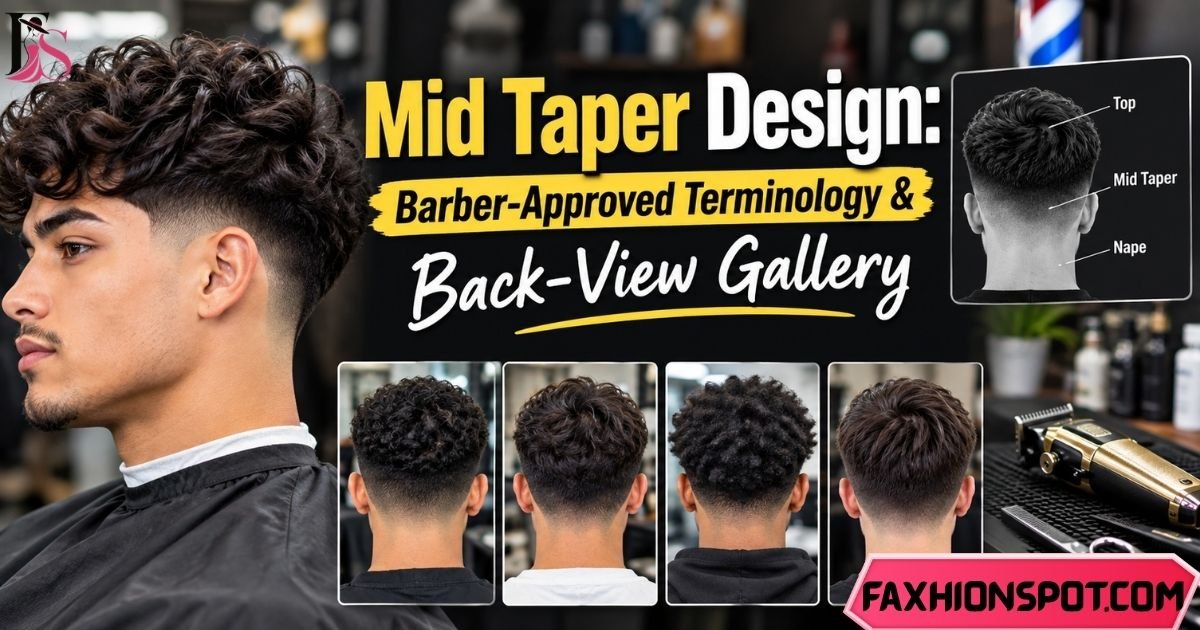
A mid taper design combines a balanced taper around the temples, sideburns, and neckline with a shaved or razor-cut pattern. The result can be subtle enough for everyday wear or detailed enough to become the main feature of your haircut.
The biggest challenge is explaining exactly what you want. Terms such as mid taper, mid fade, line design, nape design, and freestyle can mean slightly different things from one barber to another.
This guide explains the terminology, design placements, back-of-head options, hair-type combinations, maintenance schedule, and a simple script you can show your barber.
What Is a Mid Taper (and How Is It Different from a Mid Fade)?
A mid taper design starts around the middle area of the temple and gradually reduces length through selected areas such as the sideburns and neckline. Unlike a full mid fade, the taper usually preserves more weight across the main side panel.
A mid fade generally removes more hair across the sides and back, creating a wider transition from longer hair into very short or skin-level hair. A mid taper concentrates the transition into a narrower area.
| Feature | Mid Taper | Mid Fade |
| Main placement | Temple, sideburn, neckline | Wider sides and back |
| Side weight | More hair retained | More hair removed |
| Contrast | Moderate | Usually stronger |
| Design area | Temple, sideburn, nape | Sides, back, or both |
| Professional look | Easy to keep subtle | Can look more dramatic |
| Grow-out | Generally softer | More noticeable |
One important detail is the shortest length. A barber may interpret “mid taper” differently depending on whether you request a #2, #1, 0.5, or skin finish. Some professional guides specifically recommend stating how much scalp you want visible rather than depending on terminology alone.
If you want a mid taper design, tell your barber where you want the taper and design rather than simply saying “give me a mid fade with a design.”
Mid Taper Design Ideas (Categorized by Placement & Complexity)
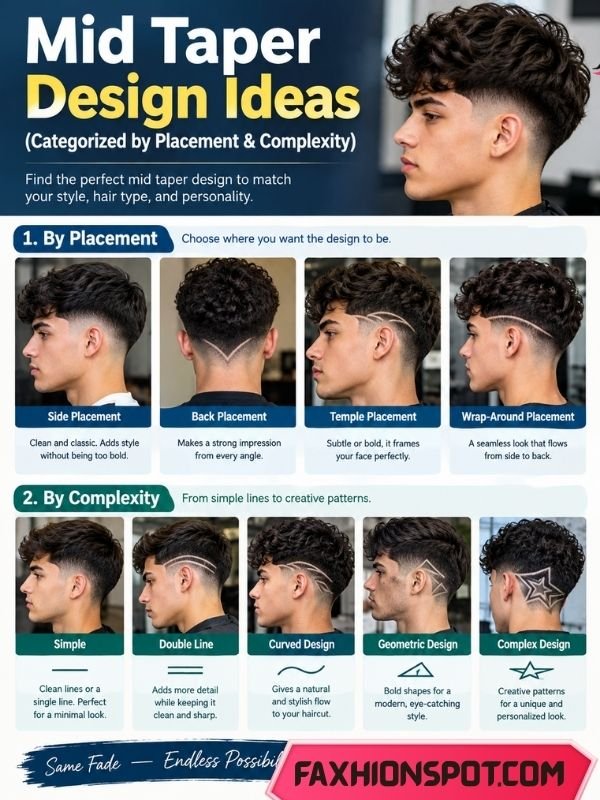
There are three practical categories to consider: simple, geometric, and freestyle.
A simple design uses minimal lines and works well when you want detail without dramatically changing the haircut. Geometric designs create stronger visual contrast, while freestyle patterns allow the barber to create something more customized.
Current hairstyle guides commonly feature shaved lines, curves, zigzags, geometric patterns, and custom razor work as ways to personalize a taper.
Simple Designs (Office-Safe)
For a workplace-friendly mid taper design, keep the pattern narrow and positioned close to the temple or nape.
Good options include:
- One clean diagonal line
- Two short parallel lines
- A small curved line
- A subtle temple slash
- A short nape accent
- A small angled notch
- A single line behind the ear
These designs create visual interest without taking over the haircut.
For an office or school environment, ask your barber to keep the design thin, symmetrical, and relatively short. Avoid large shaved graphics if your workplace has conservative grooming expectations.
Geometric Designs (Statement Styles)
Geometric designs use straight lines, angles, curves, triangles, diamonds, or repeated patterns.
Popular combinations include:
- Double-line geometric pattern
- Sharp diagonal with a curved accent
- Triangle detail
- Parallel staircase lines
- Angular temple pattern
- Small diamond shape
- Intersecting lines
A geometric mid taper design looks especially defined when the surrounding blend is clean and the design has enough negative space to remain visible.
The key is proportion. A complicated design placed in a tiny area can look crowded, while a simple pattern on a larger canvas can appear intentional and polished.
Freestyle Designs (Maximum Creativity)
Freestyle designs give the barber more artistic freedom.
Instead of requesting a specific symbol, you can say:
“Keep the mid taper clean and create a freestyle razor design around the back and side. Keep it balanced and not too large.”
Freestyle work can include flowing curves, abstract lines, waves, lightning-inspired shapes, or combinations of several patterns. Because the design depends heavily on the barber’s technique, choose a barber whose portfolio shows similar work.
What Are the Best Mid Taper Design Ideas for the Back of the Head?
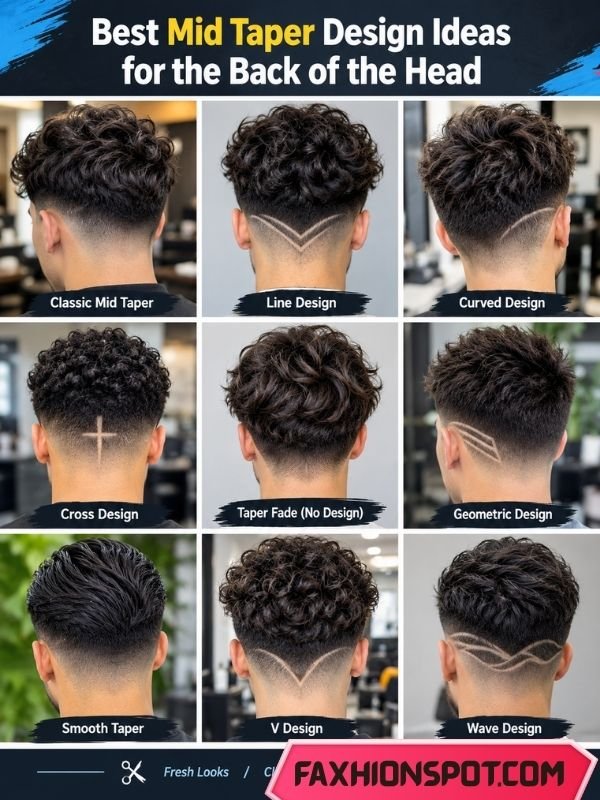
The back is one of the most interesting places for a mid taper design because it gives you a design that is visible from behind without dominating the front view.
Back designs work particularly well with a clean neckline taper. You can keep the top relatively traditional while using the nape as a small canvas for creative detail.
For a balanced look, consider:
- Single center line
- Double curved lines
- V-shaped nape design
- Small geometric pattern
- Lightning-style line
- Crossed lines
- Minimal abstract design
- Symmetrical curves
- Short horizontal accents
A barber should consider the natural shape of your skull and the direction of hair growth before placing the design. The neckline is not a flat surface, so a pattern that looks straight in a reference photo may need adjustment to follow your head shape.
Nape-Specific Design Types
The nape is especially useful when you want a subtle design.
V-shaped design: Creates a pointed visual finish and works well with a tapered neckline.
Double-line nape: Two clean lines provide definition without requiring a large graphic.
Curved nape: Follows the natural contour of the head and can look softer than sharp geometric work.
Centered geometric design: A small diamond, triangle, or intersecting-line pattern can create a focal point.
When requesting a back design, specify whether you want it centered, offset, symmetrical, or freestyle. That single detail can make communication much easier.
Mid-Taper Side Designs (Temple & Sideburn Placement)
A side mid taper design can change the appearance of the haircut more dramatically because it is visible from the front and side.
Temple designs are generally easier to notice, while sideburn and behind-the-ear designs can be more discreet.
Popular side placements include:
- Directly above the sideburn
- Behind the temple
- Above the ear
- Behind the ear
- Between the temple and ear
- Along the upper taper section
A clean mid taper design around the temple can pair well with textured crops, curls, waves, buzz cuts, quiffs, and longer textured tops. Hairstyle guides also regularly pair mid tapers with crew cuts, quiffs, comb overs, slick backs, faux hawks, and other top styles.
Side Design Placement Options
| Placement | Visibility | Style effect |
| Temple | High | Modern and noticeable |
| Sideburn | Medium | Clean and controlled |
| Behind ear | Medium-low | Subtle |
| Upper side panel | High | Bold |
| Nape | Low from front | Creative from behind |
| Side + nape | Very high | Complete custom look |
If you’re getting your first design, starting with one location can make the haircut easier to maintain.
What Should I Tell My Barber to Get a Mid-Taper Design?
The easiest approach is to break your request into four parts: taper height, shortest length, design placement, and design style.
Don’t rely on a single phrase such as “make it cool.” Your barber needs measurable or visual information.
The 4-Part Barber Communication Script
Use this simple script:
“I want a mid taper around the temples, sideburns, and neckline. Keep the sides fuller instead of turning it into a full mid fade. Start with a [guard number] and keep the design [subtle/bold]. Put the design [side/back/both] and make it [specific pattern/freestyle].”
For example:
“I want a mid taper around the temples and neckline, keeping some weight on the sides. Use a #1 at the shortest point, then blend it smoothly. Add one clean diagonal line behind my right temple.”
For a back design:
“Give me a mid taper with a clean nape and a small geometric design centered at the back. Keep the pattern sharp but not too large.”
A reference photo is even better. Barber terminology can vary, and several current guides recommend describing the actual visual result you want instead of assuming every barber interprets “mid taper” identically.
Do Mid Taper Designs Work with My Hair Type?
Yes. A mid taper design can be adapted to straight, wavy, curly, thick, fine, and coily hair, but the design may look different depending on density and texture.
Straight hair tends to reveal sharp lines clearly. Curly and coily hair can create stronger contrast between the textured top and clean tapered area. Wavy hair gives designs a softer surrounding texture.
The same taper can therefore produce noticeably different results on different hair types. Current hairstyle guides consistently describe mid tapers as adaptable across straight, wavy, curly, and coily textures.
Mid Taper Design Compatibility by Hair Type
| Hair type | Design visibility | Recommended approach |
| Straight | Very high | Fine lines and geometry |
| Wavy | High | Curved or angular lines |
| Curly | High | Simple bold patterns |
| Coily | High | Clean geometric designs |
| Thick | High | Deeper contrast if desired |
| Fine | Moderate-high | Keep design simple |
| Long hair | Variable | Expose design through taper placement |
If your hair is very fine, an extremely detailed pattern may disappear as it grows. A slightly wider, simpler design can remain recognizable longer.
Top Style Pairings
A mid taper design can be paired with:
- Textured crop
- Crew cut
- Curly top
- Short afro
- Waves
- Buzz cut
- Quiff
- Comb over
- Slick back
- Faux hawk
- Twists
- Braids
For curly or coily hair, preserving enough texture on top creates a useful contrast against the clean taper and shaved detail.
How Do I Choose a Design for Work vs. a Bold Statement?
Think about visibility, size, complexity, and location.
A small nape design can remain hidden beneath longer hair or appear mainly from the rear. A large temple design is immediately visible and creates a stronger style statement.
Design Appropriateness Scale
| Situation | Recommended design |
| Corporate office | Single line or subtle nape detail |
| School | Small geometric line |
| Casual workplace | Double line or simple curve |
| Creative workplace | Geometric or freestyle |
| Weekend/social | Larger geometric design |
| Maximum statement | Full custom freestyle |
This isn’t a universal workplace rule. Grooming expectations differ between employers, schools, professions, and cultures. When in doubt, choose a design that can be hidden or minimized.
A subtle mid taper design also gives you flexibility because you can add detail without committing to an extremely dramatic haircut.
How Long Does a Mid Taper Design Last?
The taper itself generally lasts longer than the crisp design.
The exact timeline depends on hair growth, hair texture, how short the taper was cut, and how precise the pattern is. Current haircut guides commonly place taper refreshes around three to five weeks, while crisp shaved designs can lose their sharpness much sooner.
Mid Taper Design Growth Timeline
| Time | What you can expect |
| Days 1–5 | Design looks sharpest |
| Days 6–10 | Lines remain highly visible |
| Days 11–14 | Fine details begin softening |
| Weeks 3–4 | Taper remains present but design fades |
| Weeks 4–5 | Full refresh may be useful |
If maintaining the pattern is your priority, you may need a design touch-up before you need the entire haircut redone.
Avoid shaving the design yourself unless you have the necessary skills. Uneven lines are difficult to correct once too much hair has been removed.
What Mistakes Should I Avoid?
Most disappointing results come from unclear communication rather than the idea itself.
Before your barber starts, show your reference photo and discuss exactly where the taper and design should sit.
5 Common Mid Taper Design Mistakes
1. Saying “mid fade” when you actually want a taper
These are related but not identical. A mid fade can remove substantially more side weight.
2. Not specifying the shortest guard
“Short” means different things to different people. Tell your barber whether you prefer #2, #1, 0.5, or skin-level work.
3. Choosing an overly complicated design
Intricate patterns can become difficult to maintain and may lose definition quickly.
4. Ignoring hair growth direction
A design should work with the natural growth pattern and shape of your head.
5. Showing only a front-view reference
If you want a back design, show a rear-view reference. A front photograph does not communicate the shape, placement, or scale of a nape pattern.
The best mid taper design is one that matches your haircut, hair texture, workplace needs, and maintenance routine rather than simply copying a random photograph.
Frequently Asked Questions
What is a mid taper design?
It is a mid-level taper combined with a shaved, razor-cut, or clipped pattern around the temple, sideburn, nape, or back.
Is a mid taper the same as a mid fade?
Not always. A taper usually concentrates the blend around specific areas, while a mid fade generally removes more hair across the sides and back.
Can I get a design on the back?
Yes. The nape is one of the most popular locations for subtle lines, curves, geometric shapes, and freestyle patterns.
What should I show my barber?
Show a clear reference photo and specify the taper height, shortest guard, design location, and preferred pattern.
Are taper designs good for curly hair?
Yes. Curly hair can create strong contrast between the textured top and clean tapered areas.
Can straight hair have a taper design?
Absolutely. Straight hair often makes razor lines and geometric patterns particularly visible.
How often should I refresh the design?
A crisp shaved design may need refreshing after roughly 7 to 14 days, while the underlying taper can remain present for several weeks.
Can a taper design be professional?
Yes. A single line or small nape pattern can be considerably more conservative than a large freestyle graphic.
Is a skin finish necessary?
No. Tell your barber how much scalp visibility you want. A longer guard can produce a softer result.
Can I combine side and back designs?
Yes. Keep the patterns visually related so the haircut does not look overcrowded.
What is the easiest design for a first haircut?
A single diagonal line or small nape design is a practical starting point because it adds detail without overwhelming the haircut.
Conclusion
A mid taper design gives you a practical way to personalize a classic men’s haircut without completely changing the shape of your hairstyle.
The most important decision is not the design itself but communicating exactly where you want the taper, how short it should go, and where the pattern should sit.
For a subtle appearance, choose a small line near the temple or nape. For more personality, consider geometric or freestyle work. Your hair texture, density, face shape, workplace, and maintenance schedule should all influence the final choice.
1 thought on “How to Ask for a Mid Taper Design: Barber-Approved Terminology & Back-View Gallery”