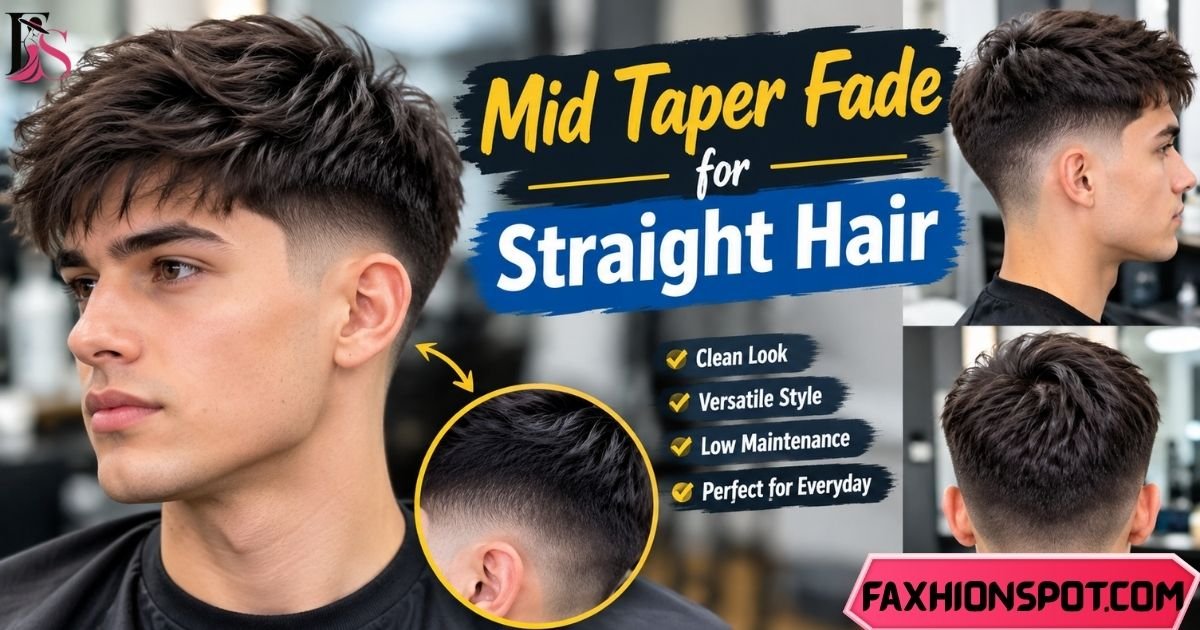
Straight hair gives a haircut a clean canvas, making precise fades, sharp transitions, and structured tops especially noticeable.
A mid taper fade for straight hair is one of the most versatile choices because it creates a balanced transition around the temples, sideburns, and neckline without taking too much weight from the sides.
This guide covers 25+ variations, styling techniques, product recommendations, barber instructions, maintenance timing, and practical advice for thin and thick straight hair.
What Is a Mid Taper Fade for Straight Hair and Why Does It Look So Sharp?
A mid taper fade creates a gradual shortening around the middle portion of the temples and side area before blending toward the sideburns and neckline. The top generally remains longer, allowing you to choose almost any hairstyle.
Straight strands make the transition particularly visible because the hair lies naturally flat. That means a clean blend can look extremely polished, while an uneven transition may also be easier to notice.
The appeal comes from balance. A low taper can look subtle, while a high taper creates stronger contrast. A mid placement sits between the two, giving you definition without removing too much of the upper-side weight.
What is a mid-taper fade for Straight Hair?
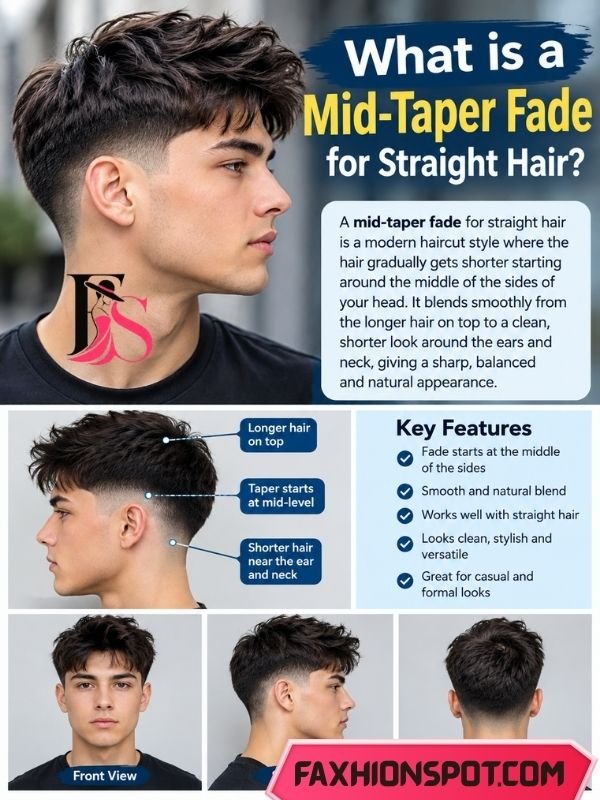
A mid-taper fade for Straight Hair is a haircut in which the taper begins around the middle area of the temples and gradually becomes shorter around the ears, sideburns, and neckline.
Unlike a traditional all-around fade, a taper concentrates the shortest area around specific edges while preserving more hair on the upper sides and top. This leaves plenty of styling freedom.
The exact starting point and shortest length can vary between barbers, so it is better to describe the desired height, top length, and finish rather than relying only on the haircut name. Current barber guides similarly emphasize explaining the blend height and what you want left on top.
Why Straight Hair Is Actually Perfect for a Mid Taper Fade
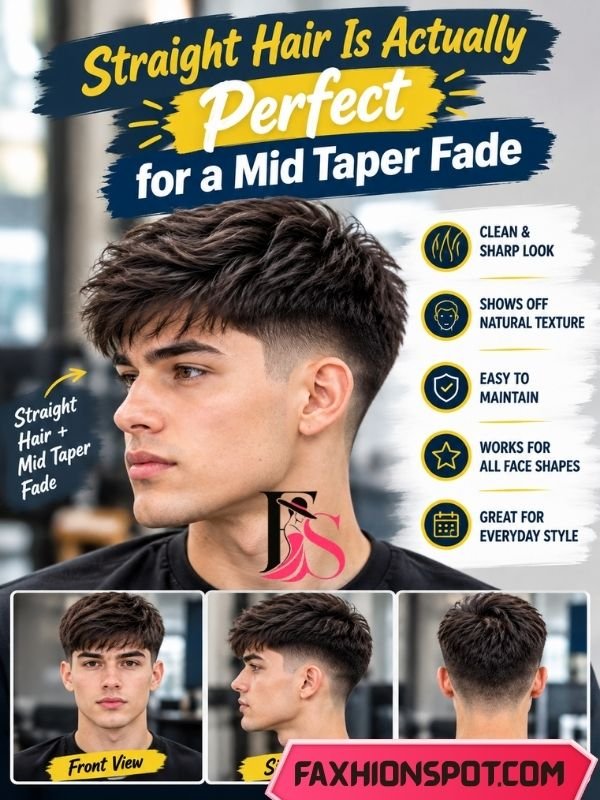
Straight hair can showcase the geometry of a taper exceptionally well. Because the strands generally fall in one direction, the contrast between the longer top and tapered sides is easy to see.
It is also flexible. Depending on length and density, straight hair can be:
- Brushed forward
- Swept sideways
- Combed backward
- Styled into a quiff
- Cut into a crop
- Separated into curtain bangs
- Textured into a messy finish
- Left longer for a mullet
The main challenge is that straight hair can sometimes look flat. Adding controlled texture, blow-dried volume, or a lightweight styling product can give the top more movement without making it greasy.
Mid Taper vs Low Taper vs High Taper – Which Is Best for Straight Hair?
There is no universal winner because the three placements create different visual effects.
| Taper Type | Starting Height | Overall Effect | Best For |
| Low taper | Lower around ears and neckline | Subtle and conservative | Professional, classic styles |
| Mid taper | Middle temple and side area | Balanced and versatile | Most face shapes and styles |
| High taper | Higher around temples | Stronger contrast | Edgy, high-definition looks |
Low Taper Fade for Straight Hair
A low taper keeps most of the side profile intact and gradually cleans the area around the ears and neckline. It works well when you want a conservative haircut that can transition easily between school, work, and casual settings.
Mid Taper Fade for Straight Hair
A mid taper provides more visible structure while keeping enough weight above the blend. It pairs particularly well with textured tops, fringe styles, comb overs, slick backs, and medium-length cuts.
High Taper Fade for Straight Hair
A high taper removes more visual weight around the upper sides and creates stronger separation from the top. Straight hair makes that contrast especially noticeable because the strands do not naturally obscure the transition.
25+ Best Mid Taper Fade Styles for Straight Hair in 2026
The styles below use the same general taper concept but change the top shape, texture, length, or finish. Your hair density and growth pattern should determine which version you choose.
1. Classic Mid-Taper Fade Straight Hair
This is the cleanest starting point. Keep the top medium length with a natural direction, while the sides gradually tighten around the temples and neckline.
It works especially well for men who want a haircut that looks polished without requiring elaborate styling every morning.
2. Textured Fringe Mid-Taper Fade Straight Hair
A textured fringe adds movement to naturally straight strands. Instead of allowing the front to fall as one solid block, the barber creates separated pieces through controlled scissor texturing.
A light matte product can emphasize the individual sections while keeping the finish natural.
3. Messy Fringe Mid-Taper Fade Straight Hair
For a relaxed appearance, leave extra length at the front and style the fringe unevenly. The messy top contrasts with the clean taper underneath.
This option is particularly useful for younger men and casual wardrobes because it looks intentionally relaxed rather than overly polished.
4. Mid-Blowout Taper Fade Straight Hair
The blowout version focuses on volume and outward movement. The top and upper sides are blow-dried away from the scalp while the taper keeps the lower area controlled.
Use a lightweight volumizer before drying, followed by a small amount of matte styling product.
5. Curtain Bangs Mid Taper Fade Straight Hair
Curtain bangs divide the front near the center and allow the hair to fall toward both sides. Straight hair makes the separation clean and predictable.
Keep enough length around the front to create a natural curtain instead of forcing a short fringe into the style.
6. Slick Back Mid Taper Fade Straight Hair
A slick back needs enough length on top to move the hair backward. Straight hair is naturally suited to this direction, making the style relatively easy to control.
For a modern finish, avoid excessive product. A lightweight pomade or styling cream can provide control while keeping some natural movement.
7. Comb-Over Mid-Taper Fade Straight Hair
The comb-over creates a clear direction from one side toward the other. It can be neat and professional or textured and casual depending on the product.
A soft side part is ideal for everyday wear, while a more defined part creates a formal appearance.
8. Hard Part Mid Taper Fade Straight Hair
A hard part uses a defined shaved or clipped line to separate the top. It adds visual precision to an already structured haircut.
Because straight hair exposes lines clearly, ask your barber to keep the part clean without making it excessively wide.
9. French Crop Mid Taper Fade Straight Hair
A French crop combines a relatively short top with a forward fringe. The taper keeps the perimeter clean while the front supplies the hairstyle’s identity.
This is a practical option if you want a shorter haircut that does not require much morning styling.
10. Pompadour Mid Taper Fade Straight Hair
The pompadour emphasizes height at the front and gradually reduces toward the back. Straight hair can be blow-dried upward and backward to create the required lift.
A stronger styling product is usually necessary because the top must maintain volume throughout the day.
11. Mid Taper Fade for Asian Straight Hair
Thicker, dense straight hair can create excellent contrast with a taper. The barber may remove controlled bulk from the top and upper sides without making the hair excessively thin.
A textured fringe, crop, curtain style, or slick back can all work depending on the density and direction of growth.
12. Mid Taper Fade for Thin Straight Hair
Fine or thin hair benefits from strategic cutting rather than aggressive thinning. Excessive texturizing can make the top appear even less dense.
Keep enough weight at the front and use lightweight volumizing products. Blow-drying against the natural direction can also create the appearance of additional body.
13. Mid Taper Fade for Thick Straight Hair
Thick straight hair gives you more freedom with length. Your barber can use scissor work or controlled debulking to prevent the top from becoming excessively heavy.
Textured crops, quiffs, pompadours, and longer brushed-back styles can all benefit from this density.
14. Disconnected Mid Taper Fade Straight Hair
A disconnected version deliberately creates a stronger separation between the long top and shorter sides.
It is more dramatic than a conventional blended style and works best when you specifically want high contrast.
15. Edgar Cut Mid Taper Fade Straight Hair
The Edgar combines a short, defined top with a forward fringe. Straight hair can make the horizontal front line particularly crisp.
Keep the fringe proportionate to your forehead and face length rather than copying a fixed length from a photograph.
16. Crew Cut Mid-Taper Fade Straight Hair
The crew cut keeps the top short and practical. The taper adds modern detailing around the sides and neckline without requiring daily styling.
It is a strong option for people who want a low-maintenance haircut with a clean silhouette.
17. Quiff Mid Taper Fade Straight Hair
The quiff lifts the front while keeping the rest of the top controlled. Blow-drying is the easiest way to create the shape before applying product.
For fine hair, use volume powder or mousse rather than heavy wax that can flatten the roots.
18. Ivy League Mid Taper Fade Straight Hair
An Ivy League keeps the top longer than a crew cut while maintaining a refined appearance. It can be parted, brushed sideways, or lightly pushed back.
The style works well when you need something suitable for both professional and casual environments.
19. Side Part Mid Taper Fade Straight Hair
A traditional side part gives straight hair a defined direction. The taper makes the sides appear cleaner without overwhelming the classic top.
Use a light styling cream for a natural finish or pomade when you want additional shine and control.
20. Faux Hawk Mid Taper Fade Straight Hair
A faux hawk creates central height without requiring the dramatic commitment of a full mohawk.
The taper keeps the sides controlled while the top is pushed toward the center. Matte clay works well when you want separation instead of a glossy finish.
21. Spiky Top Mid Taper Fade Straight Hair
Short straight hair can be styled into separated spikes using a matte clay or wax.
Avoid making every spike identical. Slight variation creates a more modern texture and prevents the style from looking dated.
22. Caesar Cut Mid Taper Fade Straight Hair
The Caesar uses a short, forward-directed top with a compact fringe. The taper gives the haircut a cleaner perimeter.
It is especially convenient for people who prefer short hair and minimal daily styling.
23. Mid Taper Fade with Beard: Straight Hair
Adding facial hair changes the visual balance of the haircut. A neatly shaped beard can create continuity between the tapered sideburn area and jawline.
The beard does not need to match the exact length of the taper, but the transition should look intentional.
24. Long Top Mid Taper Fade Straight Hair
Keeping the top longer creates numerous styling possibilities. You can wear it as a slick back, middle part, curtain style, textured flow, or loose side sweep.
Longer tops require more maintenance because shape and weight become increasingly important as the hair grows.
25. Modern Mullet Mid Taper Fade Straight Hair
The modern mullet keeps additional length toward the back while cleaning the sides with a controlled taper.
Straight hair makes the back length and side contrast obvious, so the transition should be carefully blended rather than cut as a sudden block.
How to Style Mid Taper Fade Straight Hair: Step-by-Step
The best styling method depends on your top length, density, and desired finish. Most versions can be styled in a few minutes once the correct technique is learned.
Daily Styling Routine for Mid-Taper Fade Straight Hair
Follow this basic routine:
- Start with clean, towel-dried hair.
- Apply a small amount of lightweight styling product.
- Use your fingers or a comb to establish direction.
- Blow-dry if you need additional volume.
- Add a small amount of matte clay, cream, or pomade.
- Finish by checking the fringe, temples, and top shape.
The most common mistake is using too much product. Start with a pea-sized amount and add more only if necessary.
Blow-Drying Technique for Volume on Straight Hair
For volume, direct warm air toward the roots rather than simply drying the surface.
Use your fingers to lift the front while directing the dryer backward or upward. Once the shape is established, use a cooler setting briefly to help the style settle.
For a side part, direct the airflow toward the desired side. For a slick back, work from the forehead toward the crown.
Creating Texture on Naturally Flat Straight Hair
Straight hair can sometimes fall into a single flat shape. Texture products and correct blow-drying can solve this without excessive cutting.
Try:
- Sea salt spray for lightweight movement
- Texture powder for root lift
- Matte clay for separation
- Lightweight cream for natural definition
- Volumizing mousse for fine hair
Avoid heavy oils immediately before styling because they can reduce volume.
Styling for Different Occasions
Work or school: Choose a side part, Ivy League, comb-over, or neat crop.
Casual: Try a messy fringe, textured top, or loose curtain style.
Formal: Use a slick back, pompadour, or clean side part.
Weekend or streetwear: A faux hawk, Edgar, modern mullet, or textured fringe can create more personality.
Best Products for Mid Taper Fade on Straight Hair
Product selection should follow your hair’s density rather than the haircut name alone.
Best Matte Clays for Straight Hair
Matte clay is useful when you want separation, texture, and medium-to-strong control without a glossy finish.
It is particularly effective for:
- Textured fringe
- Messy tops
- Quiffs
- Spiky styles
- Faux hawks
Use a small amount and warm it between your palms before applying.
Best Styling Creams for Straight Hair
Styling cream provides lighter control and usually leaves more natural movement.
It works well for:
- Curtain bangs
- Side parts
- Ivy League styles
- Long tops
- Loose comb overs
It is often preferable when you do not want your hair to look heavily styled.
Best Texture and Volume Products for Straight Hair
Fine straight hair may benefit from mousse, volumizing powder, or lightweight texture spray. These products can add lift without the weight associated with heavy waxes.
Choose the lightest product capable of holding your desired shape.
Which Face Shape Suits a mid-taper fade straight hair best?
The haircut is adaptable, but the top shape should change according to facial proportions.
Oval Face Shape
Oval faces can handle most variations. You can experiment with fringe, quiff, slick back, side part, or longer top styles.
Round Face Shape
Add vertical height through a quiff, textured top, or pompadour. Avoid excessive width on the sides.
Heart Face Shape
A softer fringe or medium-length top can help balance a wider forehead and narrower chin.
Square Face Shape
Structured styles such as a side part, crop, crew cut, or textured quiff can complement strong facial angles.
Diamond Face Shape
Medium-length textured tops and fringe styles can help balance prominent cheekbones while the taper keeps the lower silhouette clean.
Mid Taper Fade for Thin vs Thick Straight Hair: Key Differences
Hair density changes how the same haircut should be cut and styled.
| Hair Type | Cutting Approach | Product Choice | Main Goal |
| Thin straight hair | Preserve weight | Lightweight volume products | Create fullness |
| Medium straight hair | Moderate texturing | Cream or clay | Balance shape |
| Thick straight hair | Controlled debulking | Matte clay or cream | Reduce bulk |
Thin Straight Hair: What to Do Differently
Do not automatically ask for aggressive thinning. Fine hair can lose its visual density when too much weight is removed.
Keep the front and crown reasonably full and use the taper to create contrast around the sides.
Thick Straight Hair: What to Do Differently
Thick hair may need controlled bulk removal, especially around the upper sides.
The goal is not to make thick hair look thin. It is to create enough control that the top connects naturally to the taper.
How to Ask Your Barber for a Mid Taper Fade on Straight Hair
Instead of simply saying the haircut name, give your barber specific information.
Try this:
“I want a mid taper around the temples, sideburns, and neckline. Keep the upper sides fairly full and leave enough length on top for my chosen style. I want a smooth, natural blend rather than an overly high fade.”
Then specify your top:
- Textured fringe: “Keep enough length in front for a broken, textured fringe.”
- Slick back: “Leave enough length to comb everything backward.”
- Quiff: “Leave extra length at the front so I can create height.”
- Side part: “Keep enough length to create a natural side part.”
- Mullet: “Keep noticeable length at the back while tapering the sides.”
Bring a reference photo whenever possible because terminology can vary between barbers and regions. Current barber guides also recommend describing the blend height, shortest point, side coverage, and top length rather than relying on the haircut name alone.
Mid Taper Fade Maintenance Schedule and Growth Timeline
A taper changes gradually as the hair grows, so your ideal appointment schedule depends on how precise you want the edges to remain.
Professional Touch-Up Schedule
For a consistently sharp appearance, many people choose a barber visit approximately every 2 to 4 weeks. Faster-growing hair may require earlier cleanup, while someone comfortable with a softer grow-out can wait longer.
The exact interval depends on growth speed, desired sharpness, and how short the taper was cut.
Week-by-Week Growth Timeline
Week 1: The taper is at its cleanest, with the strongest contrast and crispest edges.
Week 2: The blend begins to soften but normally remains clearly defined.
Week 3: The sides and neckline become noticeably fuller, creating a softer appearance.
Week 4: The haircut may still look good but will have less definition around the taper.
Week 5+: The original taper becomes increasingly difficult to distinguish unless you prefer a grown-out style.
Between-Visit Home Maintenance
You can extend the polished appearance by:
- Washing according to your hair type
- Keeping the neckline clean
- Avoiding excessive product buildup
- Brushing or combing the top regularly
- Using heat protection before frequent blow-drying
- Maintaining facial hair if you wear a beard
Do not attempt to recreate the entire fade with clippers unless you have experience. A small mistake in the blend can be very visible on straight hair.
Click Here To Read Another Topic
Common Mistakes to Avoid with Mid Taper Fade on Straight Hair
Several mistakes can make an otherwise good haircut look unbalanced.
Going too high: A taper that climbs higher than intended can change the entire silhouette.
Over-thinning the top: This can make fine or straight hair look weaker.
Using too much product: Heavy product can flatten straight hair and make it appear greasy.
Ignoring the hairline: Straight hair makes uneven edges easier to see.
Choosing a style without considering density: A thick pompadour and a thin textured fringe require very different cutting and styling approaches.
Copying a reference exactly: A haircut should be adjusted for your face shape, hairline, density, and growth direction.
Skipping maintenance: Even a great taper eventually loses definition as the hair grows.
How Much Does a Mid Taper Fade for Straight Hair Cost?
The price varies considerably by location, barber experience, shop type, and whether additional services are included.
In many U.S. barbershops, a standard men’s fade or taper commonly falls within a broad range of roughly $25 to $60, while premium barbers, major-city shops, or appointments that include beard work and styling can cost more.
The best approach is to check your local barber’s current menu before booking because prices can change significantly between cities and individual shops.
Frequently Asked Questions
Is a mid taper good for straight hair?
Yes. Straight hair clearly shows the taper’s blend and works with many top styles, from crops and fringes to slick backs and quiffs.
How long does a mid taper fade last?
The sharpest appearance usually lasts around two to four weeks, depending on individual hair growth and how precise you want the edges.
Is a mid taper better than a low taper for straight hair?
They create different effects. A low taper is more subtle, while a mid taper provides a more noticeable but still balanced transition.
What length should I keep on top?
There is no single ideal length. Your top should be chosen according to the intended style, hair density, face shape, and how much daily styling you want to do.
Does a mid taper work with thin straight hair?
Yes, but the cutting strategy matters. Preserving weight and avoiding excessive thinning can help fine hair look fuller.
Does a mid taper work with thick straight hair?
Yes. Thick straight hair provides plenty of styling flexibility, although controlled bulk removal may be necessary to maintain a clean connection.
What product is best for straight hair?
Matte clay works well for texture, styling cream suits softer looks, and mousse or powder can help create volume in fine hair.
Can I style a mid taper without a blow dryer?
Yes. Shorter crops, Caesar cuts, crew cuts, and textured fringes can often be styled with your fingers and a small amount of product.
Is a mid taper professional?
It can be. A clean taper paired with a side part, Ivy League, comb-over, or controlled top can look appropriate in professional environments.
Should I show my barber a picture?
Yes. A reference image helps communicate the exact taper height, top length, fringe shape, and overall finish you want.
How do I make straight hair look more textured?
Use a lightweight texture spray, matte clay, or styling powder and work the product through small sections rather than coating the entire head.
Can I combine a taper with a mullet?
Yes. A tapered side profile combined with longer back length creates a modern interpretation of the mullet.
Conclusion
A well-designed mid taper fade for straight hair gives you a strong combination of structure, flexibility, and easy styling. The taper keeps the temples, sideburns, and neckline controlled while leaving enough top length for everything from a short crop to a long slick back.
The most important decision is not simply choosing a popular style. Think about your hair density, face shape, natural growth direction, lifestyle, and how much time you want to spend styling each morning. Thin hair may need weight-preserving techniques, while thick hair may benefit from controlled debulking.
Before your next appointment, choose your preferred top style, decide how much contrast you want, and show your barber a reference photo. With the right proportions and maintenance routine, this versatile 2026 haircut can remain clean, modern, and personalized as it grows.