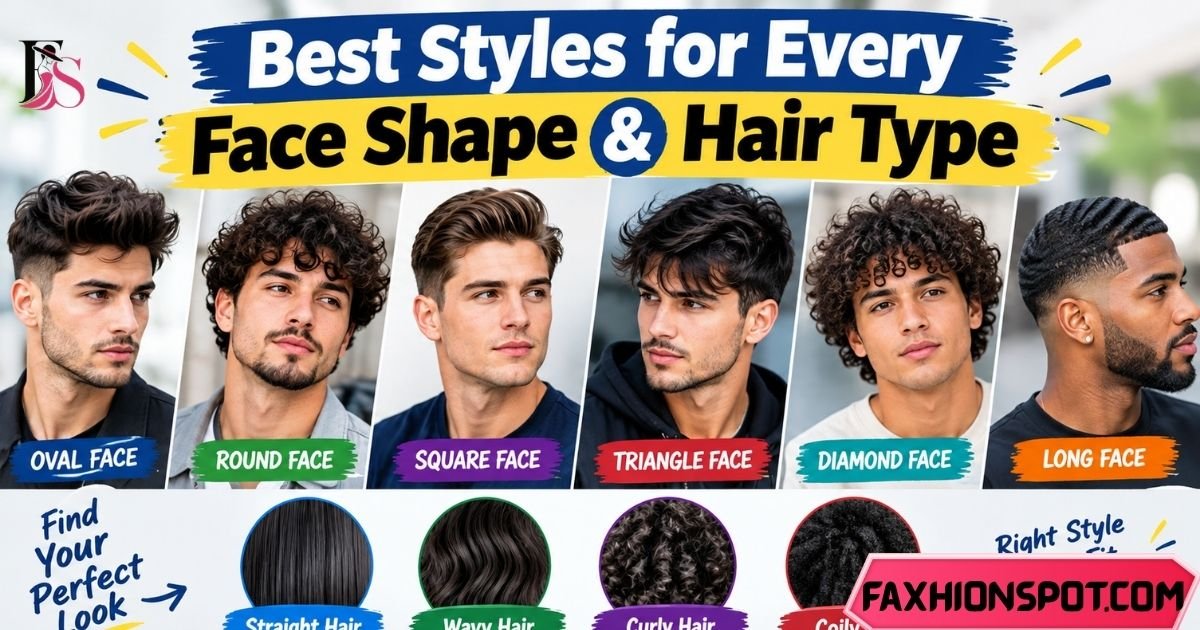
Long hair gives men plenty of styling freedom, but keeping the sides, sideburns, and neckline neat can be challenging.
A low taper fade solves that problem without taking away the length that makes longer hairstyles distinctive. Instead of pushing the taper high into the sides, the barber keeps the transition close to the natural hairline.
This guide covers 35 styles, face-shape recommendations, hair-type advice, barber instructions, styling techniques, products, maintenance, and common mistakes.
What Is a Low Taper Fade with Long Hair, and Who Does It Work Best For?
A low taper fade with long hair keeps the majority of the length on top while gradually reducing the hair around the sideburns, ears, and lower neckline. The transition stays low rather than climbing high up the sides.
It is particularly useful for men who want their longer hair to remain the main feature while maintaining a clean perimeter. The style can be adapted to different textures and face shapes, although the ideal length and styling direction should be customized to the individual.
Quick facts:
- Keeps substantial length on top.
- Cleans up the area around the ears and neckline.
- Works with straight, wavy, curly, and coily textures.
- Can be worn loose or tied back.
- Can be adapted for casual or professional environments.
- Usually requires more frequent taper maintenance than trimming the long top.
What Is a Low Taper Fade with Long Hair?
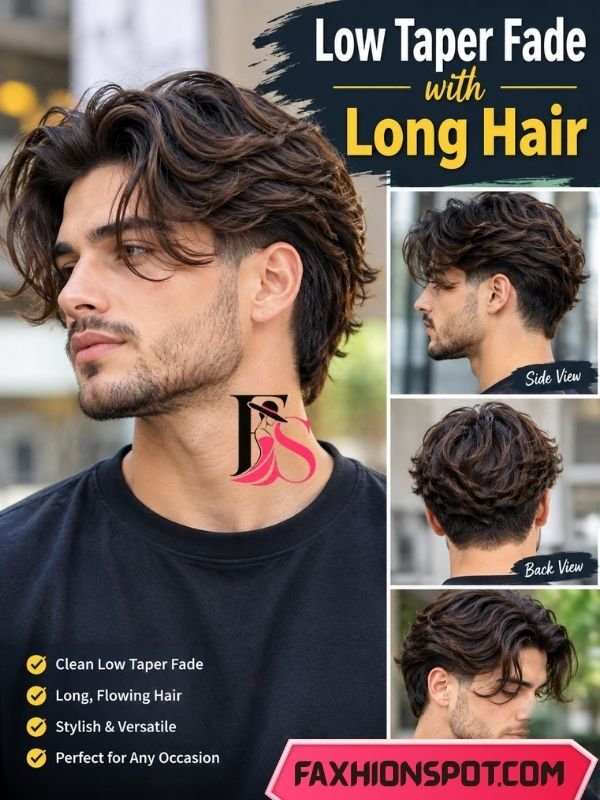
The basic idea is simple: keep the upper and main side sections relatively long while gradually shortening only the lower portions near the ears and neckline.
Unlike a dramatic high fade, this approach preserves more side weight. That creates a softer transition between the longer hair and the tapered area.
The final appearance depends heavily on hair density, growth pattern, texture, and the desired shape. Someone with thick wavy hair may need a different blend from someone with fine straight hair.
How Is a Low Taper Fade Different from a Regular Taper?
A regular taper gradually shortens hair around areas such as the sideburns and neckline. A taper fade generally creates a more noticeable transition toward very short or skin-level hair.
The important distinction is not simply the name but where the transition occurs and how much hair is removed. For longer hairstyles, keeping the transition low helps preserve the visual weight of the longer sections.
Where Exactly Does a Low Taper Fade Start?
The taper normally begins around the lower temple, sideburn, ear area, and neckline rather than extending high toward the upper sides.
The exact starting point varies according to head shape and the barber’s technique. A good barber should examine the natural hairline before deciding how low or tight the blend should be.
Why Is the Low Taper Fade Long Hair So Popular in 2026?
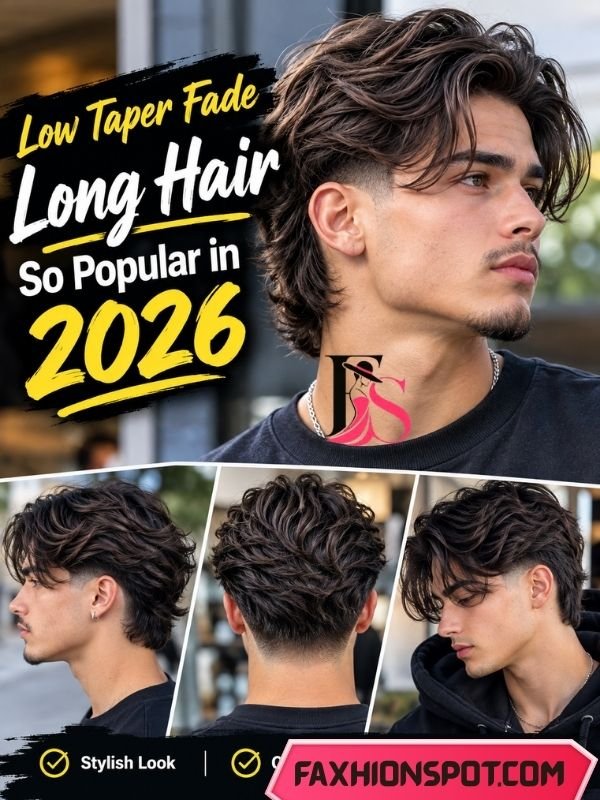
The combination fits the current preference for hairstyles that look polished without appearing overly engineered. Current hairstyle coverage repeatedly highlights natural texture, longer tops, softer transitions, curtains, flow styles, slick backs, curls, and modern mullets.
Another reason is versatility. The same tapered foundation can support very different finishes. You can wear the hair loose on one day, tied into a bun on another, and styled into a slick back for a formal event.
The cut also allows men who are growing their hair out to keep the edges controlled while retaining their progress.
35 Best Low Taper Fade Long Hair Styles for Men
The best variation depends on your hair texture, length, face shape, lifestyle, and willingness to style your hair. These 35 ideas cover classic, modern, textured, retro, and tied-back looks.
Classic Long Hair Styles
1. Long Hair with Low Taper Fade (The Classic)
The classic version leaves the long hair flowing naturally while the lower sides and neckline receive a subtle taper. It is one of the easiest options for men who want a clean haircut without sacrificing length.
Best for: Oval, square, and rectangular faces.
Styling tip: Use a lightweight cream to control flyaways without making the hair stiff.
2. Low Taper Fade with Long Slicked Back Hair
Brush the longer top backward for a polished appearance while keeping the taper understated around the ears and nape.
A water-based pomade can create a controlled finish, while a styling cream works better when you want softer movement.
Best for: Straight or slightly wavy hair.
3. Low Taper Fade with Long Wavy Hair
Natural waves add movement and dimension to the longer top. The taper creates structure underneath without removing the texture that gives the style its personality.
Apply a lightweight mousse or sea salt spray to damp hair and scrunch gently.
Best for: Medium-to-thick wavy hair.
4. Low Taper Fade with Long Straight Hair
Straight hair creates a sleek contrast against the shorter tapered sections. You can wear it loose, parted, brushed backward, or swept to one side.
Avoid excessive thinning if your hair is already fine because removing too much density can make the ends appear sparse.
Best for: Straight, fine-to-thick hair.
5. Low Taper Fade with Long Curly Hair
Long curls can provide impressive volume and shape. The taper removes some visual bulk around the lower edges while allowing the curls on top to remain prominent.
Ask your barber to respect your natural curl pattern rather than cutting the top excessively short.
Best for: Curly and dense hair.
Tied & Pinned Up Styles
6. Low Taper Fade with Man Bun
A man bun pulls longer hair away from the face and creates a strong contrast with the clean lower sides.
You can choose a relaxed bun for everyday wear or a tighter bun for formal occasions.
7. Low Taper Fade with Half-Up Long Hair
The upper portion is tied back while the remaining hair hangs naturally. This option works particularly well when you want your length visible from the back.
It is practical for keeping hair away from the eyes while retaining a relaxed appearance.
8. Low Taper Fade with Slick Back Bun
Comb the front backward before gathering the hair into a bun. The controlled top and clean taper create a sharper silhouette.
A medium-hold product can prevent loose strands without making the entire hairstyle rigid.
Parted & Framed Styles
9. Low Taper Fade with Curtain Hair
Curtain hair divides the front around the center and lets both sections fall naturally toward the sides.
The style works particularly well with medium-to-long straight or wavy hair and can soften angular facial features.
10. Low Taper Fade with Center-Parted Long Hair
A defined center part creates symmetry while the taper keeps the lower edges tidy.
For naturally straight hair, use a blow dryer on low heat to establish the part. Wavy hair can be allowed to follow its natural movement.
11. Low Taper Fade with Side Part
A side part gives long hair a more structured direction. It is especially useful for men who want a longer hairstyle that can transition into office or formal settings.
Use a comb and lightweight pomade for a neat finish.
12. Low Taper Fade with Long Fringe
A long fringe falls toward or across the forehead and can dramatically change the proportions of the face.
A slightly textured fringe generally looks more natural than an excessively rigid one.
Best for: Round, heart, and some oval faces.
Volume & Statement Styles
13. Low Taper Fade with Long Pompadour
The long pompadour builds height at the front and sweeps the hair backward. The taper provides a clean foundation underneath the larger shape.
A blow dryer and round brush are useful for creating lift.
14. Low Taper Fade with Quiff
A long quiff provides height without requiring the dramatic volume of a traditional pompadour.
Lift the front while allowing the rest of the length to move naturally backward.
15. Low Taper Fade with Messy Long Hair
This option intentionally keeps the top relaxed and textured. The clean taper prevents the overall appearance from becoming too bulky around the ears.
Use a matte texturizing cream rather than a high-shine product.
16. Low Taper Fade with Blowout Long Hair
A blowout creates volume and movement throughout the longer sections. The taper gives the style a cleaner perimeter.
Use a heat protectant before blow-drying and avoid excessive heat on the ends.
Retro & Bold Styles
17. Low Taper Fade with Mullet
A modern mullet keeps the front and sides more controlled while allowing length at the back.
The low taper can make the transition less aggressive than a higher fade, especially when the goal is a wearable everyday mullet.
18. Low Taper Fade with Curtain Mullet
Combining curtains with a mullet creates a retro-inspired shape with a modern edge.
The center-parted front frames the face while the longer back adds distinctive length.
19. Low Taper Fade with Comb Over
Long hair can be directed across the top instead of simply falling naturally. A low taper keeps the lower edges controlled while the comb-over creates a polished finish.
This is particularly practical for professional environments.
20. Low Taper Fade with Long Wolf Cut
The wolf cut combines longer layers, texture, and movement. Pairing it with a subtle taper keeps the area around the ears and neckline cleaner.
Avoid excessive layering if your goal is maximum length.
Textured & Cultural Styles
21. Low Taper Fade with Braided Top
Braids offer a protective and visually structured way to manage longer hair. The taper can clean up the sideburns and neckline without interfering with the braided section.
Choose braid size and placement according to hair density and personal preference.
22. Low Taper Fade with Twist Out Top
A twist-out emphasizes natural texture and volume. The tapered lower sections provide contrast without requiring the top to be straightened.
Use moisturizing products designed for your hair’s texture.
23. Low Taper Fade with Long Afro-Textured Hair
Long afro-textured hair can retain significant volume while the taper gives the lower perimeter a cleaner shape.
The most important factor is respecting shrinkage, density, curl pattern, and the natural direction of growth.
2026 Trending Styles
24. Low Taper Fade with Two-Block Cut
The two-block approach separates the fuller upper section from shorter lower areas. Adding a low taper can soften the lower outline while maintaining the longer top.
It works especially well with straight and slightly wavy hair.
25. Low Taper Fade with Fluffy Long Top
A fluffy top emphasizes volume and soft texture rather than sharp definition.
This style is particularly effective for hair with natural density and movement.
26. Low Taper Fade with Textured Long Top
Texture gives long hair separation and movement. Use a lightweight styling product so the strands remain flexible.
Point cutting and careful layering can help create movement without removing excessive length.
27. Low Taper Fade with Ponytail
A ponytail offers a practical option for very long hair. The taper keeps the sideburns and neckline clean while the ponytail preserves the full length.
A low or medium ponytail can change the overall balance of the style.
28. Low Taper Fade with Beach Waves
Beach waves provide a relaxed, textured appearance. Sea salt spray can enhance existing waves, but use it moderately because excessive salt-based products can leave hair feeling dry.
29. Low Taper Fade with Long Side Swept Hair
Sweep the longer hair diagonally across the forehead or away from the face.
This creates asymmetry and can help add visual width or reduce the appearance of excessive facial length.
30. Low Taper Fade with Long Shag Cut
A long shag uses layers and movement to create an intentionally relaxed shape.
The taper keeps the lowest portions cleaner while the shag layers provide volume throughout the top and back.
31. Low Taper Fade for Coily Long Hair
Coily hair can be kept long while the lower perimeter receives a subtle taper.
The cut should account for shrinkage, curl direction, density, and moisture needs rather than treating coily hair like straight hair.
32. Low Taper Fade with Flow Hairstyle
The flow lets longer hair naturally move backward and outward from the head.
It is particularly popular among men who want a relaxed appearance without giving up a groomed outline.
33. Low Taper Fade with Long Faux Hawk
Push the longer hair toward the center to create a subtle faux hawk. Unlike a very short aggressive version, the longer variation can retain considerable movement.
Use matte styling clay for separation and flexible hold.
34. Low Taper Fade with Sleek Long Top
This version focuses on smoothness and controlled direction. Straight or blow-dried hair can create a refined appearance suitable for dinners, events, and professional environments.
A lightweight serum can reduce frizz and enhance shine.
35. Low Taper Fade with Long Natural Texture
The final option keeps styling to a minimum and lets your natural texture lead.
Whether your hair is straight, wavy, curly, or coily, the objective is to clean up the perimeter without changing the character of the top.
Which Low Taper Fade Long Hair Style Suits Your Face Shape?
Face shape should be treated as a guide rather than a strict rule. Hair density, forehead height, jaw width, and personal preference can all change the ideal result.
| Face shape | Helpful styling direction | Styles to consider |
| Oval | Most balanced proportions | Flow, curtains, slick back |
| Square | Keep movement and soften angles | Wavy hair, messy texture, fringe |
| Round | Add vertical height | Quiff, pompadour, textured top |
| Heart | Balance forehead and chin | Fringe, curtains, side sweep |
| Diamond | Add controlled width | Fringe, flow, textured layers |
| Oblong | Avoid excessive height | Side part, fringe, waves |
What Hairstyle Works Best for Oval Face Shape?
Oval faces can accommodate most variations because the proportions are relatively balanced. Flow, curtains, slick backs, and natural texture are all practical choices.
What Hairstyle Works Best for a Square Face Shape?
Wavy, messy, layered, or side-swept styles can soften the strong lines associated with a square face.
What Hairstyle Works Best for a Round Face Shape?
Styles that add controlled height, such as a quiff or textured top, can create more vertical emphasis.
What Hairstyle Works Best for a Heart Face Shape?
A longer fringe, curtains, or side-swept style can help visually balance a broader forehead and narrower chin.
What Hairstyle Works Best for Diamond Face Shape?
Fringe, flow, and controlled side volume can complement the cheekbones while maintaining the face’s natural structure.
What Hairstyle Works Best for a Long or Oblong Face Shape?
Avoid excessive height if you already have a long facial appearance. Side-swept hair, fringe, waves, and moderate volume can create a more balanced visual effect.
How Does the Low Taper Fade Work for Different Hair Types?
The same taper does not look identical on every texture. Your barber should adjust the technique according to density, curl pattern, strand thickness, and natural movement.
Low Taper Fade Long Hair for Straight Hair
Straight hair makes the taper contrast easy to see. Keep enough side weight to prevent the haircut from looking disconnected from the longer top.
A light styling cream or matte paste is often enough for everyday control.
Low Taper Fade Long Hair for Curly Hair
Curly hair benefits from preserving its natural curl pattern. Avoid removing too much length from the top if you want visible curls.
A leave-in conditioner and curl cream can help improve definition while reducing frizz.
Low Taper Fade Long Hair for Coily or Afro-Textured Hair
Coily textures require careful attention to shrinkage and density. The barber should work with the natural shape rather than forcing the hair into a straight-hair template.
Moisture and gentle handling are also important for maintaining healthy-looking longer hair.
Low Taper Fade Long Hair for Fine or Thin Hair
Fine hair can still support a longer style, but excessive thinning may make it appear less dense.
A lightweight volumizing product and strategic layering can create movement without sacrificing too much visual fullness.
What Should You Tell Your Barber for a Long-Hair Low-Taper Fade?
Communication is one of the most important parts of getting the haircut you actually want. Do not rely only on saying “low taper.”
Explain how much length you want to preserve, where you want the taper, and how you normally wear the top.
What Is the Exact Script to Ask for This Cut?
Try this:
“I want to keep my length on top and through the sides. Please keep the taper low around the sideburns, ears, and neckline. I don’t want the taper climbing high into the sides. Keep the natural weight and texture on top, and blend the lower edges smoothly.”
Then explain whether you want a soft, natural, sharp, or skin-close finish.
Which Clipper Guard Sizes Are Used for a Low Taper Fade?
Guard sizes vary by barber, hair density, and desired finish. A typical taper may transition through several lengths rather than relying on one guard.
Do not choose a guard size solely from an online photo. Your barber can determine the appropriate progression based on your hairline and desired result.
What Reference Photos Should You Bring to the Barber?
Bring two or three clear photos showing the front, side, and back whenever possible.
Also show a photo that represents the amount of length you want to keep, because two cuts with similar tapers can look completely different when the top lengths differ.
When Is the Best Time to Book a Barber Appointment?
Book when the taper begins losing its shape but before the lower sections become heavily overgrown.
If you have a specific event, schedule the appointment several days beforehand so you have time to adjust to the finished shape.
How to Pair a Low Taper Fade Long Hair and a Beard
Long hair and facial hair can create a strong overall silhouette. The key is making the transitions look intentional.
A beard does not have to match the haircut exactly. Instead, consider its length, cheek line, neckline, and density in relation to your hairstyle.
Which Beard Style Complements a Low Taper Fade with Long Hair?
Short boxed beards, medium-length natural beards, and neatly trimmed stubble can all work.
If your long hairstyle has significant volume, a fuller beard can create balance. If the hair is sleek and controlled, shorter facial hair can produce a cleaner contrast.
How to Style Low Taper Fade Long Hair: Step-by-Step
Start with clean, towel-dried hair. Apply the product that matches your texture, then shape the hair in the direction you want it to sit.
Use moderate heat if blow-drying and finish with a small amount of styling product rather than repeatedly adding more.
How to Style Long Straight Hair with a Low Taper Fade
- Wash and condition the hair.
- Apply heat protectant if blow-drying.
- Create your desired part.
- Blow-dry in the direction of the style.
- Add a small amount of cream, clay, or pomade.
- Finish with a light serum if extra shine is desired.
How to Style Long Wavy Hair with a Low Taper Fade
- Start with damp hair.
- Apply leave-in conditioner or lightweight mousse.
- Add a small amount of wave-enhancing product.
- Scrunch the hair gently.
- Air-dry or diffuse on low heat.
- Avoid excessive brushing once the waves form.
How to Style Long Curly Hair with a Low Taper Fade
- Begin with damp, conditioned hair.
- Apply curl cream or leave-in conditioner.
- Distribute the product evenly.
- Scrunch upward to encourage curl formation.
- Diffuse on low heat if necessary.
- Avoid repeatedly touching the curls while drying.
Best Products for Low Taper Fade Long Hair
The right product depends on texture and the finish you want.
| Product | Best use | Finish |
| Sea salt spray | Waves and texture | Natural |
| Styling cream | Everyday control | Soft |
| Matte clay | Texture and structure | Low shine |
| Pomade | Slick backs and parts | Medium to high shine |
| Curl cream | Curly hair | Defined |
| Leave-in conditioner | Dry or textured hair | Soft and moisturized |
| Heat protectant | Blow-drying | Protective |
Avoid using a heavy product simply because you want stronger hold. Long hair can quickly become weighed down when too much product is applied.
How to Maintain a Low Taper Fade with Long Hair
Maintenance has two separate parts: preserving the long hair and refreshing the tapered areas.
Your top length may only need occasional trimming, while the taper can become visibly overgrown much sooner.
How Often Should You Get a Low Taper Fade with Long Hair?
Many men refresh the tapered area approximately every two to four weeks, depending on growth speed and how sharp they want the outline.
The longer top can usually follow a separate trimming schedule based on split ends, shape, and growth goals.
At-Home Maintenance Tips Between Barber Visits
- Wash according to your hair type rather than automatically shampooing every day.
- Condition the longer sections regularly.
- Detangle gently, especially when hair is wet.
- Avoid excessive heat.
- Use a heat protectant before hot styling.
- Sleep on a smooth pillowcase if it helps reduce friction.
- Do not repeatedly trim the taper yourself without understanding the blending technique.
Common Mistakes to Avoid with a Low Taper Fade Long Hair
The biggest mistake is asking for a low taper but allowing the blend to travel much higher than intended.
Other common problems include removing too much side weight, over-thinning long hair, ignoring natural texture, copying a style that requires a different hair density, and using too much styling product.
What Are the Most Common Mistakes Men Make with This Haircut?
Taking the taper too high: This can make the haircut look more like a mid or high fade.
Cutting the top too short: You may lose the flowing effect that made you choose long hair.
Ignoring texture: Straight, curly, wavy, and coily hair require different cutting and styling approaches.
Overusing heat: Frequent high heat can contribute to dryness and breakage.
Bringing only one unclear photo: A single front-facing image may not show the taper placement or back shape.
Is the low-taper fade with long hair suitable for professional settings?
Yes. The low placement generally creates a relatively understated outline, which can make it easier to adapt to workplaces with conservative grooming expectations.
For a professional appearance, keep the neckline tidy, control excessive flyaways, and choose a clean style such as a side part, slick back, neat flow, or restrained bun.
How to Style Low Taper Fade Long Hair for Different Occasions
| Occasion | Suggested style | Finish |
| Office | Side part or slick back | Neat |
| Date night | Flow or textured waves | Relaxed |
| Formal event | Slick back or bun | Polished |
| Casual day | Messy texture | Natural |
| Outdoor activity | Ponytail or bun | Practical |
| Creative setting | Wolf cut or curtain style | Expressive |
The Low Taper Fade Long Hair in 2026: History, Culture & Modern Influence
The taper itself is not a new idea. What has changed is how modern barbers combine traditional clean-up techniques with longer, more expressive hairstyles.
Recent hairstyle coverage shows a movement toward keeping more natural texture while using subtle tapering to control the edges. Social media has also helped circulate combinations such as long flows, curtains, textured tops, mullets, curls, and wolf cuts.
The modern interpretation is less about forcing every man into one haircut and more about using a consistent tapered foundation with personalized length and texture.
Low Taper Fade vs. Mid Taper Fade with Long Hair: Which Is Better?
The choice depends on how high you want the transition and how much contrast you prefer.
| Feature | Low taper | Mid taper |
| Transition | Lower | Higher |
| Side weight | More preserved | More reduced |
| Overall contrast | Subtle | Stronger |
| Long-hair appearance | More dominant | More contrasted |
| Grow-out appearance | Generally softer | More noticeable |
| Suitable styles | Flow, curtains, slick back, bun | Mullet, quiff, stronger textured styles |
For someone who wants the longer hair to remain the dominant feature, keeping the taper low preserves more of the original silhouette. A mid taper creates a more noticeable change in the sides.
Expert Barber Tips for the Perfect Low Taper Fade Long Hair
A strong result depends on the relationship between the long top and the tapered perimeter. The taper should support the hairstyle rather than compete with it.
Before cutting, a barber should consider the client’s natural hairline, head shape, density, growth pattern, texture, and desired styling routine.
Click Here To Read Another Topic
What Do Professional Barbers Recommend for This Style?
The most useful practical advice is to communicate length, placement, and finish.
Tell your barber exactly how much length must remain, where you want the taper to begin, and whether you want the blend soft or tight. Reference photos are particularly useful because terminology can vary between barbers and clients.
For longer hair, also explain whether you want the top layered, textured, blunt, or left largely untouched.
Frequently Asked Questions
Is a low taper good for long hair?
Yes. It cleans up the lower edges while allowing the longer sections to remain the main feature.
How long should the top be?
There is no universal length; it can range from several inches to shoulder-length or beyond, depending on the desired style.
Can I get this haircut with curly hair?
Yes. The taper can be adapted to curly hair while preserving the natural curl pattern.
Does a low taper remove a lot of hair?
Usually, the goal is to remove or shorten mainly around the lower sideburn and neckline areas while preserving more overall side weight.
How often should I refresh the taper?
A refresh every two to four weeks is common, although growth speed and preferred sharpness determine the ideal schedule.
Can I wear it with a man bun?
Yes. A bun works particularly well when the top has enough length to gather comfortably.
Is it suitable for thin hair?
It can be, but excessive thinning should be avoided because it may make fine hair look less dense.
Can I have a low taper with a wolf cut?
Yes. The subtle taper can clean up the perimeter while the wolf cut retains its layered texture and movement.
Does a low taper work with an afro?
Yes. The taper can be shaped around afro-textured hair while preserving the desired length and natural volume.
Can I style it for work?
Yes. A neat side part, slick back, controlled flow, or tidy bun can create a more professional appearance.
Should I show my barber a photo?
Absolutely. Photos communicate taper height, top length, texture, and overall shape more clearly than haircut terminology alone.
What is the biggest mistake to avoid?
Do not let the taper climb too high if your goal is to preserve a long-hair silhouette.
Conclusion
The appeal of this haircut comes from its balance. You can keep the length, movement, curls, waves, or natural texture that make long hair distinctive while cleaning up the areas that can quickly become untidy.
The 35 styles above show how flexible the foundation can be. You can choose a classic flow, slick back, curtains, fringe, man bun, ponytail, mullet, wolf cut, textured top, or natural finish depending on your face shape and hair type.
For the best result, focus less on copying a specific photograph and more on communicating the details that matter: keep the desired length, keep the taper low, preserve your natural texture, and make the finish match your lifestyle.