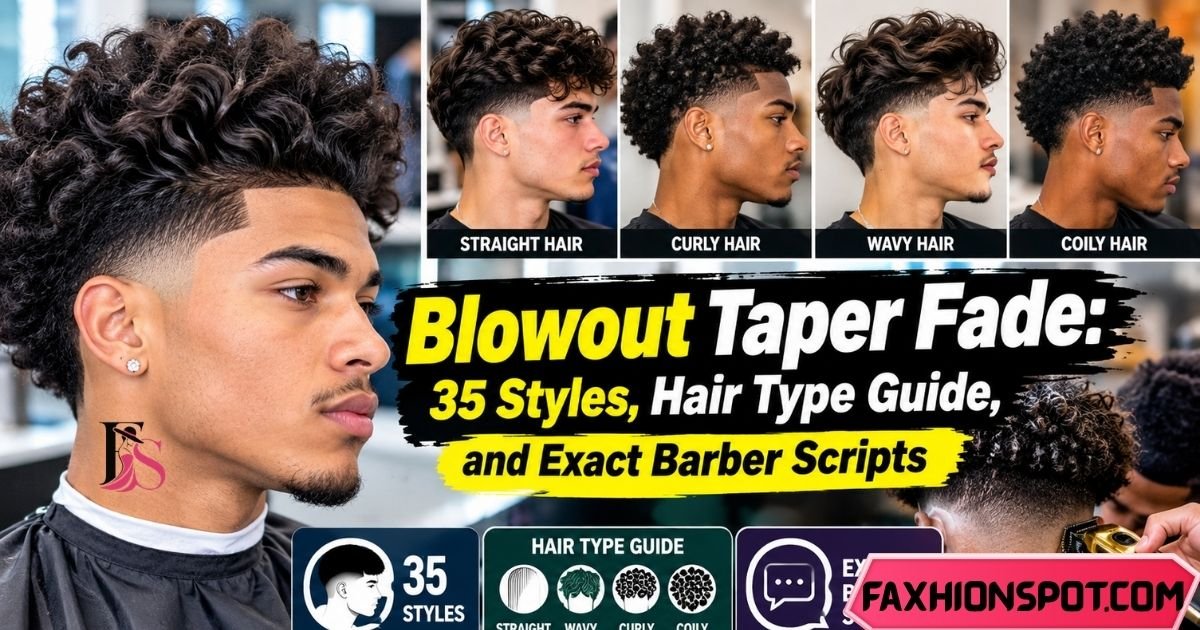
A blowout taper fade combines clean tapered edges with a fuller, lifted top that creates movement and visible volume. The appeal is its flexibility: you can keep the taper subtle around the temples and neckline or create stronger contrast while changing the top to suit straight, wavy, curly, or coily hair.
In 2026, this haircut is less about following one rigid formula and more about customizing the taper height, top length, texture, and styling direction. The same basic cut can look polished, messy, curly, textured, or dramatic depending on how it is shaped.
The most important detail is communication. “Blowout taper” can mean slightly different things to different barbers, so explaining the taper height, top length, and desired finish gives you a much better chance of getting the result you actually want.
What is a blowout taper fade?
It is a haircut built around two elements: tapered or faded edges and a longer, voluminous top. The top is normally blow-dried upward, outward, backward, or according to its natural texture to create the signature airy shape.
Key Points
- Low, mid, and high versions create different levels of contrast.
- Straight hair usually needs more blow-drying and product.
- Wavy and curly hair can create volume naturally.
- Coily hair can be shaped with a pick, sponge, diffuser, or controlled blow-dry.
- Top length is essential because excessive cutting can remove the volume needed for the style.
- A reference photo can prevent confusion between a taper, fade, and temple fade.
- Maintenance usually depends more on taper height and personal preference than on the top itself.
- The haircut can be adapted to different face shapes, densities, and styling routines.
What Is a Blowout Taper Fade?
A blowout taper fade is essentially a volume-focused haircut with progressively shorter hair around selected perimeter areas, especially the temples, sideburns, and neckline. The longer top is then styled to create height, fullness, movement, or outward flow.
The “blowout” describes the shape and styling rather than one exact cutting measurement. A barber may leave several inches on top while concentrating the taper around the edges. Another may create a stronger fade across more of the side panel. That is why describing the result you want is more useful than relying only on the haircut name.
The overall effect comes from contrast. Clean edges make the top appear fuller, while the longer hair provides the visual movement that separates this style from a conventional short taper.
35 Blowout Taper Fade Variations
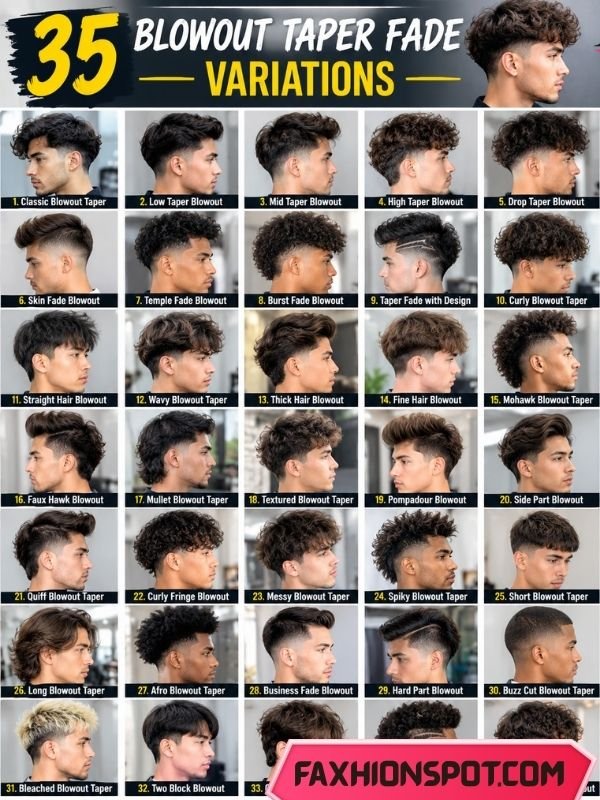
There is no single version that works for everyone. The following 35 variations cover different taper heights, textures, lengths, fringe directions, and finishing techniques.
Low Taper Blowout Variations
1. Classic Low Blowout
A subtle taper begins around the sideburns and neckline while most of the side length remains intact. It is a strong choice for someone wanting volume without an aggressive fade.
2. Low Textured Blowout
The top is cut with enough separation to create a deliberately messy finish. Matte clay or texture powder can emphasize individual strands.
3. Low Blowout With Fringe
Instead of pushing everything backward, the front is directed slightly forward. This creates a softer, youthful silhouette.
4. Low Curly Blowout
Natural curls provide the lift, while the taper cleans the perimeter. The top can be shaped without trying to straighten the curl pattern.
5. Low Blowout With Beard Blend
The taper transitions naturally into the sideburn and facial hair. This creates a connected appearance without making the haircut overly sharp.
6. Low Blowout With Line-Up
A controlled hairline adds definition around the forehead while the top retains its loose volume.
7. Low Blowout Slick Back
The top is longer and directed backward with a blow dryer and light styling product. It offers a cleaner alternative to a messy finish.
8. Low Blowout With Long Top
Extra length creates a larger silhouette and more movement. This version requires more styling time but offers greater flexibility.
9. Low Blowout With Design
A small shaved design can be added near the taper without changing the basic structure of the haircut.
Mid Taper Blowout Variations
10. Classic Mid Blowout
The taper sits higher than a low version, giving the sides more contrast while leaving the top dominant.
11. Mid Textured Blowout
Texture is distributed through the top to create separation and movement rather than one solid mass.
12. Mid Curly Blowout
Curly hair is allowed to expand naturally while the sides are controlled through a cleaner taper.
13. Mid Wavy Blowout
Natural waves are enhanced with controlled drying and lightweight texture products.
14. Mid Blowout With Fringe
The front is pushed forward or slightly diagonal while the crown receives upward volume.
15. Mid Blowout Slick Back
The top is brushed backward for a polished finish. This works especially well when the hair has enough natural density to maintain shape.
16. Mid Blowout With Beard
The sideburn taper is connected to the beard for a more complete grooming profile.
17. Mid Blowout With Hard Part
A defined part creates visual structure while the blow-dried top provides softness and volume.
18. Mid Blowout With Skin Finish
The lowest portion can be reduced very short for greater contrast. This version requires more frequent maintenance.
19. Mid Blowout Perm
A perm can add lasting wave or curl to straighter hair, increasing the top’s natural movement.
High Taper Blowout Variations
20. High Blowout
The taper rises farther up the sides, creating a stronger difference between the short perimeter and the longer top.
21. High Textured Blowout
The top is heavily separated and styled for a deliberately rugged appearance.
22. High Curly Blowout
Natural curls sit prominently above the tighter sides, creating a high-contrast silhouette.
23. High Blowout With Fringe
The front remains longer and can be worn forward, creating a strong contrast between fringe and tapered sides.
24. High Blowout With Design
A shaved line or geometric detail adds an expressive element to the higher taper.
25. High Blowout With Line-Up
A sharp front edge balances the dramatic sides and helps frame the face.
26. High Blowout With Beard
The high taper transitions into facial hair, creating a connected, structured appearance.
27. High Blowout With Long Top
Extra top length allows large volume and more styling options, although it also increases daily maintenance.
Specialty Blowout Taper Variations
28. Afro Blowout
The top retains substantial natural volume while the perimeter is shaped and cleaned up. The result emphasizes texture rather than forcing the hair into a straight blowout.
29. Coily Blowout
Coily hair can be lifted with a pick or diffuser and shaped into a controlled rounded silhouette.
30. Wavy Messy Blowout
Natural wave is paired with a loose, deliberately imperfect finish for a relaxed appearance.
31. Straight Hair Blowout
Straight hair is lifted at the roots with a round brush or controlled blow-drying technique. Volumizing mousse can help fine or flat hair.
32. Short Blowout
The top is kept relatively compact, making this a practical choice for people who want the visual idea of a blowout without long hair.
33. Long Blowout
A longer top creates dramatic movement and can be worn backward, sideways, or forward.
34. Blowout With Textured Crop
The top combines blowout volume with a shorter, separated crop-like front. It is useful when you want texture without excessive length.
35. Blowout With Natural Finish
Instead of creating maximum height, the hair is dried according to its natural direction. The result looks softer and requires less product.
Which Blowout Taper Fade Suits Your Hair?
Your texture determines how easily the top creates volume and how much daily styling you need. Current barber guides consistently note that straight, wavy, curly, and coily textures can all work, but the technique changes with each one.
Straight Hair
Straight hair usually needs the most help with volume. Use a blow dryer at the roots and direct the hair upward or backward with a round brush.
A lightweight mousse or volumizing spray can add body without making the hair greasy or heavy.
Curly Hair
Curly hair already has natural lift, so the goal is usually definition and direction rather than creating volume from zero.
A diffuser and curl cream can preserve the curl pattern while keeping the tapered edges clean.
Wavy Hair
Wavy hair is particularly versatile because it naturally combines movement and body. A sea salt spray or lightweight styling cream can emphasize the wave without creating excessive stiffness.
Afro-Textured or Coily Hair
Coily and Afro-textured hair can produce impressive natural volume. The barber should work with the curl pattern instead of removing too much density from the top.
Depending on the desired shape, a pick, sponge, diffuser, or controlled blow-dryer technique can create lift.
Fine or Thin Hair
Fine hair benefits from strategic length. Leaving too much weight can make it collapse, while cutting it too short can make the top appear even less dense.
Volumizing mousse, root-lifting products, and matte styling products are generally more useful than heavy pomades.
Choosing by Hair Density
| Hair density | Recommended approach |
| Fine | Keep moderate top length and use lightweight volume products |
| Medium | Most variations are possible |
| Thick | Use texture and controlled weight removal |
| Very thick | Ask the barber to preserve shape without creating excessive bulk |
| Curly/coily dense | Maintain natural volume while controlling the perimeter |
What Face Shape Suits This Cut?
The style can be adjusted for most face shapes because the top volume and taper height are customizable.
| Face shape | Helpful approach |
| Oval | Most variations work |
| Round | Add controlled height and avoid excessive width |
| Square | Textured or rounded volume can soften the overall profile |
| Oblong | Avoid extreme vertical height; keep some side fullness |
| Heart | Moderate top volume can balance a narrower chin |
| Diamond | Controlled width and textured movement can complement the cheekbones |
The goal is not to follow a rigid face-shape rule. Your hair density, natural growth pattern, and preferred styling routine also matter.
How Long Does Your Hair Need to Be?
There is no universal minimum length because texture changes how much visible volume you get. However, many versions work better when the top has enough length to lift and move rather than sitting flat.
As a practical starting point:
- Short version: around 2–3 inches on top
- Medium version: around 3–4 inches
- Fuller version: around 4–5+ inches
- Long version: 5 inches or more
Some stylists recommend keeping four inches or more through the top and front when the goal is a pronounced, fluffy silhouette.
How Do You Ask Your Barber?
Do not simply say the haircut name and expect an identical result. Different barbers can interpret “blowout,” “taper,” and “fade” differently.
Bring a reference image and explain three things: where you want the taper, how much length you want on top, and how you plan to style it.
The 4-Part Barber Script
Use this four-part formula:
- Taper height: “I want a low, mid, or high taper.”
- Top length: “Leave about ___ inches on top.”
- Texture: “Keep it smooth, textured, curly, or natural.”
- Finish: “I want the top blown up, back, forward, or outward.”
A useful general script is:
“I want a medium-height taper around the temples and neckline. Leave enough length on top for volume and movement. Keep the sides blended rather than taking the fade too high, and show me the shape before removing extra length.”
Scripts for Each Variation
Low version:
“Give me a low blowout taper. Keep the taper close to the sideburns and neckline, leave the sides fuller, and keep enough top length for volume.”
Mid version:
“Give me a mid blowout taper with about three to four inches on top. Keep the blend smooth and leave enough texture for a lifted finish.”
High version:
“I want a high blowout taper with stronger contrast. Keep the top full and textured, but make the transition clean rather than overly harsh.”
Curly version:
“Keep my natural curls on top and shape the perimeter with a clean taper. Don’t remove too much curl density because I want the top to stay full.”
Straight version:
“Leave enough length for a round-brush blowout. Keep the taper clean around the temples and neck, and don’t over-thin the top.”
Long version:
“Keep the top long enough to move backward and outward. Clean up the taper but don’t sacrifice the length I need for styling.”
Common Client Mistakes to Avoid
Avoid these common problems:
- Asking for “a fade” without explaining the height.
- Showing only one front-facing picture.
- Forgetting to tell the barber how you style your hair.
- Allowing too much top length to be removed.
- Confusing a temple taper with a full side fade.
- Asking for maximum volume when your hair naturally lacks density.
- Ignoring your cowlick or natural growth direction.
- Not explaining whether you want a natural or sharp hairline.
How Do You Style It at Home?
Styling is where the haircut gets its signature shape. A good cut can still look flat if the top is allowed to dry without direction.
Simple styling routine
- Start with towel-dried, damp hair.
- Apply a small amount of volumizing mousse or lightweight styling product.
- Use a blow dryer while lifting the roots.
- Direct the hair upward and outward with your fingers or a round brush.
- Work section by section instead of blasting the entire top randomly.
- Let the hair cool briefly after shaping.
- Add a small amount of matte clay, cream, or texture product.
- Finish with light hairspray if extra hold is required.
For straight hair, the brush creates most of the lift. For curly or coily hair, a diffuser or natural-texture technique may work better.
Avoid applying too much heavy product. Excessive pomade or wax can flatten the roots and remove the airy effect that makes the haircut distinctive.
How Often Do You Need a Trim?
Most people can expect to refresh the edges roughly every 2–4 weeks, depending on taper height, hair growth, and how precise they want the haircut to look.
A low taper generally allows more forgiving grow-out because less of the side panel has been shortened. Higher or skin-level versions show regrowth sooner and usually need more frequent maintenance.
What Does Grow-Out Look Like?
As the hair grows, the sharp contrast around the temples and neckline gradually becomes softer. Low versions typically blend into the surrounding hair more naturally, while higher cuts can show the returning length more quickly.
If you want to extend the time between appointments, ask your barber for a softer taper rather than an extremely tight skin finish.
How Is It Different From a Taper Fade?
A conventional taper fade focuses primarily on progressively shortening the edges. The defining feature here is the combination of that clean perimeter with a deliberately voluminous, blown-out top.
A full fade may remove much more hair across the sides. A taper generally concentrates the shortest area around specific perimeter zones. Terminology also varies between barbers, so the exact coverage should always be discussed before cutting.
| Feature | Blowout taper fade | Classic taper | Full fade |
| Main focus | Volume + tapered edges | Clean gradual edges | Strong side contrast |
| Top | Usually longer | Flexible | Flexible |
| Volume | Important | Optional | Optional |
| Side coverage | Depends on variation | More retained | More removed |
| Styling | Usually required | Often simpler | Depends on top |
| Grow-out | Depends on height | Generally forgiving | More visible |
Click Here To Read Another Topic
Is It Still Trending in 2026?
Yes, the style remains prominent in current men’s hairstyle coverage, with 2026 guides continuing to feature low, mid, high, curly, wavy, textured, and specialty versions. Recent grooming coverage also emphasizes customization rather than one fixed formula.
Its continued appeal comes from versatility. The same foundation can be made subtle enough for everyday wear or pushed toward a more dramatic social-media-inspired silhouette.
More importantly, current styling advice treats the haircut as a combination of cut + texture + styling, rather than assuming the taper alone creates the finished look.
Frequently Asked Questions
What is a blowout taper fade?
It combines tapered or faded edges with a longer top styled for lift, movement, and volume.
Is a blowout taper fade good for straight hair?
Yes. Straight hair can work well, but it usually needs more blow-drying and root-lifting product to maintain volume.
Is this haircut good for curly hair?
Yes. Curly hair can create natural volume, while the taper keeps the temples, sideburns, and neckline controlled.
How long should the top be?
A practical starting point is around 3–4 inches, although shorter and longer versions can work depending on texture and the desired silhouette.
Is a low or high taper easier to maintain?
A low taper is generally more forgiving during grow-out, while a higher taper can show regrowth sooner.
Can thin hair get this haircut?
Yes, but the top should be cut strategically. Lightweight volumizing products and controlled blow-drying can make fine hair appear fuller.
Should I bring a picture to my barber?
Absolutely. A reference image combined with instructions about taper height, top length, and texture is usually clearer than the haircut name alone.
Can I style it without a blow dryer?
You can, but the signature volume may be reduced. Wavy, curly, and coily hair can often achieve a fuller shape with less heat.
How often should I get it cleaned up?
Around every 2–4 weeks is a useful starting point, with higher or tighter versions generally needing more frequent attention.
Is a blowout taper the same as a blowout fade?
Not always. A taper usually concentrates shortening around the perimeter, while a fade can extend farther across the side panel. Barber terminology varies, so specify the coverage you want.
Conclusion
The modern blowout taper fade is best viewed as a customizable haircut rather than one fixed style. The taper height, top length, hair texture, density, face shape, and styling routine all influence the final result.
For a softer everyday appearance, a low version with moderate top length is a practical starting point. If you want stronger contrast, a mid or high variation can create a more noticeable silhouette. Curly, wavy, straight, and coily hair can all work when the cutting and styling techniques are adapted to the texture.
Most importantly, tell your barber exactly where you want the taper, how much length should remain on top, and how you intend to style it. Add a clear reference photo, and you will give your barber far more useful information than the haircut name alone.