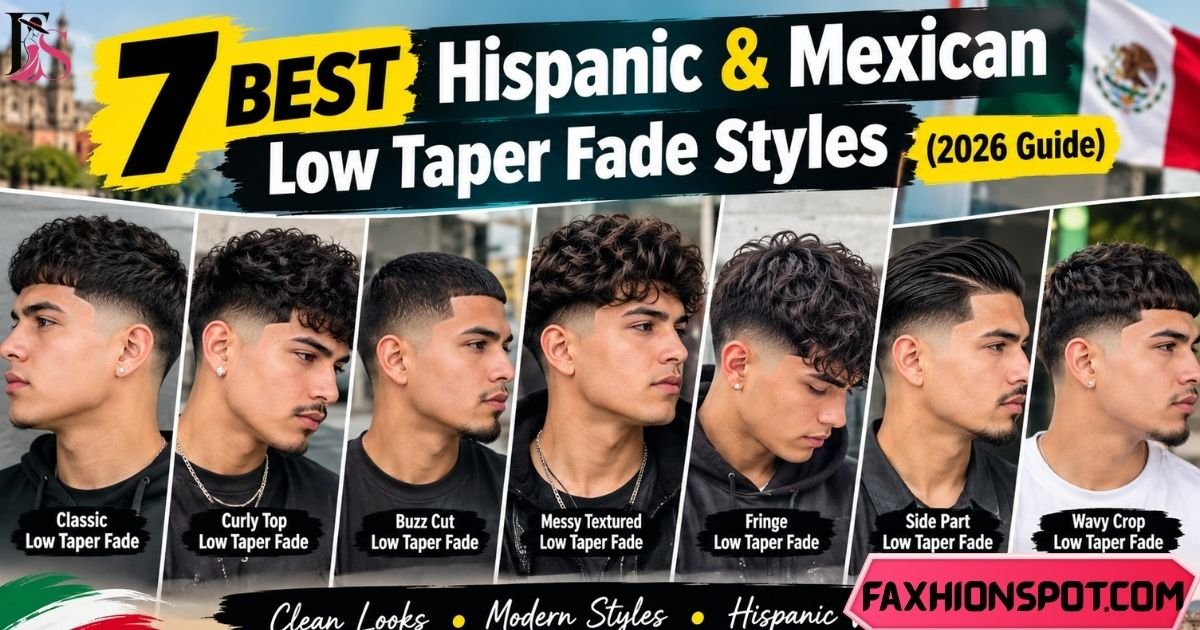
The Hispanic & Mexican low taper fade has become a popular men’s haircut because it combines a clean, controlled taper with natural texture and plenty of styling flexibility.
This guide covers seven wearable styles, the differences between Hispanic and Mexican-inspired approaches, barber instructions, maintenance, cost, and face-shape recommendations.
What Is a Low Taper Fade?
A low taper fade gradually shortens the hair around the sideburns, temples, ears, and neckline while keeping most of the sides and top fuller. The transition starts low instead of moving high toward the temples. This creates a subtle contrast and preserves more natural weight around the head.
Unlike a high fade, which removes considerably more hair from the sides, a low taper concentrates the shortest section near the edges. Depending on the desired finish, a barber may use a #0.5, #1, or skin-level finish before blending upward.
The Hispanic & Mexican low taper fade is generally used to describe a low taper combined with styling details frequently seen in Latino and Mexican-American barbering, such as sharp lineups, textured tops, curls, fringes, longer backs, or carefully shaped facial hair.
Low taper fades are popular because they:
- Keep the sides clean without removing too much bulk.
- Work with straight, wavy, curly, and thick hair.
- Allow many different top styles.
- Grow out more softly than some higher fades.
- Can look appropriate in casual and professional settings.
- Work well with lineups, beards, fringes, curls, and textured tops.
- Give you flexibility without requiring an extremely short haircut.
Because the fade remains low, many men can also stretch appointments longer than they might with a very tight high fade. Several current barber guides place refreshes roughly in the two-to-four-week range, depending on the guard length and desired sharpness.
Hispanic Low Taper Fade:
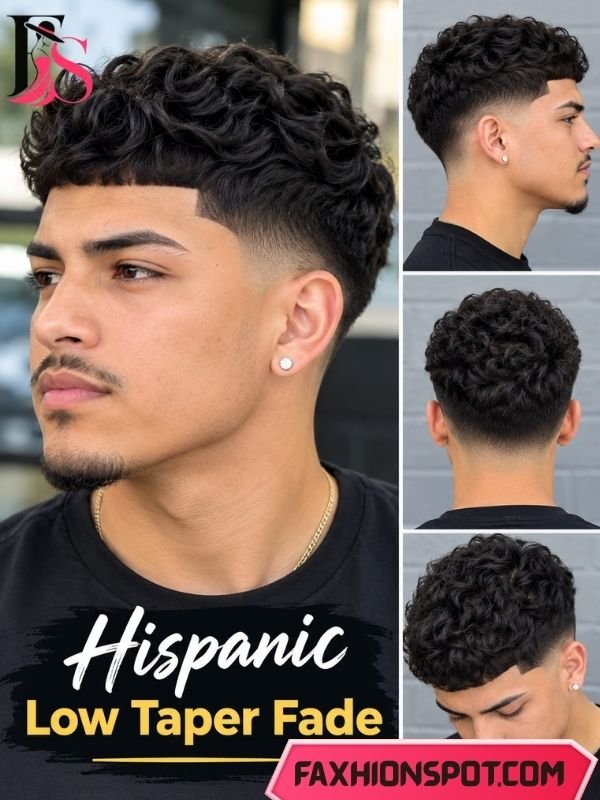
A Hispanic low taper fade is not a single standardized haircut. “Hispanic” describes a broad cultural and linguistic category that includes people with many different hair textures and grooming traditions.
In practice, the style usually refers to a low taper combined with a neat shape, natural volume, clean edges, and a personalized top. A barber may adapt the cut to straight, dense, wavy, or curly hair rather than following one fixed formula.
Key Features
Common features include:
- Low taper around the temples and neckline
- Natural-looking volume on top
- Clean sideburns
- Defined hairline or lineup when requested
- Textured, curly, wavy, or brushed-back top
- Optional beard connection
- Controlled but not necessarily skin-tight sides
The Hispanic & Mexican low taper fade can therefore look very different from one person to another. The underlying taper placement stays similar, while the top and finishing details create the individual character.
Best For
This approach works particularly well for men who want a polished haircut without losing the natural shape of their hair.
It can be a strong option for:
- Straight, thick hair
- Loose waves
- Natural curls
- Medium-length textured hair
- Men who prefer subtle fades
- Students and professionals
- Men who want a haircut that can be dressed up or down
The most important point is that the haircut should be customized to the individual rather than selected solely because of ethnicity. Current style guides repeatedly emphasize hair density, texture, growth direction, and face shape as important factors.
Mexican Low Taper Fade:
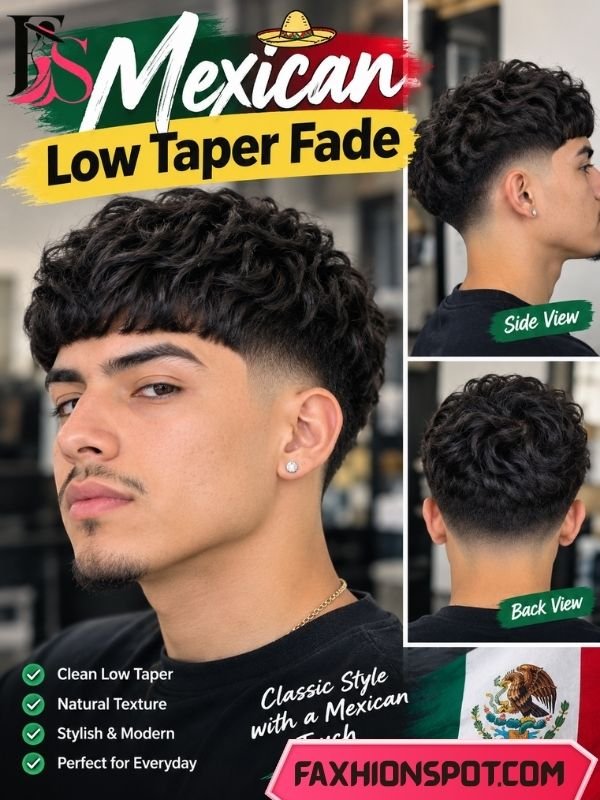
The Mexican low taper fade generally uses the same low taper foundation but may be paired with more distinctive Mexican and Mexican-American-inspired styling details.
Popular combinations include textured crops, Edgar-inspired fringes, curly tops, sharp lineups, mullet-inspired backs, and takuache-influenced shapes. The exact look varies significantly by person and region.
Key Features
Typical details can include:
- Low taper around the ears
- Clean neckline
- Defined temples
- Strong lineup
- Textured or voluminous top
- Fringe or Edgar-inspired front
- Curly or wavy texture
- Optional longer back
- Beard or mustache integration
The Hispanic & Mexican low taper fade can be especially versatile because the low taper does not dictate the entire haircut. You can keep the top short and textured or grow it considerably longer.
A takuache-inspired version, for example, may incorporate a longer back, fringe, and faded sides. Contemporary versions can soften the overall effect by using a low rather than a higher taper.
Best For
The Mexican-inspired variation can suit men who enjoy:
- Textured hairstyles
- Stronger hairline definition
- Edgar-inspired cuts
- Curly tops
- Longer backs
- Mullet-inspired silhouettes
- Bold but controlled barbering details
If you prefer a conservative haircut, the same low taper foundation can be kept simple by reducing the amount of fringe, design work, and contrast.
Hispanic vs Mexican Low Taper Fade
The two terms overlap heavily, and there is no universal barbering standard that officially separates them. In many online haircut guides, the distinction is mainly about styling direction rather than a different fading technique.
| Feature | Hispanic-Inspired | Mexican-Inspired |
| Taper placement | Low | Low |
| Overall appearance | Natural and versatile | Can be sharper or more expressive |
| Top | Texture, curls, waves, combed styles | Texture, fringe, curls, Edgar or longer styles |
| Lineup | Optional | Frequently emphasized |
| Hair length | Short to medium/long | Short to longer |
| Best setting | Casual, school, office | Casual, social, creative |
| Styling intensity | Low to moderate | Moderate to high |
| Customization | Very high | Very high |
Rather than treating one label as universally better, consider the actual haircut you want. A picture showing the desired taper height, top length, hairline, and texture will usually communicate more effectively than simply saying “Hispanic fade” or “Mexican fade.”
Popular Hispanic & Mexican Low Taper Fade Styles
Here are seven practical variations worth considering in 2026.
1. Classic Low Taper With Lineup
The classic version keeps the sides relatively full while the taper cleans the area around the ears, temples, and neckline.
Add a crisp lineup if you like a sharper finish. Keep the top natural for a low-maintenance haircut that can work for school, work, or everyday wear.
The Hispanic & Mexican low taper fade works especially well here because the taper provides structure without overwhelming the natural top.
Best for: Straight, wavy, or moderately thick hair.
2. Curly Low Taper Fade
A curly low taper keeps the curls on top while cleaning up the lower sides and neckline. This creates a strong texture-versus-structure contrast without removing the character of the curls.
Curly hair should not automatically be treated like straight hair. The barber needs to account for shrinkage, curl direction, density, and how the curls fall naturally.
For a defined finish, ask for the curls to remain longer on top and avoid taking too much weight away from the upper sides.
Best for: Curly and coily textures.
3. Textured Crop With Low Taper
A textured crop combines a short, choppy top with a subtle taper around the edges.
This is useful for men who want movement without spending a lot of time styling their hair. A small amount of matte clay or texture product can emphasize individual pieces.
The Hispanic & Mexican low taper fade foundation keeps the haircut neat while allowing the textured top to become the main feature.
Best for: Thick, straight, and wavy hair.
4. Low Taper With Edgar-Inspired Fringe
The Edgar-inspired variation uses a more defined front while keeping the taper low around the sides.
The front can be blunt and structured or slightly softer depending on your preference. Straight hair often makes the fringe appear especially crisp, while wavy hair can produce a more relaxed version.
If you want a conservative version, ask for a softer fringe rather than an extremely sharp horizontal line.
Best for: Straight and dense hair.
5. Low Taper Blowout
A blowout adds volume and direction to the top while the taper controls the edges.
This creates more visual height and a more noticeable silhouette. Use a blow dryer and lightweight styling product to push the top upward and away from the head.
The Hispanic & Mexican low taper fade becomes more dramatic when combined with a voluminous blowout, making this a useful choice for someone who enjoys a styled appearance.
Best for: Thick, wavy, and coarse hair.
6. Curly or Wavy Top With Beard
A low taper can transition neatly into facial hair when the sideburn area is carefully blended.
The goal is not necessarily to make the beard disappear. Instead, the barber can gradually connect the head hair and beard so there is no distracting hard break.
The Hispanic & Mexican low taper fade can look particularly balanced with a short beard because the low taper keeps the haircut from becoming too disconnected.
Best for: Curly, wavy, and thick hair with facial hair.
7. Takuache-Inspired Low Taper
A takuache-inspired haircut can combine a low taper with a longer back, fringe, and strong shape.
The style has connections with Mexican-American youth culture and the broader takuache aesthetic. Modern versions can be customized so the taper is lower and less aggressive while maintaining the longer-back silhouette.
This is one of the more expressive options, so show your barber a front, side, and back reference image before cutting.
Best for: Men who want a distinctive, fashion-forward haircut.
Face Shape & Hair Type Guide
Your face shape and hair characteristics should influence the final version. The same taper can look noticeably different when the top length or volume changes.
Face Shapes
| Face Shape | Suggested Approach |
| Oval | Most top styles can work |
| Round | Add controlled height and texture |
| Square | Textured or classic styles complement strong angles |
| Oblong | Avoid excessive height; maintain some side volume |
| Heart | Balanced top with moderate side fullness |
| Diamond | Textured top with controlled side shape |
For a round face, excessive width at the sides can make the face appear wider, so controlled volume on top can create a more balanced silhouette.
For an oblong face, avoid pushing all the volume vertically. Keeping some natural side fullness can provide better visual proportion.
Hair Types
Straight hair:
A classic taper, textured crop, fringe, comb-over, or slicked-back top can work well. Straight hair also makes clean blending particularly visible.
Wavy hair:
Leave enough length for the wave pattern to develop. A textured top can create natural movement without requiring heavy styling.
Curly hair:
Preserve curl length and definition. The taper should frame the curls rather than remove too much of the side structure.
Thick or coarse hair:
A low taper can remove visual bulk around the edges while leaving enough density on top for volume.
Fine hair:
Use texture strategically. Excessive thinning can make fine hair appear less dense, so discuss the desired top shape with your barber.
Current guides generally agree that the taper itself is adaptable across hair types, but the cutting and styling approach should change according to texture.
How to Ask Your Barber
The easiest way to get the haircut you want is to describe the taper placement and top separately.
Instead of only saying “Give me a Hispanic or Mexican fade,” explain exactly what should happen around the sides.
Choose:
- Taper height: Tell the barber you want it low.
- Bottom length: Choose skin, #0, #0.5, #1, or another guard level.
- Side fullness: Say whether you want the hair above the taper kept full.
- Top length: Give an approximate length or show a photo.
- Texture: Explain whether you want curls, waves, messy texture, or a smooth finish.
- Hairline: Decide whether you want a natural edge or sharp lineup.
- Neckline: Choose natural, tapered, or squared.
- Beard: Tell the barber whether the sideburn should connect to the beard.
A useful barber script is:
“I want a low taper around the temples, sideburns, and neckline. Keep the sides above the taper full. Leave the top at my current length and keep its natural texture. Blend everything smoothly and give me a clean but natural hairline.”
For a bolder version:
“Keep the taper low, leave the top textured, sharpen the lineup, and keep the transition clean around the ears and neckline.”
Photos remain especially useful because haircut terminology can vary between barbershops.
Styling & Care Tips
A good cut still needs appropriate maintenance.
For straight hair:
- Use a lightweight pomade or matte product.
- Comb the top in the desired direction.
- Avoid applying too much product near the roots.
For wavy hair:
- Use a lightweight cream or texture product.
- Let the natural wave pattern remain visible.
- Avoid aggressive brushing when dry.
For curly hair:
- Use a curl-friendly cream or leave-in product.
- Avoid excessive touching while the curls dry.
- Maintain moisture to reduce unwanted frizz.
For textured styles:
- Use a matte clay, paste, or texture powder.
- Apply small amounts rather than one large amount.
- Use your fingers to separate the top.
The Hispanic & Mexican low taper fade is relatively flexible because the taper itself requires little styling. Most of your daily effort will be determined by the top.
Cost & Touch-Ups
Prices vary considerably by location, barber experience, shop type, and additional services.
| Service | Typical consideration |
| Basic low taper | Lower cost |
| Taper + lineup | Moderate |
| Taper + beard | Moderate to higher |
| Detailed design | Higher |
| Premium barbershop | Higher |
| Regular touch-up | Usually cheaper than a full restyle |
For upkeep, many men return every 2 to 4 weeks depending on how sharp they want the edges. A skin-level taper may need more frequent refreshing, while a #0.5 or #1 can remain visually softer for longer.
If you are trying to extend the time between visits, a natural taper without an extremely sharp lineup may age more gracefully.
Do & Don’t Tips
Do
- Bring clear reference photos.
- Tell your barber exactly how low you want the taper.
- Explain how much top length you want to preserve.
- Consider your natural hair texture.
- Ask for a gradual blend.
- Maintain the neckline and sideburns.
- Use products designed for your hair type.
Don’t
- Assume “Mexican fade” means one universal haircut.
- Ask for a skin fade when you actually want a subtle taper.
- Let the barber remove too much top length without discussing it.
- Ignore curl shrinkage.
- Overuse heavy styling products.
- Expect a sharp lineup to stay perfect for several weeks.
- Choose a style only because it looks good on someone with a different hair texture.
The Hispanic & Mexican low taper fade should be treated as a customizable foundation rather than a one-size-fits-all haircut.
Final Summary:
The Hispanic & Mexican low taper fade offers a flexible way to keep the sides and neckline clean while preserving the natural character of the hair on top..
The key difference between the Hispanic and Mexican labels is not a universally defined fading technique. Both can use the same low taper foundation, while the top, lineup, texture, fringe, and overall styling create different appearances.
For the best result, focus less on the label and more on the details: taper height, guard length, top length, texture, hairline, neckline, and face shape. A reference photo and clear barber instructions can make the final result much closer to what you expect.
Frequently Asked Questions
Are Hispanic and Mexican low taper fades the same?
They can be very similar because both use a low taper foundation, but styling details can vary. “Hispanic” is broader, while Mexican-inspired versions may include specific fringe, Edgar, textured, or takuache influences.
Which is better for office jobs?
A subtle low taper with a natural top, moderate lineup, and controlled styling is generally easier to adapt to a professional workplace than an extremely bold design or exaggerated fringe.
Which looks bolder?
A version with a sharp lineup, strong fringe, blowout volume, or longer takuache-inspired back usually creates more visual contrast than a classic low taper.
Are both good for curly hair?
Yes. A low taper works well with curls when the barber preserves enough length and definition on top while cleaning the edges around the ears and neckline.