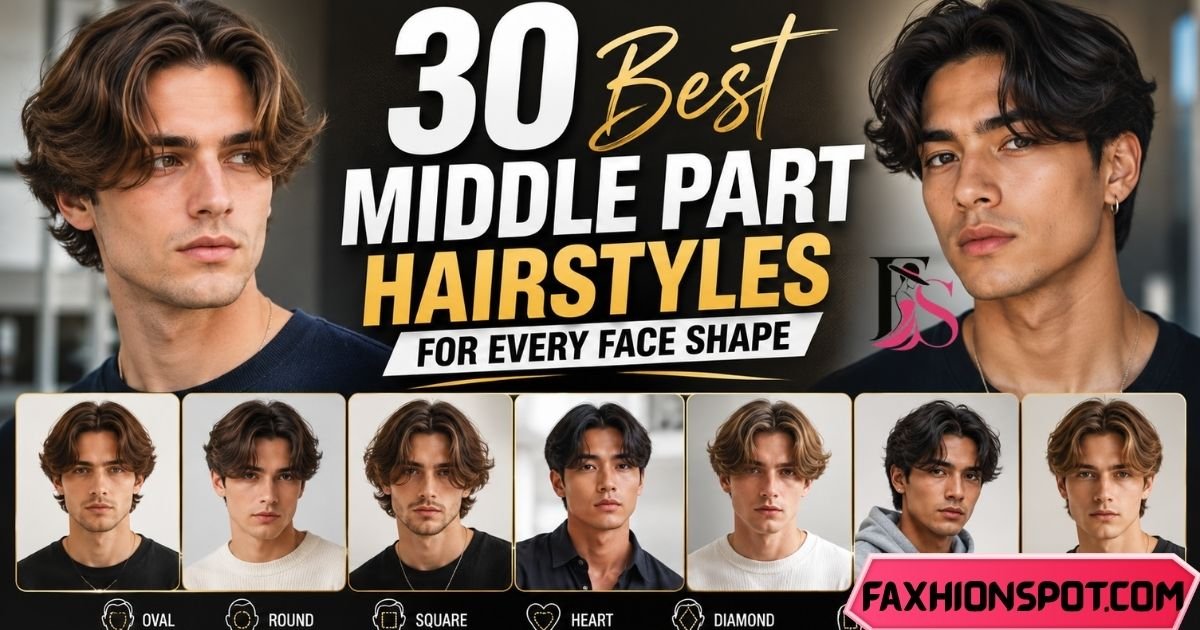
A great haircut can completely change the way your face looks, and the right center part is one of the easiest ways to create a balanced, stylish appearance. From classic curtains and flowing layers to modern fades, tapers, undercuts, and textured finishes, there are more options than ever.
The best part is that this trend is not limited to one hair type or length. Straight, wavy, curly, thick, and fine hair can all be adapted to a center-parted look with the right cut and styling technique.
Current hairstyle guides also highlight how the part can be customized according to face shape, hair density, and personal style.
Popular Men’s Middle Part Hairstyles
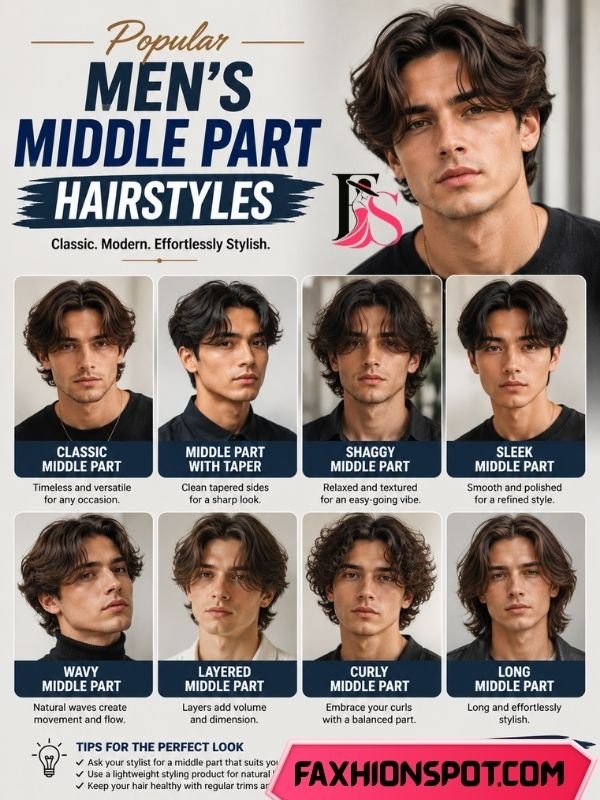
From short and practical cuts to longer curtain styles, these looks show how flexible the modern center part can be.
Stylish Classic Middle Part
The classic version keeps medium-length hair divided evenly at the center, allowing both sides to naturally frame the forehead and cheeks. It works especially well with straight or slightly wavy hair.
For a traditional finish, ask your barber for soft layers rather than extremely sharp transitions. This gives the hair movement while preserving its timeless character.
Short Middle Part
A short middle part is ideal if you want the look without committing to long hair. The front remains long enough to separate naturally while the sides and back are kept relatively neat.
It is particularly practical for oval and square faces because the shorter length maintains a clean outline around the head.
Long Middle Part
Longer hair creates a softer, more dramatic appearance. The center division allows the front sections to fall naturally around the cheekbones or jawline.
Long layers are useful because they prevent heavy hair from forming two flat sections. This approach also works beautifully with natural waves.
Middle Part with Taper Fade
Combining longer center-parted hair with a taper creates a modern contrast. The sides gradually become shorter around the temples and neckline while the top remains full.
A low taper offers a subtle finish, while a stronger taper provides more visible separation. Tapered versions have become particularly popular because they combine classic curtains with contemporary barbering.
Sleek Middle Part with Short Sides
This polished option keeps the top smooth and controlled while the sides are noticeably shorter. A lightweight pomade or styling cream can create definition without making the hair look overly stiff.
It is a strong choice for formal occasions, business settings, or anyone who prefers a refined silhouette.
Flowing Center Part
The flowing center part focuses on movement rather than precision. Hair is allowed to sweep away from the forehead and fall naturally toward the sides.
Medium-to-long hair with a soft wave works particularly well. A round brush and low-heat blow-dry can add volume without removing the relaxed character.
Short Textured Middle Part with Low Fade
Texture makes a shorter center part look fuller and more contemporary. The low fade keeps the area around the ears and neckline clean while leaving enough length above for separation.
Use a matte clay or paste to create small pieces of definition instead of forcing every strand into place.
Middle Parted Brush Back
This style combines a center division with hair brushed backward rather than falling heavily onto the forehead. It creates an open facial appearance and works well with medium-length hair.
For a softer result, use your fingers instead of a fine-tooth comb.
Parted Curtains
Curtains are one of the most recognizable forms of the center-parted haircut. The front sections fall like two panels around the face, usually reaching somewhere between the cheekbones and jaw.
Modern versions can be combined with fades, tapers, layers, waves, or longer sides.
Textured Middle Part Flow
This variation uses layers and natural texture to create movement throughout the top. It is excellent for men whose hair looks flat when cut at one uniform length.
A sea-salt spray can enhance natural texture, while a lightweight styling cream provides control without making the hair rigid.
Messy Middle Part
The messy version is deliberately relaxed. Instead of creating perfectly symmetrical curtains, the hair is separated loosely and allowed to move naturally.
It is a particularly good option for wavy hair because natural bends create effortless volume.
Middle Part Flow with Long Curtains
Long curtains create a dramatic face-framing effect. The front sections can extend toward the jaw or even below it, depending on the overall haircut.
This look suits people who enjoy longer hairstyles and are comfortable spending more time on conditioning and styling.
Loose Curtains
Loose curtains have less structure than traditional versions. The center separation remains visible, but the hair is allowed to fall naturally.
This creates a casual appearance that works especially well with medium-length straight or wavy hair.
Cool Middle Part with Temp Fade
A temple fade provides a clean detail around the temples while keeping most of the top intact. This creates a youthful and contemporary contrast.
The look is especially effective when the top has enough length to form visible curtains.
Textured Wavy Middle Part
Wavy hair gives a center part natural movement and volume. Instead of fighting the wave pattern, the haircut should follow it.
Barber guides commonly recommend layering and carefully removing bulk so waves remain defined rather than becoming heavy.
Two Block Middle Part
The two-block cut is strongly associated with contemporary Korean and K-pop-inspired grooming. The sides and lower back are cut much shorter while the top remains longer and covers the transition.
The center part then divides the longer top into two flowing sections. Straight hair produces the cleanest curtain effect, while waves can create a softer interpretation.
Middle Part with Fade
A fade creates a stronger contrast between the top and sides. Low, mid, and high fades can all be used, depending on how dramatic you want the haircut to look.
A low fade is usually easier to wear in professional environments, while a higher fade produces a bolder appearance.
Pulled Back Center Part with Short Sides
Here, the hair is divided at the center and swept backward. Shorter sides prevent the hairstyle from becoming too bulky.
This option works especially well for thick hair because the shorter sides remove excess weight while the top retains its natural volume.
Short Textured Center Part
A shorter textured cut offers a practical interpretation of the trend. The hair does not need to reach the cheekbones to create a recognizable central division.
Ask for point-cut texture or subtle layering if you want a more natural, separated finish.
Messy Curly Middle Part
Curly hair can produce an especially distinctive result because the curls naturally frame the face. The key is to preserve enough length for the curls to form rather than cutting them too short.
A curl cream or lightweight leave-in conditioner can help maintain definition while reducing unwanted frizz.
Textured Middle Part with Undercut
An undercut creates a much sharper contrast than a taper or fade. The sides are kept very short while the top remains significantly longer.
This edgy variation works particularly well for thick, straight hair and square or oval faces.
Short Parted Curtains
Short curtains provide the recognizable two-sided shape without requiring substantial length. The front can end around the eyebrows, upper cheek, or temples.
This is one of the easiest options for men who want to experiment with the style before growing their hair longer.
Voluminous Parted Curtains
Volume transforms traditional curtains into a fuller, more noticeable hairstyle. Blow-drying the roots upward and outward can create lift before the hair falls toward the sides.
Avoid heavy products that flatten the crown. A lightweight mousse or volumizing spray is often more suitable.
Medium Parted Flow
Medium-length hair provides a useful balance between manageability and movement. It gives you enough length for curtains while remaining easier to maintain than very long hair.
Soft layers can make the hairstyle look more natural and prevent excessive weight around the sides.
Middle Part with Mid Fade
A mid fade begins higher on the sides and creates a stronger visual difference between the top and sides. It suits men who want a sharper, more contemporary haircut.
Keep additional length around the front if you want the center-parted shape to remain obvious.
Long Curly Middle Part
Long curls divided at the center can create a bold, romantic appearance. The curls should be shaped with their natural pattern in mind rather than treated like straight hair.
Regular conditioning is important because longer curly hair can become dry and difficult to control.
Attractive Long Flowing Middle Part
This relaxed style lets longer hair fall naturally from the crown. It has a soft, effortless character and can work with straight, wavy, or lightly curly textures.
The main goal is healthy movement. Regular trims help remove damaged ends without sacrificing overall length.
Curtain Bangs with an Undercut
Curtain bangs combined with an undercut create a dramatic modern contrast. The long front sections frame the face while the sides remain extremely clean.
This option is best for someone comfortable with a noticeable hairstyle and regular maintenance.
Wet Look Middle Part
The wet-look version uses shine and control to create a sleek, fashion-forward finish. A pomade applied to damp hair can define the center division and keep the sections close to the head.
Modern styling advice recommends controlling shine carefully so the part remains visible rather than becoming one glossy mass.
The Buzzed Sides Middle Part
Buzzed sides create one of the strongest contrasts in this collection. The top remains long enough for a visible center part while the sides are clipped extremely short.
It is a bold choice that can make the top appear fuller and more prominent.
How to Choose the Right Style for Your Face Shape
The center part is versatile, but the best variation depends on your facial proportions. Hair length, volume, and side treatment can all change how the face appears.
| Face Shape | Recommended Variation | Why It Works |
| Oval | Classic, wavy, long, or textured | Naturally balanced proportions |
| Round | Voluminous, taper, mid fade | Adds height and visual length |
| Square | Curtains, classic taper, soft flow | Softens strong angles |
| Oblong | Short curtains, textured styles | Adds width and avoids excess height |
| Heart | Wavy flow, loose curtains | Balances forehead and chin |
| Diamond | Layered curtains, textured flow | Adds softness around cheekbones |
These are guidelines rather than strict rules. Hair density, texture, forehead height, and personal preference can be just as important as face shape.
What Is A Middle Part?
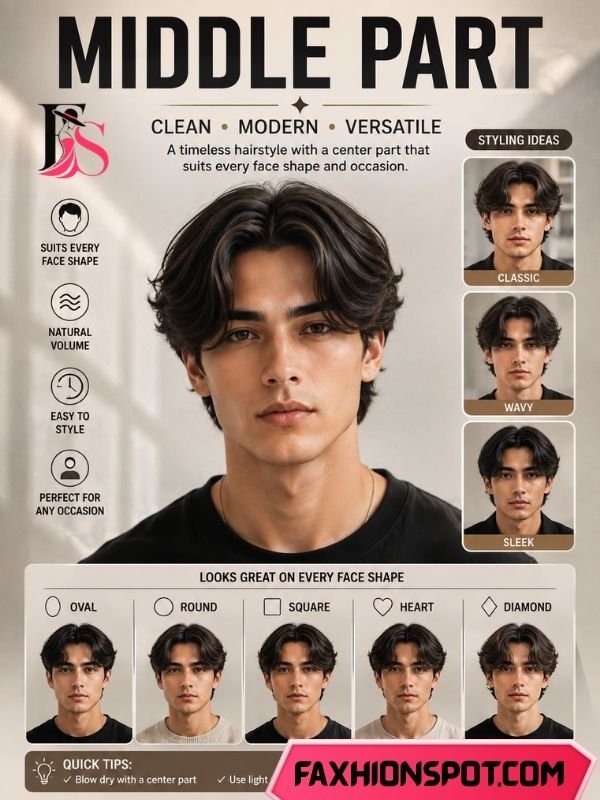
A middle part is a hairstyle in which the hair is divided approximately down the center of the head, creating two sections that move away from one another. The front may fall forward, outward, backward, or into curtain-like sections.
The defining feature is the central division rather than a specific length. That is why the same basic idea can appear as a short textured cut, long flowing hairstyle, fade, taper, undercut, or curly look.
A classic curtain haircut usually has enough length at the front for the two sections to frame the face. Contemporary guides commonly recommend several inches of front length for recognizable curtains, although the exact amount depends on texture and desired finish.
The Evolution of the Middle Part Hairstyles
The center-parted look has a much longer history than its modern social-media popularity suggests. Middle-parted hair has appeared in different forms across fashion eras, including late-19th-century styles and the highly recognizable curtains of the 1990s.
During the 1990s, curtain-style hair became closely associated with actors, musicians, athletes, and youth culture. The look was generally softer and longer, often worn with natural texture.
Its modern revival combines that nostalgic influence with contemporary barbering. Instead of simply recreating an old haircut, today’s versions frequently use:
- Low and mid tapers
- Skin or traditional fades
- Textured layers
- Two-block cutting
- Undercuts
- Natural waves and curls
- Matte styling products
- Blow-dried volume
- Sleek wet finishes
This evolution has made the style much more adaptable. Current guides regularly present it across different lengths, textures, fades, and styling approaches rather than treating it as one fixed haircut.
How to Ask Your Barber for the Look
Do not simply say, “Give me a middle part.” Bring a reference photo and explain the details that matter.
Tell your barber:
- How much length you want on top.
- Where you want the front sections to finish.
- Whether you want a taper, fade, undercut, or natural sides.
- How much texture you want.
- Whether you prefer a sharp or relaxed center part.
- How much daily styling you are willing to do.
For example, you might request a medium-length center part with layered curtains, a low taper, and natural texture. Specific details make it easier for your barber to reproduce the desired shape.
Click Here To Read Another Topic
Styling Tips for Better Results
The right haircut is only half the process. Styling determines whether the finished result looks intentional.
For straight hair: Use a light styling cream or matte product and blow-dry away from the center.
For wavy hair: Apply sea-salt spray or curl-enhancing cream and let the natural wave form.
For curly hair: Avoid brushing the curls aggressively. Use a curl cream and separate the center with your fingers.
For fine hair: Focus on root volume and lightweight products rather than heavy pomades.
For thick hair: Ask for internal layers to remove unnecessary weight while keeping the front long enough to frame the face.
Maintenance Guide
Maintenance depends heavily on the side treatment. A natural long style can grow out gradually, while a fade or taper requires more frequent barber visits.
| Style Type | Maintenance | Styling Effort |
| Short center part | Low | Low |
| Classic curtains | Medium | Medium |
| Tapered version | Medium | Medium |
| Fade + curtains | High | Medium |
| Long flowing style | Medium | Medium |
| Curly center part | Medium | Medium |
| Wet-look style | Medium | High |
| Undercut version | High | Medium |
A useful rule is simple: the sharper the sides, the more often they usually need refreshing.
Frequently Asked Questions
Is a middle part good for every face shape?
It can be adapted to most face shapes by changing the length, volume, and side treatment.
How long should hair be for curtains?
Several inches of front length generally make it easier to create recognizable curtain sections, although hair texture changes the exact requirement.
Does a middle part suit round faces?
Yes. Added crown volume, longer front sections, or a taper can create extra vertical balance.
Is a middle part good for thin hair?
Yes, especially when layers and lightweight volumizing products are used to create movement without weighing the hair down.
Can curly hair have a middle part?
Absolutely. Curly hair can create a distinctive center-framed look when the cut follows the natural curl pattern.
What is the difference between curtains and a middle part?
A middle part describes the division of the hair, while curtains usually describe the longer, face-framing sections created around that division.
Is a taper better than a fade?
Neither is universally better. A taper is softer and more subtle, while a fade creates stronger contrast.
Are middle parts still popular in 2026?
Yes. Current 2026 hairstyle guides continue to feature center-parted curtains, tapers, fades, two-block cuts, textured flows, and longer variations.
How do I make a middle part stay in place?
Style the part while the hair is damp, blow-dry each section away from the center, then finish with a lightweight product.
Can I have a middle part with short hair?
Yes. A short textured version can create the appearance of a center part without requiring long curtains.
Conclusion
The modern middle part has moved far beyond its classic 1990s image. Today, you can combine the central division with fades, tapers, undercuts, layers, waves, curls, short cuts, or long flowing hair. That flexibility makes it one of the easiest hairstyles to customize.
When choosing your style, consider your face shape, natural hair texture, density, desired length, and daily routine. A great haircut should not only look good in a photo but also work with the way your hair naturally behaves.
1 thought on “30 Best Middle Part Hairstyles for Every Face Shape 2026”