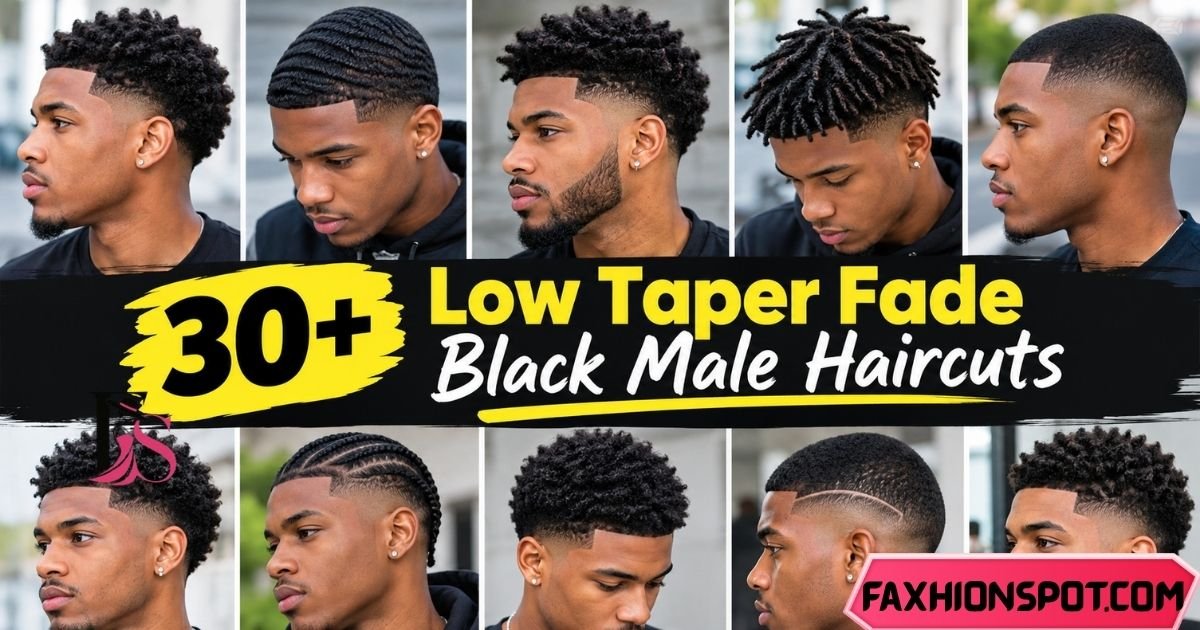
A great haircut should work with your natural texture, not force it into a shape that is difficult to maintain.
That is exactly why the low taper fade black male haircut remains one of the most versatile choices in 2026.
It cleans up the temples, sideburns, and neckline while leaving enough hair on top for waves, curls, coils, afros, twists, braids, or locs.
What Is a Low Taper Fade for Black Men and Why Does It Work So Well?
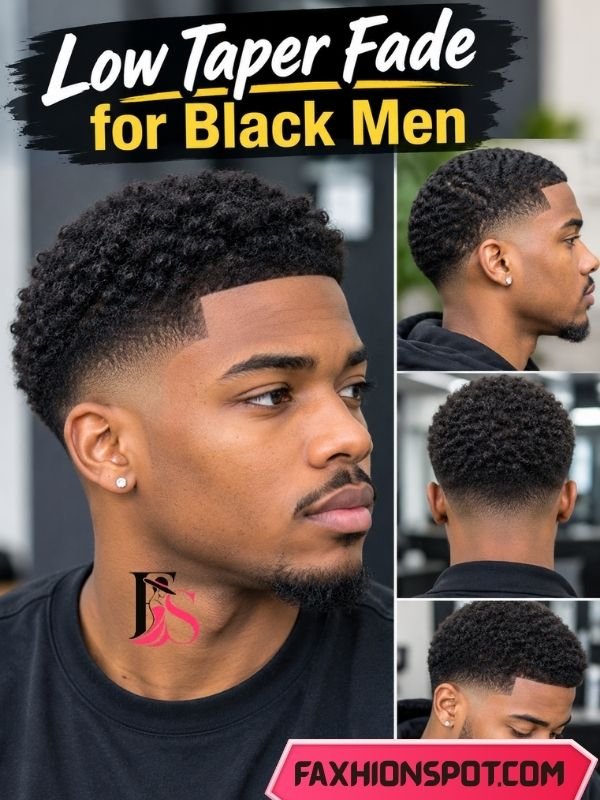
A low taper fade black male haircut gradually reduces hair around the sideburns, temples, ears, and lower neckline while preserving most of the hair above the taper area. The transition can finish at a very short guard or near the skin, depending on the look you request.
The key difference is placement. A low taper keeps the blend low instead of carrying it far up the sides of the head. This preserves volume and makes natural texture the focal point.
Why Does This Cut Work So Well on Black Hair?
Black hair often has strong density, curl definition, shrinkage, and natural volume. A low taper complements those characteristics instead of removing too much of them.
It works particularly well with:
- 360 waves
- 3C curls
- 4A, 4B, and 4C coils
- Short and medium afros
- Sponge curls
- Twists
- Braids
- Cornrows
- Locs
Another advantage is versatility. You can keep the top natural today and change to twists or braids later without completely changing the taper.
Low Taper Fade vs. Other Fades: What Every Black Man Needs to Know
Understanding the terminology before sitting in the barber chair can prevent a disappointing haircut.
| Style | Where the blend begins | Overall appearance |
| Low taper | Around ears and lower neckline | Subtle and natural |
| Low fade | Low on the sides and back | More noticeable |
| Mid taper | Around temple area | Balanced contrast |
| High taper | Higher around temples | Bold and defined |
| Skin fade | Blends to bare skin | Maximum contrast |
Low Taper Fade vs. Low Fade
A low taper concentrates the blend around the edges, while a low fade generally removes more hair from the lower sides and back. If you want to preserve more fullness, ask specifically for a low taper, not simply a low fade.
Low Taper Fade vs. Mid Taper Fade
A mid taper starts higher around the temple area. It creates more visible contrast and changes the silhouette more noticeably.
Low Taper Fade vs. High Taper Fade
A high taper pushes the short section farther upward. It is more dramatic and can make the top appear larger by comparison.
Taper vs. Fade: What Is Actually the Difference?
A taper traditionally focuses on gradually shortening hair around specific edges, especially the temples and neckline. A fade usually creates a more extensive transition across the sides and back.
In practice, barbers may use the terms differently, so showing a reference photo remains one of the safest ways to communicate the exact result you want.
30+ Best Low Taper Fade Black Male Styles
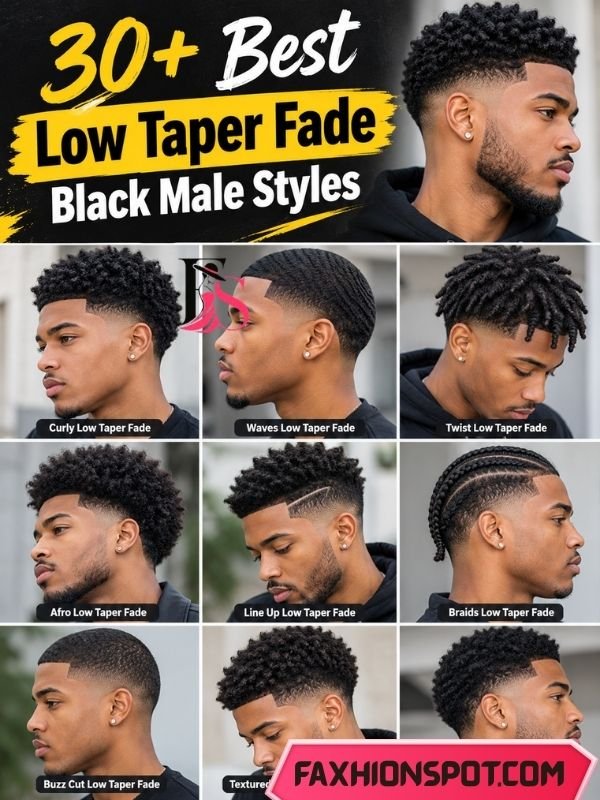
Short & Classic Styles
1. Low Taper Fade Black Male Short Hair
Keep the top short and naturally textured while tapering only around the temples and neckline. It is simple, clean, and easy to maintain.
2. Low Taper Fade Buzz Cut
A #2 to #4 buzz on top combined with a low taper creates a sharp, masculine silhouette. It requires minimal styling and highlights facial structure.
3. Low Taper Fade Caesar Cut
A short Caesar fringe gives the haircut a defined front while the taper cleans up the perimeter. Ask your barber to keep the front line natural if your hairline is uneven.
4. Low Taper Fade Crew Cut
The crew cut adds slightly more height than a buzz cut. It is a strong choice if you want a traditional style with a modern finish.
5. Low Taper Fade Textured Crop
Keep the top short but irregular and textured. This creates movement without requiring significant daily styling.
Waves & Curl Styles
6. Low Taper Fade with 360 Waves
This combination keeps the wave pattern on top while cleaning up the edges. Protect the wave pattern by telling your barber not to cut too far into the sides.
7. Low Taper Fade Curly Hair
Leave enough length for curls to form naturally. A small amount of curl cream can define the texture without making it look heavy.
8. Low Taper Fade with Natural Coils
Natural coils provide excellent contrast against clean tapered edges. Ask for shape preservation rather than aggressive thinning.
9. Low Taper Fade with Sponge Curls
Sponge curls add definition and texture on top. The taper keeps the sides controlled while allowing the curls to remain the visual focus.
Afro Styles
10. Low Taper Fade Afro (Short)
A short afro paired with a low taper creates a rounded, balanced shape. It is especially effective for dense 4A to 4C hair.
11. Low Taper Fade Afro (Medium to Full)
Keep more volume on top for a stronger afro silhouette. Your barber should taper the perimeter without shrinking the main body.
12. Low Taper Fade High Top
A high-top shape creates height and a distinctive profile. Keep the taper narrow if you want maximum top volume.
13. Low Taper Fade Frohawk
The frohawk concentrates volume through the center of the head. A low taper gives the sides a cleaner outline without eliminating the textured character.
Protective & Long Styles
14. Low Taper Fade with Two-Strand Twists
Two-strand twists combined with a clean taper create a relaxed but polished appearance. Keep the taper limited to the edges.
15. Low Taper Fade with Sponge Twists
Sponge twists work especially well when you want visible texture without long hair. Keep the twist length consistent for a cleaner silhouette.
16. Low Taper Fade with Box Braids
Box braids can remain the main feature while the taper keeps the temples and nape neat.
17. Low Taper Fade with Cornrows
Cornrows and a low taper create strong contrast between structured braids and clean edges. Ask your barber to taper only exposed areas.
18. Low Taper Fade with Locs (Dreadlocks)
Locs can be long, medium, or short while the taper provides a cleaner frame. Avoid taking the taper too high unless you want a more undercut-like appearance.
19. Low Taper Fade with Finger Coils
Finger coils give shorter natural hair a defined pattern. A subtle taper around the edges makes the style look intentional without removing its natural character.
Beard Combination Styles
20. Low Taper Fade with Full Beard
Blend the sideburn area gradually into the beard. The transition should look continuous rather than disconnected.
21. Low Taper Fade with Short Trimmed Beard
A short beard works particularly well for professional settings. Ask for a subtle beard blend rather than an overly sharp transition.
22. Low Taper Fade with Goatee
The goatee draws attention toward the center of the face. Keep the taper clean and relatively understated for balance.
Bold & Creative Styles
23. Low Taper Fade with Hair Design
A small design near the taper can add personality without dominating the haircut. Simple lines usually grow out more gracefully than complicated patterns.
24. Low Taper Fade with Line-Up (Shape-Up / Edge-Up)
A line-up sharpens the forehead, temples, and beard area. If your corners are naturally uneven, consider a softer edge-up rather than forcing perfectly symmetrical corners.
25. Low Taper Fade Blowout
A blowout keeps volume higher on top while the taper controls the lower sides. It is a good option for curls and dense textured hair.
Styles for Black Boys and Teens
26. Low Taper Fade for Black Boys (Ages 8–12)
For younger boys, keep the taper practical and avoid excessive designs if school rules are restrictive. A short afro, curls, or waves can all work.
27. Low Taper Fade for Black Teens (Ages 13–17)
Teens have more freedom to experiment with texture, designs, twists, and line-ups. A moderate taper is a versatile choice for both school and weekends.
More Styles to Try
28. Low Taper Fade with Flat Twist
Flat twists create a structured top while the taper keeps the edges tidy.
29. Low Taper Fade with Curly Fringe
A curly fringe adds texture toward the forehead. Leave enough length for the curls to fall naturally.
30. Low Taper Fade with Colored Tips
Subtle color on the tips can make curls or coils stand out. Ask your stylist about hair condition before bleaching.
31. Classic Low Taper Fade (Natural Length, No Top Style)
Simply maintain your natural texture on top and clean the perimeter. This is one of the easiest versions to maintain.
32. Low Taper Fade with Hard Part Line
A hard part adds a defined visual break. Pair it with a neat line-up for a sharper finish.
Best Low Taper Fade Style for Your Face Shape
The best low taper fade black male variation depends partly on your face shape and how much height you want.
| Face shape | Recommended approach |
| Oval | Almost any variation |
| Round | Add controlled height |
| Square | Keep the structure clean |
| Diamond | Preserve balanced top volume |
| Heart/Triangle | Keep some temple fullness |
| Oblong/Long | Avoid excessive height |
Oval Face
Most variations work because the proportions are naturally balanced.
Round Face
Choose curls, waves, or textured hair with some vertical height. Avoid making the top excessively round.
Square Face
The strong jawline works well with short hair, waves, afros, and sharp line-ups.
Diamond Face
Keep enough volume around the upper sides to balance the cheekbones.
Heart/Triangle Face
A moderate taper with some temple fullness can prevent the forehead from appearing disproportionately wide.
Oblong/Long Face
Avoid adding too much height. A wider textured top or shorter afro can create better visual balance.
How Black Hair Textures Work with the Low Taper Fade
Type 3C Hair with Low Taper Fade
3C curls can be defined with curl cream or leave-in conditioner. Keep enough top length so the curl pattern remains visible.
Type 4A Hair with Low Taper Fade
4A coils create excellent volume and definition. A short afro, sponge curls, or twists can complement the taper.
Type 4B Hair with Low Taper Fade
4B hair benefits from controlled shaping. Moisture and gentle handling are important when maintaining the top.
Type 4C Hair with Low Taper Fade
4C hair can produce a striking contrast between dense natural texture and tapered edges. Avoid excessive manipulation and keep the perimeter carefully shaped.
How to Ask Your Barber for a Low Taper Fade
Knowing what to say is almost as important as knowing what you want. Current barber guides repeatedly recommend using a reference photo and clearly specifying taper height, top length, neckline, and edge-up preferences.
Step 1: Bring a Reference Photo
Bring a front and side photo whenever possible. One picture may not show the neckline or temple area clearly.
Step 2: Use the Right Barber Language
Try this simple script:
“I want a low taper around the temples, sideburns, and neckline. Keep the taper low and preserve the length on top. I want a smooth blend, not a high fade.”
Then add your preferred top style, such as waves, curls, afro, twists, or locs.
Step 3: Specify Your Neckline Shape
Ask whether you want a natural, rounded, squared, or tapered neckline. Your neckline can significantly change how the haircut grows out.
Step 4: Describe Your Add-Ons
Mention your line-up, beard blend, hard part, design, or color before the barber starts.
Common Mistakes to Avoid at the Barbershop
- Saying “fade” without specifying the height
- Not showing a reference photo
- Forgetting to mention top length
- Asking for a skin fade when you actually want a taper
- Ignoring shrinkage
- Taking the taper too high
- Over-sharpening an uneven hairline
How to Maintain Your Low Taper Fade
A low taper fade black male haircut can stay attractive between appointments when the hair and edges are maintained properly. Several current guides recommend roughly two-to-four-week maintenance depending on how sharp you want the perimeter.
Maintenance Schedule
| Routine | Suggested timing |
| Moisturize textured hair | Several times weekly as needed |
| Light edge cleanup | As needed |
| Full taper refresh | About every 2–4 weeks |
| Deep conditioning | Weekly or according to hair needs |
| Protective-style maintenance | Based on the specific style |
Barbershop Visit Schedule
For a crisp appearance, many men return every two to three weeks. If you prefer a softer grow-out, you may be able to stretch appointments longer.
Daily Hair Care Routine for Black Hair with a Taper
Start with moisture rather than excessive product. Use a suitable leave-in conditioner, gently shape the hair, and avoid aggressive brushing when the hair is dry.
If you wear waves, maintain your brushing pattern consistently. If you wear curls or coils, use products designed to preserve moisture and definition.
Products Every Black Man Needs for His Low Taper Fade
Your routine does not need dozens of products. Consider:
- Moisturizing shampoo
- Conditioner
- Leave-in conditioner
- Curl cream for curls
- Light pomade for waves
- Wide-tooth comb
- Pick for afro styles
- Durag for waves
- Satin or silk bonnet for overnight protection
The Cultural Significance of the Low Taper Fade for Black Men
The low taper fade black male style is more than a technical haircut. It sits within a long tradition of Black grooming in which barbershops function as spaces for personal expression, community, identity, and creativity.
Modern versions combine traditional barbering techniques with natural hairstyles such as afros, waves, twists, braids, and locs. The result is a haircut that can be understated in one setting and highly expressive in another.
Its popularity also reflects a broader preference for styles that preserve natural texture while maintaining clean edges.
Click Here To Read Another Topic
Low Taper Fade Black Male: 2026 Trends
Hybrid Texture Combinations
One growing direction is combining different textures, such as natural curls with twists, or waves with a textured top. The taper provides a consistent frame.
Micro-Designs in the Fade Zone
Small lines and geometric details are becoming popular because they add personality without requiring a large shaved design.
Low Taper Fade with Color
Subtle blonde, copper, or other colored tips can emphasize curls and coils. Professional consultation is especially important before bleaching tightly textured hair.
The “Black Ninja” Low Taper
This trend emphasizes a very clean, controlled silhouette with a tight taper, defined texture, and sharp perimeter.
Virtual Try-On Tools
Virtual hairstyle tools are increasingly useful for comparing taper heights, top lengths, facial proportions, and different textures before visiting a barber. Several current hairstyle guides now encourage visual previews as part of the decision process.
Conclusion
The low taper fade black male haircut remains popular in 2026 because it combines clean barbering with the natural character of Black hair.
Instead of removing large sections of the sides, it focuses the blend around the perimeter while allowing waves, curls, coils, afros, twists, braids, and locs to remain the centerpiece.