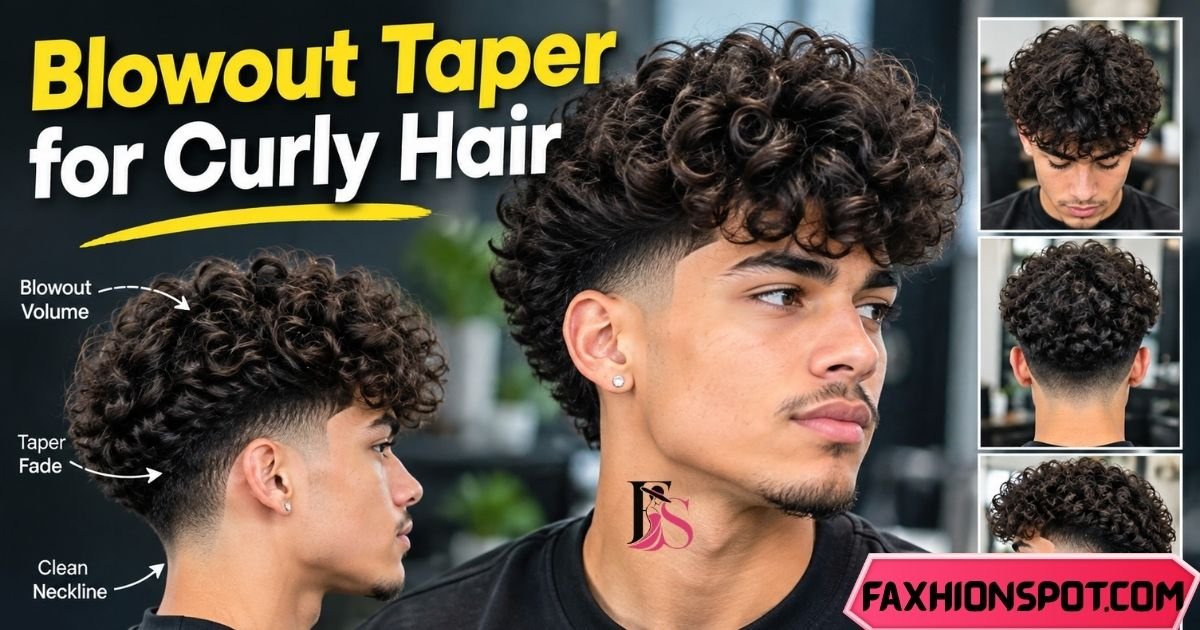
A blowout taper for curly hair combines a full, textured top with gradually shortened hair around the temples, sideburns, and neckline. Instead of hiding your natural curls, the haircut uses them to create height, movement, and a rounded silhouette. The result is clean around the edges while remaining full and expressive through the top.
The biggest difference between getting this haircut with straight hair and curly hair is technique. Curl shrinkage, density, curl pattern, and moisture can dramatically change how the finished cut looks.
Your barber needs to understand how your hair behaves when dry, not simply how it looks when wet. Current barber guides consistently emphasize preserving natural texture and using controlled taper placement rather than treating curls like straight hair.
What is a blowout taper for curly hair, and who is it best suited for?
A blowout taper for curly hair is best suited to people who want noticeable volume on top with cleaner, shorter sides and neckline. It can work with Type 3 curls and Type 4 coils when the cut is adjusted for density and shrinkage.
It is especially useful if you want:
- Natural-looking volume
- Defined curls or coils
- Clean temples and neckline
- A modern alternative to a full fade
- A rounded or lifted silhouette
- A haircut that works with your natural texture
The style is flexible, but the final shape depends heavily on your curl density, face shape, hair length, and how high the taper is placed.
What Is a Blowout Taper and How Is It Different from a Regular Fade?
A blowout taper for curly hair has two main components: a fuller top that creates the blowout effect and a gradual taper around the sides and neckline. The taper usually concentrates on specific areas rather than removing large amounts of hair across the entire side.
A regular fade generally travels farther upward through the sides and can expose more scalp. A taper is more localized, particularly around the temples, sideburns, and nape. However, terminology varies between barbers, so a reference photo is often more useful than relying on the haircut name alone.
| Feature | Taper | Regular Fade | Curly Blowout Taper |
| Main focus | Temples and neckline | Larger side area | Full top + tapered perimeter |
| Top length | Usually preserved | Depends on fade | Usually medium or full |
| Scalp exposure | Lower | Can be high | Depends on taper height |
| Curl emphasis | Moderate | Strong contrast | Very strong |
| Grow-out | Usually softer | More noticeable | Relatively natural |
For curly hair, the softer perimeter can help the curls transition into the sides without creating an overly abrupt visual break.
What Does a Blowout Taper Look Like on Curly Hair?
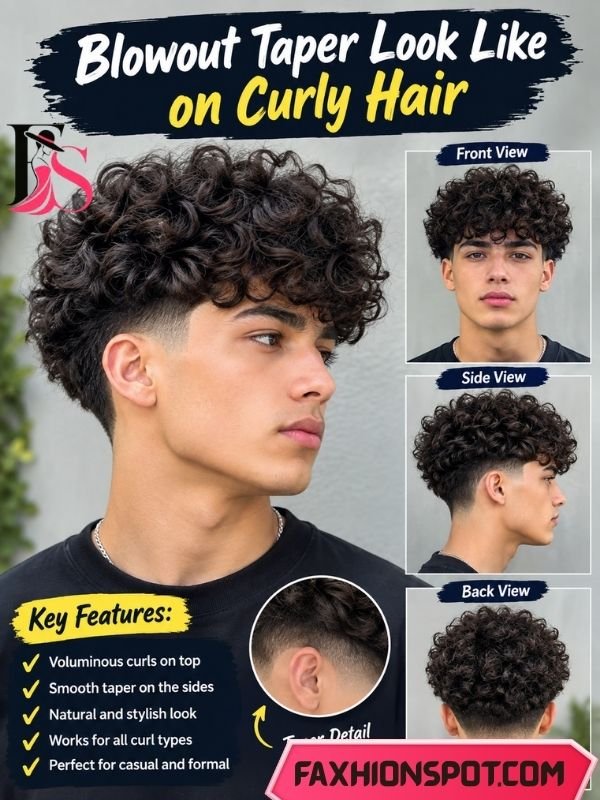
The appearance changes significantly according to curl pattern. A blowout taper for curly hair with loose Type 3 curls may look rounded and springy, while Type 4 hair can create a more compact, sculpted afro-like silhouette.
The goal is not to make every curl identical. Good curly styling normally emphasizes the natural pattern while controlling the overall shape. A diffuser, lightweight curl cream, and careful drying can help preserve definition and volume.
Type 3 Curly Hair (2c, 3a, 3b, 3c): Defined Curl Rings with Volume
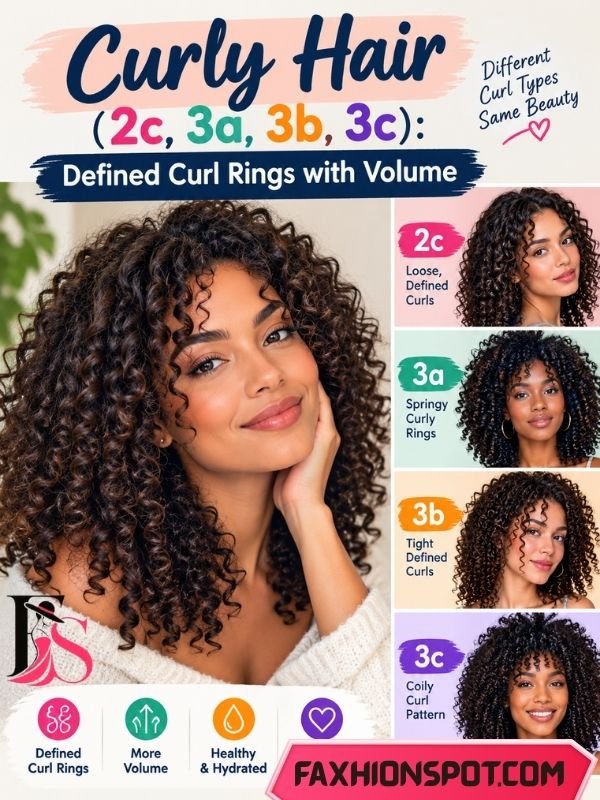
Type 3 textures can produce clearly visible curls ranging from loose S-shaped patterns to tighter spiral rings. A blowout taper for curly hair can make these curls the focal point by keeping the top relatively full.
For 3A through 3C hair:
- Keep enough length for the curls to form properly.
- Avoid removing excessive weight from the crown.
- Use curl cream rather than heavy wax.
- Diffuse with controlled airflow.
- Let curls settle before separating them.
The top can be shaped into a rounded profile, a forward curl style, or a slightly taller silhouette depending on personal preference.
Type 4 Coily Hair (4a, 4b, 4c): Afro-Shaped Top with Precision Taper
Type 4 hair can create substantial volume even at relatively shorter lengths. With a blowout taper for curly hair, the barber can preserve the density through the top while creating a clean transition around the ears and nape.
The result may resemble a compact afro, rounded coily top, or stretched blowout depending on length and styling method. The important factor is maintaining the hair’s natural structure instead of over-thinning it.
Leave-in conditioner, curl cream, a pick, or a controlled blow-drying technique can help create the desired shape.
Which Blowout Taper Is Right for You: Low, Mid, or High?
Choosing the taper height changes the amount of contrast around your head. A blowout taper for curly hair can be adapted as a low, mid, or high taper.
| Taper height | Overall appearance | Good starting point for |
| Low | Subtle and conservative | First-timers, softer looks |
| Mid | Balanced contrast | Most curl patterns |
| High | Strong contrast | Dense hair and dramatic styles |
A low taper keeps more hair around the sides. A mid taper creates a clearer separation between the voluminous top and shorter sides. A high taper produces the strongest visual contrast.
There is no universal “correct” height. Your hair density and preferred silhouette matter more than simply following a trend.
Does Head Shape Affect Which Taper Height Works Best?
Yes. Head shape can influence how the taper and top volume visually balance each other.
If your head is naturally narrow, preserving side fullness may prevent the haircut from appearing excessively tall. If your head is wider, a higher taper can create additional contrast.
For a first appointment, a low or mid taper is often easier to adjust later. Once you know how your curls respond, you can experiment with a higher placement.
What Exactly Should You Tell Your Barber?
The best blowout taper for curly hair starts with clear instructions. Do not simply say “give me a blowout taper” and assume every barber interprets the phrase identically.
Tell your barber:
- How much length you want on top.
- Whether you want a low, mid, or high taper.
- How much volume you want.
- Whether you want the curls defined or stretched.
- Whether you want the neckline natural or sharp.
- Whether you want the temples lightly tapered or more dramatic.
- Whether you want the top rounded, forward, or upward.
Bring two or three reference photos taken from different angles. This gives the barber information that words alone cannot always communicate. A current barber guide specifically recommends reference photos because “blowout taper” can be interpreted differently from one barber to another.
The Shrinkage Problem: Why Curly Hair Requires Different Instruction
Shrinkage is one of the most important considerations when cutting curly hair. Hair can appear considerably shorter after it dries and curls back into its natural pattern.
That means a barber who cuts curly hair while it is wet may misjudge the finished length. Some professional-oriented guides recommend dry cutting or stretching sections during the cut to better account for the final shape.
For this reason, tell your barber how your hair looks when completely dry and explain how much shrinkage you normally experience.
Ready-to-Use Barber Scripts (Copy or Screenshot These)
For a subtle style:
“I want a low blowout taper. Keep the top full and preserve my natural curls. Clean up the temples and neckline without taking the taper too high.”
For a balanced style:
“Give me a mid blowout taper with plenty of curly volume on top. Keep my curl pattern intact, shape the top evenly, and blend the sides smoothly.”
For a more dramatic style:
“I want a high taper with a full curly top. Keep the crown dense and create strong contrast around the sides while keeping the curls natural.”
For Type 4 hair:
“Keep the top full and rounded, preserve my natural coils, and make the taper clean around the temples and neckline without over-thinning the top.”
How Should Your Barber Cut Curly Hair Differently?
A blowout taper for curly hair requires more attention to texture, shrinkage, density, and weight distribution than a basic short haircut.
The barber should evaluate the hair in its natural state before removing significant length. Cutting against the curl pattern or taking too much weight from one area can create an uneven silhouette after the hair springs back.
The objective is not simply to make the hair shorter. It is to create a balanced shape that still looks good when the curls are dry and fully formed.
Point Cutting vs. Blunt Cutting on Curly Hair
Point cutting can soften the ends and help remove selected bulk without creating an overly rigid line. Blunt cutting creates a stronger perimeter and can sometimes be useful when a specific shape is desired.
For curly hair, the choice should depend on density, curl pattern, and the intended finish. The barber should avoid automatically using one technique on every client.
Why the Fade Line Matters More on Coily Hair
Coily hair can make an uneven transition particularly noticeable because dense texture can create strong visual blocks.
With a blowout taper for curly hair, the taper should flow naturally into the surrounding density. The transition around the temple and neckline should complement the shape of the top rather than competing with it.
This is why experienced barbers often focus heavily on blending and weight distribution instead of simply taking the sides as short as possible.
How Do You Style a Blowout Taper at Home?
Styling a blowout taper for curly hair is mostly about controlling moisture, defining the curl pattern, and creating lift without producing excessive frizz.
Start with clean, damp hair rather than soaking-wet hair. Apply a lightweight leave-in product if your hair needs extra moisture, followed by a curl-defining product.
Then use your fingers or a diffuser to encourage the curls upward. Avoid aggressively brushing or rubbing the hair once the curl pattern begins forming.
Type 3 Curly Hair Styling Routine (Step-by-Step)
For 2C through 3C textures:
- Wash and condition according to your normal routine.
- Gently remove excess water with a microfiber towel or soft T-shirt.
- Apply a small amount of leave-in conditioner if needed.
- Work curl cream through the top.
- Scrunch the curls upward.
- Use a diffuser on low or controlled heat.
- Lift the roots gently for additional volume.
- Allow the curls to finish drying before separating them.
- Add a tiny amount of lightweight product only if necessary.
The key is restraint. Too much manipulation while curls are drying can create frizz and break up curl clumps.
Type 4 Coily Hair Styling Routine (Step-by-Step)
For 4A through 4C hair:
- Start with damp, conditioned hair.
- Apply leave-in conditioner where extra moisture is needed.
- Add a lightweight curl cream or styling product.
- Shape the top with your fingers, sponge, or pick.
- Stretch the hair gently if you want a more blown-out appearance.
- Use controlled warm airflow if blow-drying.
- Finish with a small amount of moisturizing product if required.
- Avoid repeatedly disturbing the hair once the shape is established.
The goal is a full, controlled silhouette rather than perfectly uniform coils.
How to Refresh Your Curls on Day 2 and Day 3
You usually do not need to completely restyle your hair every morning.
For a blowout taper for curly hair, lightly mist the top with water, add a small amount of leave-in or curl refresher, and reshape individual curls with your fingers.
If the roots have flattened, gently lift them with your fingers or a pick. Avoid soaking the entire hairstyle unless it genuinely needs a reset.
What Products Do You Need for a Blowout Taper on Curly Hair?
Product selection depends on your curl pattern, density, and desired finish.
| Product | Main purpose | Best use |
| Leave-in conditioner | Moisture | Dry or thirsty curls |
| Curl cream | Definition | Type 3 and Type 4 textures |
| Lightweight mousse | Volume and hold | Fine curls |
| Gel | Stronger definition | Frizz-prone curls |
| Diffuser | Controlled drying | Curl preservation |
| Hair pick | Root lift | Coily or dense hair |
| Light styling paste | Texture | Finishing short sections |
Avoid automatically choosing the heaviest product. Heavy waxes and pomades can flatten curls and reduce the airy appearance that makes this haircut work.
A diffuser is particularly useful because it spreads airflow instead of blasting one concentrated stream directly into the curl pattern.
How Long Does a Blowout Taper Last and How Do You Maintain It?
Most people need a taper cleanup roughly every 2 to 3 weeks if they want the edges consistently sharp. Some can stretch the haircut longer because the tapered areas grow out gradually. Current hairstyle guides commonly place maintenance around this two-to-three-week window, although individual growth rates vary.
A blowout taper for curly hair can remain visually attractive between appointments because the natural texture disguises some gradual growth.
To maintain it:
- Protect curls while sleeping.
- Avoid excessive heat.
- Moisturize according to your hair’s needs.
- Refresh rather than fully restyle every day.
- Keep the neckline and temples clean.
- Return to your barber before the taper becomes completely overgrown.
Does the Blowout Taper Work for Your Hair? (First-Timers and Edge Cases)
A blowout taper for curly hair can work across a wide range of curl patterns, but the best version depends on your actual density and styling habits.
People with fine curls may need a lower taper and careful weight preservation. Very dense Type 4 hair may support a taller, more dramatic silhouette. Medium-density Type 3 curls offer considerable flexibility.
Getting Your First Blowout Taper on Curly Hair
If this is your first time, start conservatively. A low or mid taper lets you see how your hair responds without dramatically changing the overall shape.
Keep more length on top than you think you need. You can always remove additional length during a later appointment, but regrowing a top that was cut too short takes time.
Take photos of your hair when it is naturally dry before visiting the barber. These can help communicate your normal curl shape and shrinkage.
Click Here To Read Another Topic
Common Mistakes to Avoid
The most common mistakes with a blowout taper for curly hair involve either removing too much hair or styling too aggressively.
Avoid:
- Cutting the top too short for your curl pattern.
- Asking for a high taper without considering head shape.
- Using excessive heavy product.
- Brushing curls while they are drying.
- Ignoring shrinkage.
- Over-thinning dense curly hair.
- Expecting wet hair to look the same when dry.
- Giving your barber only a haircut name without a reference photo.
The haircut should work with your natural texture rather than forcing the curls into an unrelated shape.
Frequently Asked Questions
Is a blowout taper good for curly hair?
Yes. The combination works particularly well because natural curls and coils provide much of the volume needed for the blowout shape.
Is a blowout taper the same as a fade?
No. A taper usually concentrates shortening around specific areas such as the temples and neckline, while a fade generally travels farther across the sides.
What curl types can get this haircut?
Type 3 curls and Type 4 coils can both work, provided the cut is adjusted for density, shrinkage, and desired shape.
Should curly hair be cut wet or dry?
Dry cutting or cutting while carefully accounting for stretched length can help the barber judge shrinkage and the final shape more accurately.
Is a low or mid taper better for curly hair?
Both can work. Low tapers create a softer appearance, while mid tapers provide more contrast between the sides and the curly top.
Can 4C hair get a blowout taper?
Yes. Dense 4C hair can create a strong rounded silhouette, particularly when the top has enough length and the taper is blended carefully.
How often should I get it touched up?
A common maintenance schedule is approximately every two to three weeks, although growth speed and your preferred level of sharpness matter.
What should I use to style curly hair?
A lightweight leave-in conditioner, curl cream, diffuser, and optional gel or mousse can provide moisture, definition, and controlled volume.
Can I style it without a diffuser?
Yes. Air-drying can work well when you want maximum natural definition, although a diffuser can provide faster drying and additional root volume.
How do I prevent frizz?
Limit touching while the curls dry, avoid excessive brushing, use appropriate moisture, and choose lightweight products that support your curl pattern.
Conclusion
A blowout taper for curly hair is a versatile haircut because it combines controlled edges with the natural volume of curls and coils. Instead of forcing textured hair into a straight-hair formula, the cut works with the pattern you already have.
The most important step happens before the clippers touch your head: communicate the taper height, top length, desired shape, and natural curl behavior to your barber. A reference photo is even better. Once the cut is right, a simple routine using moisture, curl definition, controlled drying, and minimal manipulation can keep the top looking full and the perimeter clean.
Whether you choose a low, mid, or high version, the best result is one that matches your curl density, face shape, lifestyle, and willingness to maintain it.