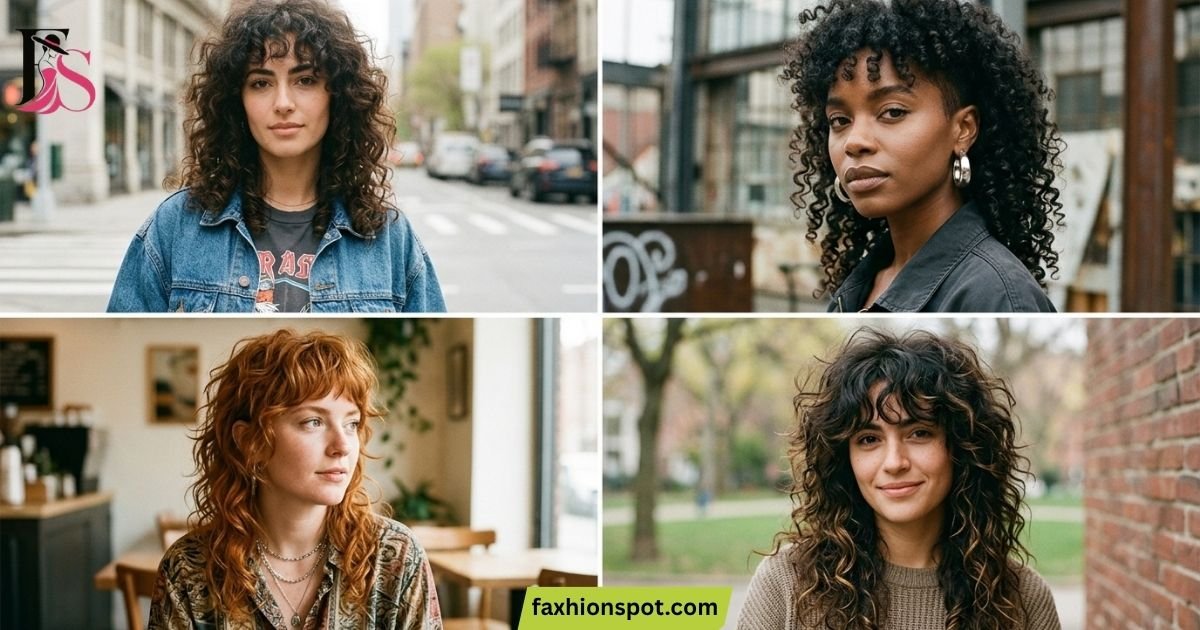
Curly hair deserves a haircut that celebrates its natural texture, volume, and movement. A modern mullet offers all three by combining shorter layers around the front and crown with a longer, textured back.
From soft, romantic shapes to bold punk-inspired cuts, there are plenty of ways to personalize this versatile hairstyle in 2026.
The best mullet curly hair styles for women work with your curl pattern instead of forcing your hair into a shape it cannot naturally hold.
In this guide, you will discover 42 hairstyle ideas, learn how to choose the right cut for your curls, and find practical tips for styling and maintaining your new look.
Why Modern Curly Mullet Is Trending in 2026
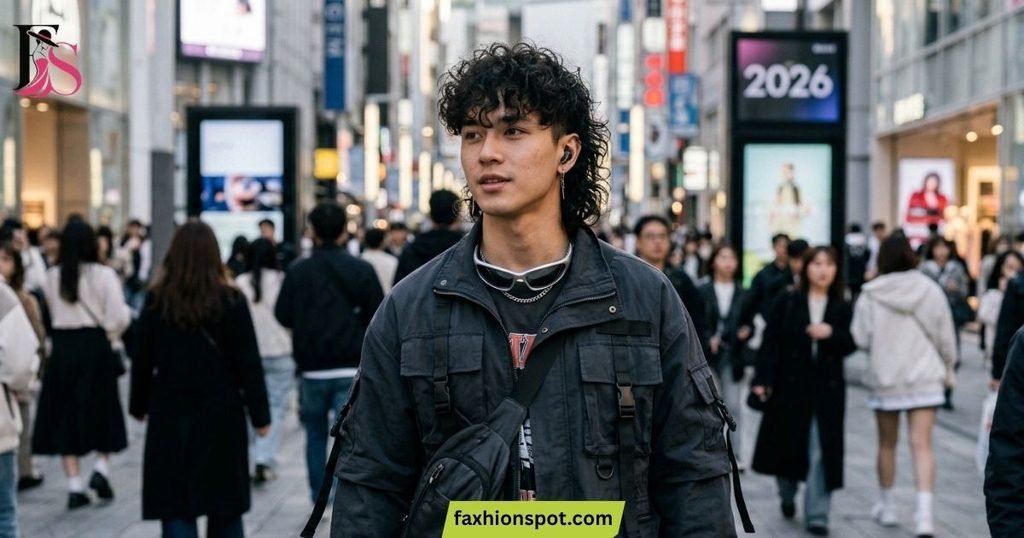
The modern mullet has moved beyond its retro reputation. Today’s versions feature softer transitions, personalized layers, natural volume, and different lengths that suit individual preferences. Curly hair makes this haircut especially interesting because every curl contributes to its shape and movement.
Several factors explain its popularity:
- Natural texture: The haircut highlights waves, ringlets, and coils instead of requiring a straightened finish.
- Customizable shape: You can choose subtle layers or a dramatic contrast between the sides and back.
- Versatile styling: Bangs, face-framing pieces, undercuts, and color treatments create different looks.
- Individual expression: The style can feel elegant, casual, alternative, or punk-inspired.
- Movement and volume: Strategic layers help curls look lively rather than weighed down.
Social media hairstyle galleries have also helped popularize shag-inspired cuts, wolf cuts, and softer modern mullets. However, the most successful version is the one that suits your hair density, lifestyle, and preferred maintenance routine.
Benefits of Choosing a Curly Mullet Hairstyle
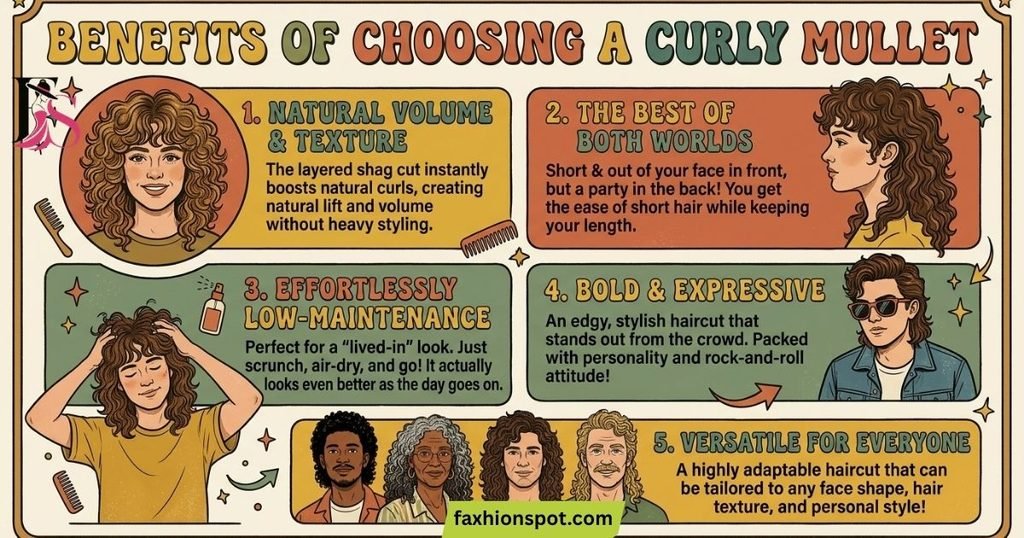
A well-planned mullet can enhance your natural curls while giving your hair a recognizable silhouette. Its benefits depend on the way your stylist distributes the layers and balances the front, sides, crown, and back.
Key benefits include:
- Better movement: Removing selected areas of excess weight can help curls move more freely.
- Customized volume: Shorter crown layers can create lift, while longer back sections preserve length.
- Flexible styling: Wear your curls defined, tousled, brushed out, or paired with bangs.
- Personalized face framing: The front layers can be adjusted to complement your forehead, cheekbones, and jawline.
- Options for different lengths: Short, medium, and long versions are possible.
- Distinctive appearance: The contrast between the crown and nape creates a recognizable shape.
- Natural texture appreciation: The cut can reduce the need to fight your natural curl pattern with heat styling.
Keep in mind that layers do not automatically make curly hair easier to manage. Poorly placed layers can create unwanted volume, uneven shapes, or excessive frizz. A stylist experienced with your curl type can help you achieve the intended result.
42 Best Modern Mullet Curly Hair Styles for Women
The following ideas cover subtle, classic, short, medium, long, colorful, and alternative variations. Use them as inspiration for your salon consultation, remembering that the final shape will depend on your natural curl pattern and how much your hair shrinks when dry.
1. Soft Layered Curly Mullet
This style features gentle layers around the crown and face, blending into a longer back. It creates movement without an overly dramatic difference between the front and rear sections.
It is an excellent starting point if you want a feminine, wearable haircut that emphasizes natural curls. Ask your stylist to preserve enough length through the nape and avoid removing too much bulk from the sides.
2. Classic Curly Mullet
The classic version combines a shorter front and sides with a noticeably longer back. Natural curls soften the contrast, giving the haircut more volume and personality than a rigid, straight-haired silhouette.
Choose this style if you enjoy retro fashion or want a recognizable mullet shape. Defined curls make the outline stand out, while a slightly tousled finish gives it a relaxed appearance.
3. Natural Curly Mullet
This variation follows your natural curl pattern with minimal manipulation. The stylist shapes the crown and back to complement your existing texture rather than creating a highly sculpted finish.
It works particularly well for people who prefer air-drying or using a diffuser. A lightweight leave-in conditioner and curl cream can help maintain definition without making the hair feel heavy.
4. Subtle Blended Curly Mullet
A blended version offers a softer transition between the shorter sides and longer back. From the front, it may resemble a layered curly shag, while the longer nape reveals the mullet shape from the side.
This option suits first-time wearers who want something modern but not too bold. It can also be adapted for workplaces with more conservative grooming expectations.
5. Minimalist Curly Mullet
The minimalist version focuses on clean shaping, restrained layers, and a balanced silhouette. It avoids excessive choppiness and dramatic differences in length.
Use this idea if you prefer understated hairstyles that do not require elaborate styling. A small amount of curl cream can enhance definition while keeping the finished shape simple.
6. Wolf Cut Curly Mullet
A wolf cut blends the shag’s heavy layering with the mullet’s longer back. On curly hair, the result can feature a voluminous crown, textured fringe, and loose, irregular layers throughout.
The main difference is that a wolf cut usually distributes shaggy layers more extensively, while a mullet often emphasizes the longer nape. Your stylist can combine the two depending on how dramatic you want the silhouette to look.
7. Shaggy Curly Mullet
This style uses choppy layers, soft fringe, and a relaxed finish. The uneven texture gives curls a carefree appearance rather than a perfectly polished shape.
It is a good choice for someone who likes vintage-inspired fashion or intentionally messy hair. A lightweight texturizing product can enhance separation without stiffening the curls.
8. TikTok-Inspired Curly Mullet
This contemporary interpretation often combines a fuller crown, defined curls, shorter face-framing sections, and a noticeable back. The finish may be glossy and defined or deliberately tousled.
Bring a reference image to your stylist, but discuss the actual cut rather than relying on a filter or styling effect. Hair density, curl shrinkage, and the amount of layering all influence the final result.
9. Korean Style Curly Mullet
A Korean-inspired version typically emphasizes softer outlines, airy layers, and face-framing pieces. The result can look youthful and textured without relying on extremely short sides.
This option works well if you prefer a gentle, balanced shape. Ask for layers that blend around the temples and crown, with enough length at the back to maintain the mullet silhouette.
10. French Girl Curly Mullet
This variation combines relaxed French-inspired styling with natural curls, soft fringe, and an intentionally imperfect finish. The overall effect is effortless rather than overly structured.
It pairs nicely with loose curls, subtle layers, and a natural parting. Avoid over-styling the hair; a small amount of curl cream is usually enough to define the texture while preserving movement.
11. Curly Mullet with Bangs
Adding bangs brings attention to the eyes and gives the front of the haircut a stronger shape. The fringe can be short, rounded, wispy, or blended into the side layers.
Curly bangs often spring up as they dry, so your stylist should account for shrinkage. Ask to see how the fringe sits naturally before deciding on its final length.
12. Curtain Bangs Curly Mullet
Curtain bangs part around the center and frame both sides of the face. Combined with a longer nape and layered crown, they create a soft, balanced appearance.
This variation suits people who want fringe without a solid line across the forehead. It is especially attractive when the bangs blend naturally into the side curls.
13. Wispy Bangs Curly Mullet
Wispy bangs use lighter, separated strands rather than a dense fringe. They soften the forehead and complement the airy layers often found in modern shag-inspired cuts.
This is a useful choice if you want a delicate finish. The fringe should not be thinned excessively, because curly hair can become uneven or lose its shape when too much weight is removed.
14. Baby Bangs Curly Mullet
Baby bangs sit well above the eyebrows and create a striking contrast with the longer back. This is a fashion-forward option that gives the haircut a distinctive, editorial appearance.
Choose this style if you enjoy expressive looks and do not mind regular fringe maintenance. The short length is difficult to conceal while growing out, so discuss the commitment with your stylist first.
15. Side-Swept Bangs Curly Mullet
Side-swept bangs create an asymmetrical frame across the forehead. They can soften a bold mullet shape and offer a versatile alternative to straight-across fringe.
This option is especially useful if you prefer moving your hair away from your face throughout the day. Your stylist can adjust the angle to work with your natural part and curl direction.
Short Curly Mullet Styles
Short cuts are practical for people who want a noticeable shape without maintaining long hair at the back. They can also make the crown appear fuller when the layers are placed carefully.
16. Short Curly Mullet
This version keeps the overall length compact while preserving the characteristic longer nape. The crown remains textured, and the sides are shaped to prevent excess bulk.
It is a strong option if you want a manageable haircut with a little edge. Ask for a soft transition if you prefer a less dramatic result.
17. Pixie Curly Mullet
The pixie mullet combines the short silhouette of a pixie cut with extra length at the back. Curly texture creates fullness around the crown, while the nape adds movement.
This style can suit fine to medium hair when the layers are carefully balanced. A light styling cream helps define the curls without flattening the top.
18. Cropped Curly Mullet
A cropped variation features short, textured layers and a compact outline. The back remains longer than the sides, but the difference is more restrained than in dramatic mullets.
It is ideal for people who want a bold shape with minimal styling time. Finger styling and a small amount of curl-enhancing product are often enough for everyday wear.
19. Chin-Length Curly Mullet
This haircut brings the front and side sections near chin level while retaining more length at the nape. The result combines some of the softness of a curly bob with the recognizable mullet outline.
It works well if you like face-framing curls but do not want a very short pixie cut. Ask your stylist to consider where your curls sit when dry, particularly around the cheeks and jaw.
20. Tapered Short Curly Mullet
A tapered version gradually reduces bulk around the temples and neckline. The top remains fuller, while the back retains enough length to create the mullet shape.
This approach produces a neater outline than a heavily shaggy cut. It is a practical option if you want defined curls with a cleaner finish around the ears and neck.
Medium Length Curly Mullet Styles
Medium-length hair provides room for layered shaping without requiring the commitment of a long back. These styles balance crown volume, face-framing pieces, and enough length to show off your curl pattern.
21. Shoulder-Length Curly Mullet
This version preserves length around the shoulders while creating shorter layers through the crown and sides. The curls at the back provide movement, while the front keeps the style from looking like a conventional long haircut.
It is a versatile choice for someone who wants to keep much of their length. A diffuser can enhance the shape without making the curls look overly styled.
22. Layered Medium Curly Mullet
Layered medium hair creates a balanced shape with a textured crown and a longer back. The layers help distribute volume, especially when thick curls tend to form a heavy outline.
Ask for layers that follow your curl pattern rather than uniform sections. The goal is to create movement without making the ends look sparse.
23. Textured Medium Curly Mullet
This variation emphasizes separated curls and irregular layers. It can look polished with defined ringlets or relaxed when the curls are allowed to fall naturally.
A small amount of mousse can help support the crown, while curl cream adds definition through the lengths. Avoid using too much product, which can make medium-length curls look weighed down.
24. Bouncy Curly Mullet
The bouncy version focuses on springy, well-defined curls and a rounded crown. The longer back keeps the shape distinctive while the shorter layers help maintain lift.
This style is particularly effective for curls with a natural spring. A diffuser on low or moderate heat can enhance volume while reducing excessive disturbance to the curl pattern.
25. Volume-Boost Curly Mullet
This variation uses strategically placed crown layers to create extra height and fullness. The back remains longer, balancing the top and giving the overall shape more dimension.
It may suit fine or medium-density curls, but the layering must be adjusted carefully. Too many short layers can create unwanted puffiness, especially around the sides.
Long & Dramatic Curly Mullets
Longer versions create a stronger contrast between the crown and back. They allow you to preserve substantial length while experimenting with dramatic layering, color, or alternative styling.
26. Long Curly Mullet
A long version keeps the back noticeably extended while the front and crown are shaped into shorter layers. The contrast is clear, but natural curls can soften the transition.
This style is ideal if you want a statement haircut without losing the length you have grown. Use a moisturizing conditioner and a curl-defining product to keep the longer sections manageable.
27. Extended Back Curly Mullet
The extended-back variation emphasizes length at the nape, creating a pronounced profile from the side and rear. The crown can remain moderately short or heavily layered, depending on your preference.
It suits people who want the defining mullet silhouette to stand out. Ask your stylist to preserve the back length while blending the sides enough to avoid an abrupt, disconnected shape.
28. Dramatic Length Curly Mullet
This bold version combines a shorter, voluminous crown with a much longer back. The difference in length is intentional and becomes the central feature of the haircut.
It is a strong choice for expressive personal style, alternative fashion, or editorial looks. Regular conditioning and detangling are important because longer curls can knot and lose definition more easily.
29. Flowing Curly Mullet
The flowing version prioritizes movement over sharp contrast. Long curls cascade through the back, while softer layers around the face and crown create a connected silhouette.
It is a good choice if you want a romantic, less aggressive interpretation. Ask for long, curved layers that allow the curls to move without making the ends appear too thin.
30. Mermaid Curly Mullet
This fantasy-inspired variation combines flowing back length with defined curls and optional vivid color. The result can be soft and whimsical or bold and dramatic.
Sea-inspired shades such as teal, blue, violet, and turquoise can enhance the look. If you choose chemical color, discuss the condition of your hair first and plan for moisture-focused care.
31. Undercut Curly Mullet
An undercut removes or significantly shortens hair beneath the longer top and back sections. This creates strong contrast and reduces bulk around the sides.
It works well for thick, dense curls that feel heavy near the temples. However, the shaved or closely cropped area needs regular maintenance, and growing it out may require patience.
32. Asymmetrical Curly Mullet
An asymmetrical version uses uneven lengths or a stronger sweep on one side. The difference can be subtle around the fringe or more noticeable through the sides and back.
This style suits people who enjoy unconventional shapes. Ask your stylist to assess how your curls fall on both sides before choosing the angle.
33. Punk Rock Curly Mullet
The punk-inspired version features choppy layers, a pronounced back, and an intentionally rebellious outline. Shaved sections, vivid colors, or uneven fringe can intensify the effect.
This is an expressive option that works well with alternative fashion. You can keep it wearable by choosing a moderate amount of contrast and styling the curls with a flexible-hold product.
34. Choppy Layered Curly Mullet
Choppy layers create visible separation throughout the crown and back. Rather than forming a smooth outline, the haircut uses varied lengths to highlight the curl pattern.
This variation can give dense curls a lighter appearance when the layers are strategically placed. Avoid excessive thinning, which can make the ends frizzy or cause the silhouette to lose balance.
35. Razor Cut Curly Mullet
A razor-cut interpretation uses a cutting razor to create softer, feathered edges in suitable hair types. It can give the shape a light, airy appearance.
Razor techniques are not ideal for every curl pattern. If your hair is fragile, very dry, or prone to frizz, ask whether careful scissor cutting would provide better control.
36. Blonde Curly Mullet
Blonde color can make the different layers more visible and give curls a brighter appearance. Depending on your preference, you can choose warm honey blonde, neutral beige, or a cooler shade.
Lightening curly hair can affect moisture and elasticity, so consult a colorist before making a major change. A bond-building treatment and a suitable conditioning routine may help support hair health.
37. Balayage Curly Mullet
Balayage places lighter color through selected sections, creating dimension without requiring a uniform blonde finish. On a layered mullet, the color can highlight the crown, face-framing pieces, and longer back.
Choose a subtle blend for a natural appearance or stronger contrast for a more dramatic look. Your colorist should place the highlights according to how your curls fall when styled.
38. Highlighted Curly Mullet
Highlights add lighter strands throughout the haircut, emphasizing the separation between individual curls. They can create dimension on dark brown, black, auburn, or blonde hair.
For a softer result, choose shades close to your natural color. More contrasting highlights create a bolder effect but may require additional maintenance.
39. Ombre Curly Mullet
Ombre transitions from a darker root area to lighter ends. This color technique can emphasize the longer back and create a noticeable gradient through the curls.
It is useful if you want color dimension without lightening every section equally. Ask for a smooth transition that complements your natural base color and curl pattern.
40. Pastel Colored Curly Mullet
Pastel pink, lavender, peach, mint, or pale blue can turn a layered cut into a playful statement. The color looks particularly striking when individual curls catch the light.
Many pastel shades require pre-lightening, which can be demanding on curly hair. Ask a professional about your hair’s condition, color upkeep, and the possibility of using a less intensive alternative.
41. Afro Curly Mullet
The afro-inspired variation celebrates coily texture and natural volume. The crown can retain a rounded shape, while the back extends into a longer nape and the sides are shaped to balance the silhouette.
The most important factor is working with the hair’s natural shrinkage. Choose a stylist experienced with coily hair who understands how to preserve volume without creating unwanted gaps or uneven sections.
42. Messy Textured Curly Mullet
This relaxed style combines irregular layers, natural volume, and loosely defined curls. It is designed to look lived-in rather than perfectly arranged.
Apply a small amount of curl cream or lightweight mousse, scrunch gently, and allow the hair to air-dry or use a diffuser. The result should retain movement instead of feeling stiff or overly controlled.
How to Choose the Right Style for Your Curls
With so many variations available, the best choice depends on your texture, density, desired length, and styling habits.
| Hair characteristic | Styles to consider | What to discuss with your stylist |
| Loose waves | Soft layered, French-inspired, flowing | Gentle layers and a blended nape |
| Springy ringlets | Bouncy, classic, layered medium | Curl shrinkage and crown balance |
| Thick, dense curls | Shaggy, undercut, volume-controlled | Removing bulk without thinning the ends |
| Fine curls | Minimalist, soft layered, short tapered | Preserving fullness and avoiding excessive layers |
| Tight coils | Afro-inspired, natural, sculpted short | Dry cutting, shrinkage, and shape retention |
| Long curls | Extended back, mermaid, flowing | Maintaining length and preventing tangles |
| First-time mullet wearers | Subtle blended, minimalist, shoulder-length | A gradual transition and conservative initial cut |
Remember that face shape is only one consideration. The way your hair naturally grows, how much time you spend styling it, and whether you prefer a polished or messy finish are equally important.
How to Style and Maintain a Curly Mullet
A good haircut provides the shape, but a consistent routine helps your curls look their best.
Simple styling routine
- Start with damp hair. Gently squeeze out excess water with a microfiber towel or soft cotton T-shirt.
- Apply a suitable product. Use leave-in conditioner for moisture, curl cream for definition, or lightweight mousse for volume.
- Encourage curl formation. Scrunch gently from the ends toward the roots without repeatedly touching the hair.
- Diffuse or air-dry. If diffusing, use low airflow and moderate heat where possible.
- Finish with minimal handling. Once dry, gently separate curls if you want more volume.
How often should you trim it?
Many people benefit from a trim every six to ten weeks, but the ideal interval depends on how quickly their hair grows and how precise they want the shape to remain. Short cuts, baby bangs, and undercuts may require more frequent appointments.
Products worth considering
- A moisturizing shampoo and conditioner suitable for curly hair
- A leave-in conditioner for dry lengths
- Curl cream for definition and softness
- Lightweight mousse for volume
- Heat protectant when using heat tools
- A satin pillowcase or bonnet to reduce overnight friction
You do not need every product. Start with the basics that suit your hair’s moisture needs and adjust your routine according to the results.
Click Here To Read Another Topic
Common Mistakes to Avoid
Even a beautiful reference image may not translate perfectly to your hair. Avoid these common mistakes when choosing or maintaining your cut.
- Ignoring shrinkage: Curly hair can appear much shorter when dry than when wet. Always discuss the finished dry length.
- Removing too much weight: Excessive thinning can make the ends appear wispy and increase frizz.
- Choosing a style only because it is trending: Consider your natural texture, daily routine, and comfort with a bold shape.
- Cutting the fringe too short: Curly bangs can spring upward after drying, so allow for shrinkage.
- Leaving the back unbalanced: The nape should complement the crown and sides rather than looking disconnected by accident.
- Using too much styling product: Heavy products can flatten fine curls and leave buildup.
- Neglecting regular trims: As the layers grow, the original silhouette may become less defined.
- Lightening damaged hair without advice: Chemical treatments can compromise curl definition and hair strength.
- Expecting a reference photo to be identical: Curl pattern, density, color, and natural growth direction all affect the final result.
The best approach is to discuss the overall shape with your stylist and make adjustments that suit your own hair rather than copying every detail of another person’s haircut.
FAQs – Modern Mullet Curly Hair Women
Is a modern mullet suitable for curly hair?
Yes. Curly hair naturally creates volume and movement, making it well suited to layered mullets. The cut should be customized to your curl pattern, density, shrinkage, and preferred length.
How do I ask my stylist for a curly mullet?
Bring two or three reference photos showing the front, side, and back. Explain your preferred crown volume, side length, fringe, and nape length, and ask the stylist to account for shrinkage.
How often should I trim a curly mullet?
A trim every six to ten weeks works for many people, although short fringes and undercuts may need more frequent attention. Your preferred shape and rate of growth determine the best schedule.
Can I style a curly mullet at home?
Yes. Apply a suitable curl cream or mousse to damp hair, scrunch gently, and air-dry or use a diffuser. Avoid excessive brushing and handling while the curls dry.
Is a curly mullet professional enough for the workplace?
Yes. A softly blended shape with moderate length and restrained styling can look polished in many workplaces. If your workplace has specific grooming expectations, choose a subtler version.
Conclusion
The right mullet can transform natural curls into a hairstyle with movement, volume, and personality.
hether you prefer a subtle layered shape, a short pixie variation, a shoulder-length cut, or a dramatic look with vivid color, the key is finding proportions that work with your natural texture.
Ultimately, the best hairstyle is not simply the trendiest one. It is the cut that makes your curls feel comfortable, expressive, and easy to wear every day.
1 thought on “42 Mullet Curly Hair Styles for Women Trendy Ideas”