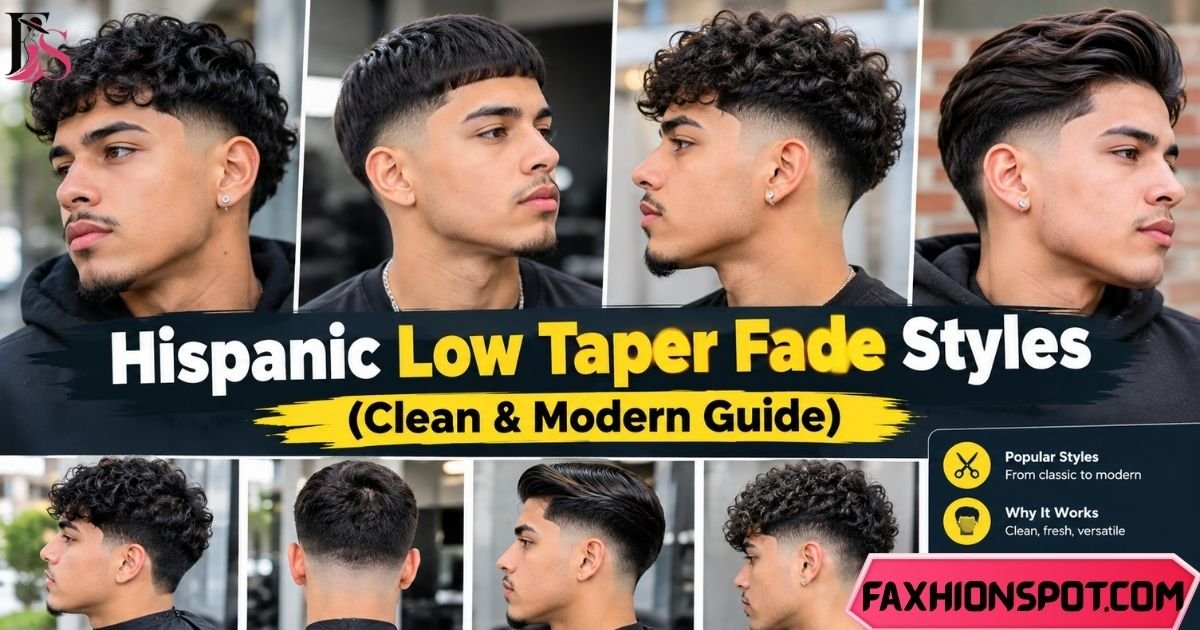
The Hispanic Low Taper Fade has become a popular choice for men who want clean sides without removing too much weight from the head.
It combines a subtle taper around the temples and neckline with enough length on top to create everything from an Edgar haircut to natural curls, waves, textured fringes, and slick styles.
This guide explains the haircut, popular variations, styling options, maintenance routine, barber terminology, and differences between clean and bold versions.
What Is a Low Taper Fade?
A low taper fade gradually reduces the hair around the sideburns, temples, ears, and neckline while keeping most of the sides and upper hair fuller.
Unlike a high fade, the transition does not travel far up the sides of the head. This creates a softer appearance and allows the natural shape and density of the hair to remain visible.
The Hispanic Low Taper Fade usually adds details that make the overall haircut more distinctive, such as a clean lineup, textured top, fringe, natural volume, curls, waves, or a beard connection.
Key Features
- Taper starts low around the ears and neckline
- More weight remains above the taper
- Works with multiple hair textures
- Can be paired with a lineup
- Looks good with short or medium-length tops
- Can connect naturally with facial hair
- Offers a softer grow-out than many higher fades
A low taper is also different from a traditional low fade. A low fade generally creates a broader faded area around the lower sides, while a taper focuses more closely on the edges. Current barber guides describe this distinction as one of the most important points to communicate during a haircut consultation.
Why Low Taper Fade Works Best for Hispanic Hair
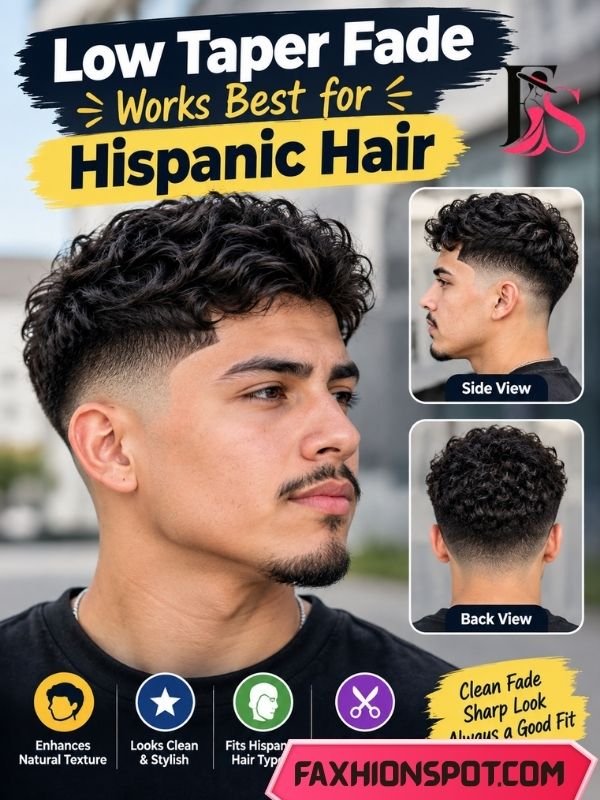
There is no single “Hispanic hair type.” Hispanic men can have straight, wavy, curly, coarse, dense, or fine hair. That variety is exactly why a customizable taper can work so well.
The Hispanic Low Taper Fade leaves room for the barber to work with the natural texture instead of cutting away too much of the side profile. This is particularly useful for thick or dense hair where completely removing the sides could make the haircut look overly aggressive.
A good barber considers:
| Hair characteristic | Recommended approach |
| Straight and thick | Textured top with clean taper |
| Wavy | Keep natural movement and volume |
| Curly | Preserve curl pattern and shape |
| Coarse | Remove excess bulk gradually |
| Fine | Keep enough top length for fullness |
| Dense | Use controlled tapering instead of excessive fading |
Face shape also matters. A longer top can add height to a rounder face, while a wider textured style can balance a longer face. Your natural hairline and growth direction should also influence the final design.
Most Popular Hispanic Low Taper Fade Styles
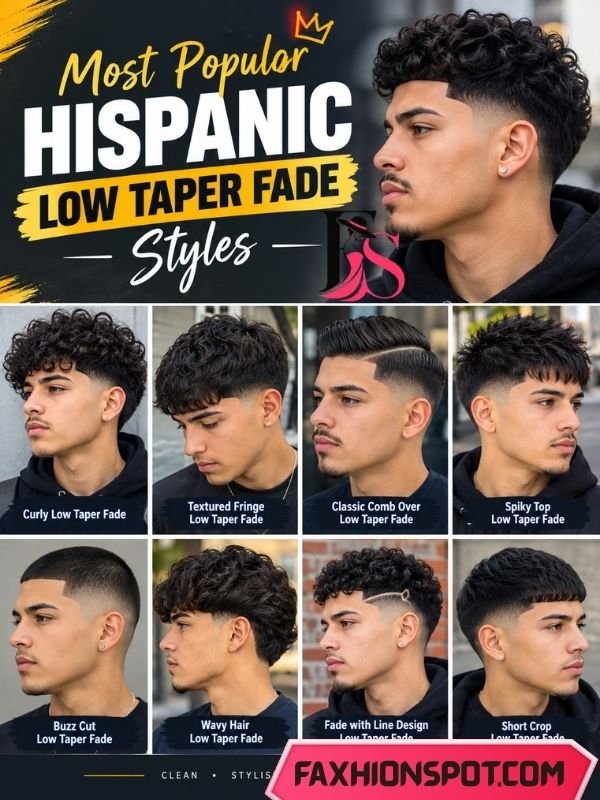
The Hispanic Low Taper Fade can be adapted into many different hairstyles. The most popular versions usually differ in the top rather than the basic taper itself.
Popular variations include:
- Classic low taper with natural texture
- Edgar haircut with low taper
- Textured fringe
- Curly top with tapered edges
- Wavy messy top
- Straight brushed-forward style
- Slick-back taper
- Middle-part taper
- Taper with lineup
- Taper connected to a beard
- Fluffy textured top
- Low taper with a short crop
Current Hispanic and Mexican haircut guides frequently highlight fringe styles, textured crops, curls, waves, longer tops, mullet-inspired shapes, and beard combinations as variations of the same low taper foundation.
The best choice depends less on a label and more on your hair density, texture, face shape, lifestyle, and the amount of styling you want to do each morning.
Edgar Haircut with Low Taper Fade
The Edgar is one of the most recognizable hairstyles associated with modern Latino barbering. It normally features a forward fringe with a defined front edge and short, controlled sides.
An Hispanic Low Taper Fade gives the Edgar a softer side profile than a higher fade. Instead of removing a large section of hair, the barber concentrates the taper around the temples, sideburns, and neckline.
This combination is especially useful if you like the recognizable Edgar shape but want something less extreme.
Edgar Styling Options
- Blunt straight fringe
- Textured Edgar
- Curly Edgar
- Short Edgar
- Fluffy Edgar
- Takuache-inspired Edgar
- Edgar with a subtle lineup
For a clean version, ask the barber to keep the fringe controlled and the taper compact. For a bolder version, you can add a sharper lineup, stronger texture, or a more defined fringe.
Modern Edgar guides similarly distinguish low-taper versions from stronger high-fade variations because the lower taper preserves more weight around the sides.
Low Taper Fade with Curly or Wavy Top
Curly and wavy hair can give the Hispanic Low Taper Fade a naturally textured appearance. Instead of forcing the top into a straight shape, the barber can preserve the natural curl or wave pattern.
For curly hair, the most important detail is controlling the perimeter without destroying the shape of the curls. The taper should clean the edges while leaving enough length for the curls to remain visible.
For wavy hair, a textured or slightly messy top can create a relaxed appearance.
Styling Tips for Curly or Wavy Hair
- Use a lightweight curl cream
- Avoid brushing curls when they are completely dry
- Let the hair dry naturally when possible
- Use a diffuser for additional volume
- Ask the barber to respect your natural curl pattern
- Avoid removing too much weight from the top
The result can be youthful and casual while still looking polished around the ears and neckline.
Low Taper Fade with Straight Hair
Straight hair gives the Hispanic Low Taper Fade a particularly clean silhouette. The straight texture makes the taper easy to see and allows several different top styles.
You can wear the hair forward, upward, backward, or to one side depending on the length.
Good Straight-Hair Combinations
- Straight textured fringe
- Side part
- Slick back
- Short crop
- Brushed-forward top
- Middle part
- Spiky textured top
For thick straight hair, ask your barber to remove some internal bulk if necessary. The goal is to prevent the top from becoming too heavy while maintaining enough length for styling.
For finer straight hair, avoid excessive thinning. Keeping controlled length on top can help the haircut appear fuller.
Low Taper Fade with Beard (Latino Style)
Adding facial hair creates a stronger connection between the haircut and the jawline. A beard can be blended into the sideburn area so the transition looks intentional rather than disconnected.
The Hispanic Low Taper Fade with a beard can be worn with short stubble, a boxed beard, or a fuller beard.
Beard Pairing Ideas
| Beard style | Overall effect |
| Light stubble | Simple and modern |
| Short boxed beard | Clean and mature |
| Medium beard | Stronger contrast |
| Full beard | More substantial appearance |
| Beard fade | Seamless connection |
Ask your barber to coordinate the sideburn taper with the beard length. Keeping the transitions balanced is more important than making every section extremely short.
If your beard is naturally uneven, a skilled barber can shape the outline around its growth pattern instead of forcing an unrealistic shape.
Clean vs Bold Hispanic Low Taper Fade Looks
The same basic haircut can look very different depending on how aggressively the barber handles the lineup, texture, fringe, and contrast.
Clean Look
A clean version focuses on subtle detailing and easy styling.
It usually includes:
- Low, compact taper
- Natural top texture
- Soft or precise lineup
- Moderate contrast
- Conservative neckline
- Minimal razor designs
This version works particularly well for school, college, work, interviews, and situations where you want a modern haircut without an overly dramatic finish.
Bold Look
A bold version uses stronger details to make the haircut stand out.
Common additions include:
- Sharp lineup
- Defined Edgar fringe
- Strong texture
- Razor line or design
- Higher contrast at the edges
- Beard fade
- More dramatic top styling
The Hispanic Low Taper Fade can therefore move between subtle and expressive depending on how the top and edges are finished.
Best Low Taper Fade for Different Situations
Choosing a haircut is easier when you consider where you will wear it.
| Situation | Style to consider |
| School | Natural taper with textured top |
| College | Edgar or wavy textured top |
| Office | Side part or neat straight top |
| Casual outings | Fluffy or messy texture |
| Formal events | Slick back or controlled side part |
| Athletic lifestyle | Short textured crop |
| Beard wearers | Taper blended into beard |
| Curly hair | Natural curls with clean edges |
The Hispanic Low Taper Fade is especially adaptable because the sides remain relatively conservative while the top can be changed to match the occasion.
How to Ask Your Barber
A clear barber request can prevent one of the most common haircut problems: getting a fade that is much higher than expected.
Instead of simply saying “give me a low taper,” explain exactly what you want.
Try this barber script:
“I want a low taper around the temples, sideburns, and neckline. Keep the sides above the taper full, and don’t take the fade too high. Keep the top around my current length and shape it according to my natural texture.”
Then add your preferred top style:
- “I want a textured fringe.”
- “I want an Edgar.”
- “Keep my curls natural.”
- “Leave enough length for a side part.”
- “Connect the taper naturally into my beard.”
Taking a reference photo is also useful because terms such as “low taper,” “low fade,” and “Edgar” can be interpreted differently between barbershops.
Maintenance & Styling Tips for Hispanic Hair
A fresh haircut looks best when the home routine matches the haircut.
The Hispanic Low Taper Fade generally requires less daily work than more elaborate high-contrast styles, but the edges still need regular attention.
Simple Maintenance Routine
- Wash according to your hair type.
- Use conditioner when your hair needs additional moisture.
- Apply a suitable styling product.
- Shape the top according to its natural texture.
- Keep the neckline and sideburns clean.
- Schedule a barber refresh before the taper becomes overgrown.
Skin-close versions may need refreshing sooner than guarded versions. One current barber guide suggests roughly two to three weeks for a skin taper and around three to five weeks for softer guarded versions, although individual hair growth varies.
For curly hair, prioritize products that enhance definition. For straight hair, a matte clay or lightweight styling cream can add texture without making the hair appear greasy.
Common Mistakes Hispanic Men Make
Even a good haircut can lose its shape when the consultation is unclear.
Mistake 1: Asking for a fade without specifying the height
“Fade” does not tell your barber whether you want low, mid, or high.
Mistake 2: Removing too much side weight
If you want a traditional low taper, explain that you want the upper sides to remain full.
Mistake 3: Ignoring natural texture
Curly, wavy, and straight hair require different cutting and styling approaches.
Mistake 4: Overdoing the lineup
A very sharp hairline may look impressive immediately but can make the haircut appear less natural as it grows.
Mistake 5: Forgetting the neckline
The back of the haircut affects the overall silhouette. Ask whether you want a natural, squared, or tapered neckline.
Mistake 6: Choosing a style only because it is trending
A haircut should fit your hair density, growth pattern, face shape, and daily routine.
Low Taper Fade vs Other Fades
The biggest difference between fades is where the shortest transition begins and how much side weight gets removed.
| Haircut | Fade position | Side weight | Overall appearance |
| Low taper | Very low | High | Subtle and versatile |
| Low fade | Low | Medium | Cleaner contrast |
| Mid fade | Middle | Lower | More noticeable |
| High fade | High | Low | Strong and dramatic |
| Burst fade | Around ear | Depends | Rounded, distinctive shape |
The Hispanic Low Taper Fade is generally the more conservative option because the transition stays concentrated around the lower edges.
A mid or high fade removes more visual weight from the sides. That can create stronger contrast but also changes the overall silhouette more dramatically.
For someone trying a fade for the first time, a low taper can provide a relatively conservative starting point because additional hair can always be removed later during the appointment.
Final Thoughts
The Hispanic Low Taper Fade is a flexible haircut rather than a single rigid style. Its defining idea is simple: keep the taper low, preserve useful weight above it, and shape the top around the wearer’s natural hair texture.
The most important step is communication. Tell your barber exactly how low you want the taper, how much side weight you want to keep, and what you want to do with the top. With the right proportions and regular maintenance, this haircut can remain clean, modern, and easy to style.
Frequently Asked Questions
Is low taper fade good for Hispanic hair?
Yes. It can work with straight, wavy, curly, coarse, and thick hair because the taper can be customized around the individual’s natural texture.
Is Edgar better with low taper or high fade?
A low taper creates a softer Edgar with more side weight, while a high fade creates stronger contrast and a more dramatic silhouette.
How long does a low taper fade last?
Most people refresh it every two to five weeks, depending on hair growth, taper length, and how sharp they want the edges to remain.
Is low taper fade professional?
Yes. Its subtle placement makes it suitable for many professional settings, especially when paired with a neat top and controlled neckline.