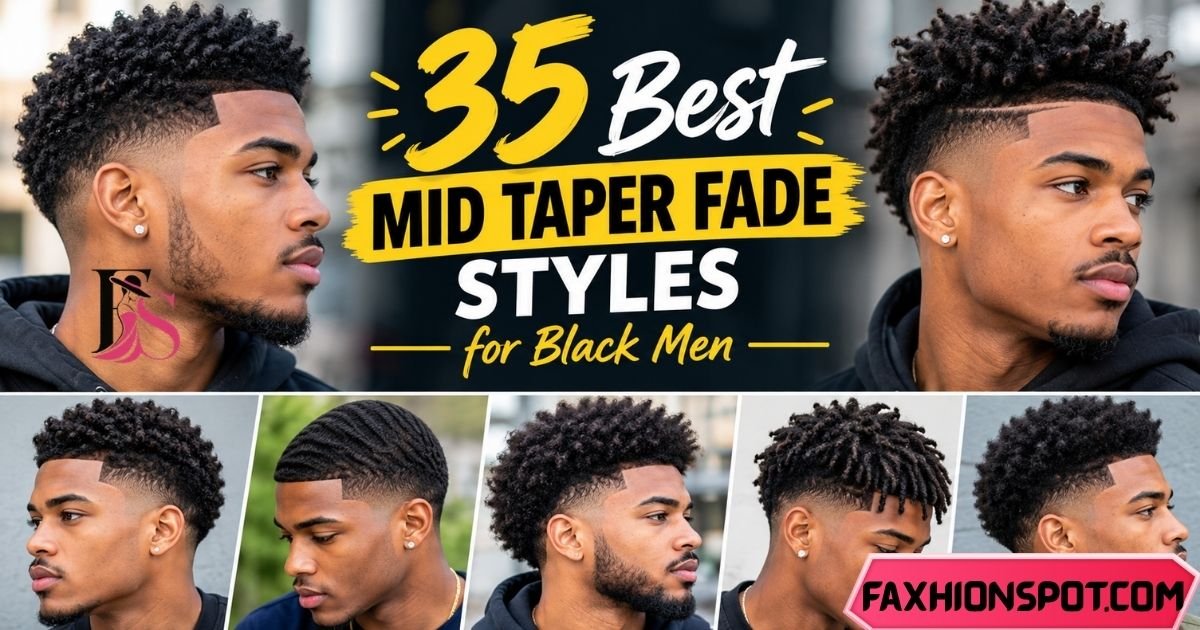
A great haircut does more than make your hair look neat. It should work with your natural texture, face shape, lifestyle, and personal style.
The challenge is knowing which variation suits you best and how to explain it to your barber. The phrase “mid taper” can produce slightly different results from one barbershop to another, so details matter.
This guide covers 35 popular styles, differences between taper heights, hair-type recommendations, barber scripts, maintenance, styling, common mistakes, and a practical at-home cutting overview.
What Is a Mid Taper Fade for Black Men and Why Does It Work So Well?
A mid taper fade gradually reduces the hair around the middle area of the temples and continues toward the sideburns and neckline. Unlike a full fade, the shortest area is concentrated around the perimeter rather than removing large sections of hair across the entire side.
The result is a clean outline with plenty of room for the natural texture on top to remain the star.
For Black men, this combination works particularly well with coily, curly, wavy, and textured hair. The shorter perimeter can make the top appear fuller and more defined while giving the haircut a polished finish.
Modern barber guides describe the cut as a balanced option between a lower taper and a higher, more dramatic taper.
What is a mid-taper fade?
The defining feature is where the taper begins, not simply how short the hair becomes.
Generally:
- A low taper begins closer to the ears and lower neckline.
- A mid taper begins around the middle of the temple area.
- A high taper starts farther upward and creates stronger contrast.
- A skin finish determines how short the lowest section becomes.
- A shadow or clipper finish leaves slightly more visible hair.
“Mid” therefore describes the placement of the transition. It does not automatically mean that the barber should take the sides down to the skin.
Mid Taper Fade vs Low Taper vs High Taper: What’s the Real Difference?
| Feature | Low Taper | Mid Taper | High Taper |
| Starting point | Lower temple/sideburn | Middle temple | Higher temple |
| Overall contrast | Subtle | Balanced | Strong |
| Top remains dominant | Very high | High | Moderate |
| Best for | Conservative styles | Versatile everyday cuts | Bold looks |
| Visual effect | Soft and understated | Clean and balanced | Sharp and dramatic |
| Maintenance | Usually lower | Moderate | Often higher |
If you want your haircut to look noticeable without making the sides dominate the entire style, the middle placement is often the safest choice.
Why the Mid Taper Fade Works So Well for Black Hair
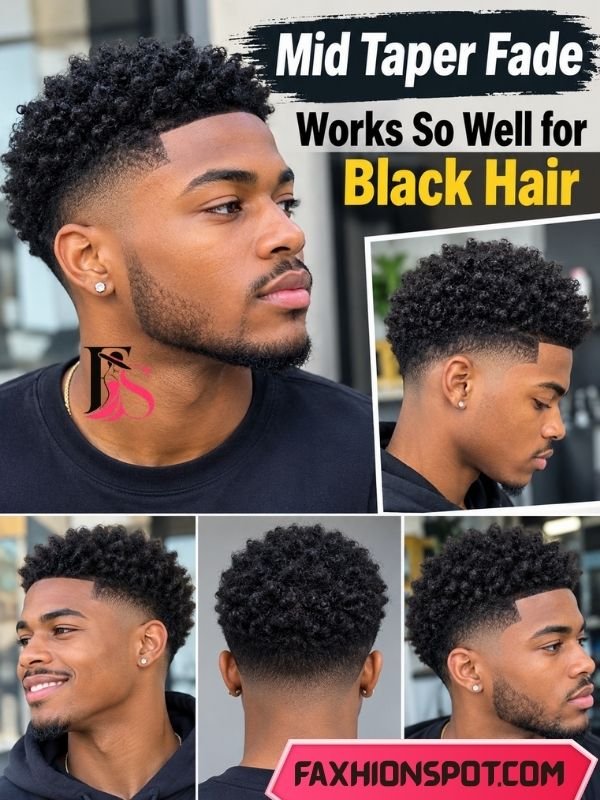
Black hair offers an exceptional range of textures and styling possibilities. From tight 4C coils to looser curls, waves, twists, locs, and natural afros, the same perimeter technique can support completely different looks.
The taper helps control bulk around the temples and neckline while allowing the top to retain personality.
Another advantage is adaptability. You can keep the top extremely short for a buzz cut, medium length for curls or twists, or considerably longer for locs and braids.
Which Mid Taper Fade Styles Work Best for Your Hair Type?
| Hair type | Recommended styles | Styling priority |
| 4A curls | Defined curls, crop, short afro | Moisture + definition |
| 4B coils | Sponge twists, afro, coils | Shape + hydration |
| 4C hair | Afro, waves, twists, short crop | Moisture + controlled shaping |
| Wavy hair | Waves, side part, textured top | Brushing + light hold |
| Thick hair | High top, afro, textured crop | Bulk control |
| Long hair | Locs, braids, bun | Perimeter cleanup |
| Fine hair | Caesar, short crop, waves | Avoid excessive removal |
The texture itself does not determine whether the haircut works. It changes how the final silhouette appears and how much length should remain on top.
35 Best Mid Taper Fade Styles for Black Men
Here are 35 versatile variations organized by hair length, texture, protective style, facial hair, and design preference.
Short Hair Mid Taper Fade Styles
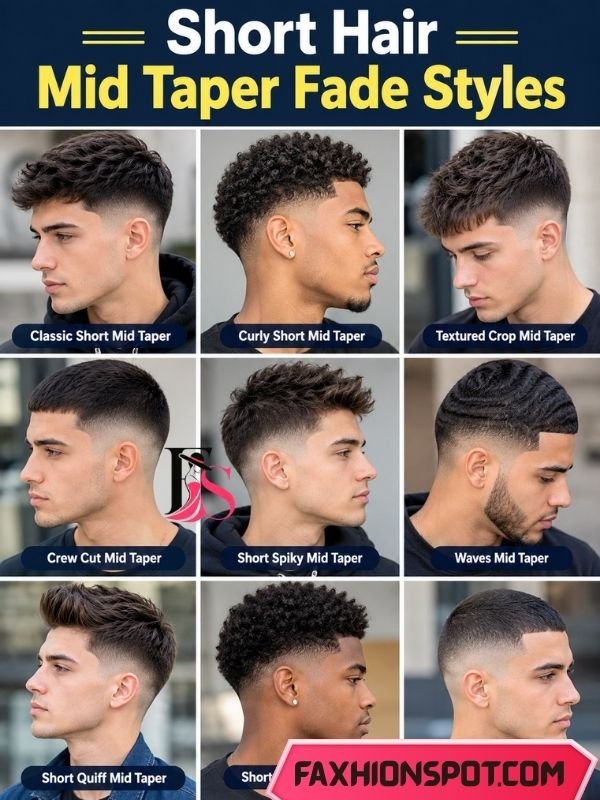
1. Buzz Cut with Mid Taper
A buzz cut keeps the top extremely short and uniform while the taper creates definition around the temples and neckline.
This is one of the easiest choices for men who want minimal styling. Ask your barber to keep the top even and make the transition around the perimeter smooth rather than overly aggressive.
Best for: Low-maintenance grooming and active lifestyles.
2. Low Afro with Mid Taper
A compact afro gives you natural volume without requiring the height of a traditional high top.
The tapered perimeter creates contrast between the rounded top and cleaner sides. A sharp line-up can make this style look especially polished.
3. Textured Crop with Mid Taper
The textured crop keeps a short, deliberately messy top while the sides remain clean.
Use a small amount of matte styling product to separate the texture. This is particularly useful when you want a modern haircut that does not require extensive daily work.
4. French Crop with Mid Taper
A French crop combines a short textured top with a forward fringe.
The taper keeps the area around the temples controlled while the fringe provides a strong front profile.
Styling tip: Work product through the top with your fingertips rather than flattening the hair with a comb.
5. Caesar Cut with Mid Taper
The Caesar features a short, forward-directed top and compact fringe.
It is a practical choice for men who prefer short hair but still want texture and shape. The clean perimeter gives the classic cut a more contemporary finish.
6. Crop Top Fade with Mid Taper
A crop top adds slightly more volume and texture than a traditional Caesar.
Keep the top textured rather than overly uniform. A natural edge-up can complete the look without making the haircut appear too rigid.
7. 360 Waves with Mid Taper
360 waves require commitment, brushing, compression, and proper hair care.
The taper creates a clean perimeter while the waves remain the centerpiece. Because the wave pattern is highly visible, a precise line-up can dramatically improve the finished appearance.
Best for: Short, dense hair that responds well to wave training.
8. Side Part with Mid Taper
A side part adds structure to a classic short haircut.
Your barber can create a natural part or define it with a razor. Keep the part subtle for a professional appearance or more pronounced for a sharper fashion look.
Afro Mid Taper Fade Styles for Black Men
9. Classic Afro with Mid Taper
A classic rounded afro provides natural volume while the taper reduces visual bulk around the perimeter.
This is one of the strongest options for men who want to celebrate natural texture without sacrificing a clean outline.
10. High Top Afro with Mid Taper
The high top creates vertical height and a recognizable silhouette.
The taper keeps the lower sides controlled, allowing the upper shape to appear taller. It can be squared off or given a slightly rounded finish depending on your preference.
11. Mini Afro with Mid Taper
A mini afro is shorter, easier to maintain, and suitable for everyday grooming.
It works especially well when you want visible natural texture without committing to a large amount of hair.
12. Sponged Afro with Mid Taper
A curl sponge can create small, separated coils across the top.
Apply a suitable curl product to slightly damp hair and use the sponge in circular motions. Avoid excessive manipulation because too much friction can create dryness or breakage.
13. Afro Hawk (FroHawk) with Mid Taper
The FroHawk concentrates volume through the center of the head while the sides are reduced.
It offers a bold shape without requiring the full commitment of a traditional mohawk. The taper makes the transition cleaner and more wearable.
14. Blowout Afro with Mid Taper
A blowout afro emphasizes volume and upward movement.
This version works best when the top has enough density to create height. Use a diffuser or controlled blow-drying technique rather than excessive heat.
15. Afro with Edge-Up and Mid Taper
Adding an edge-up gives the afro a sharper frame.
The key is restraint. A natural-looking hairline usually complements textured hair better than an excessively squared or pushed-back edge.
16. Short Afro with Beard and Mid Taper
Combining a short afro with facial hair creates a cohesive, masculine silhouette.
The barber should connect the sideburn area carefully with the beard so that the transition does not appear disconnected.
Curly and Textured Top Mid Taper Fades
17. Defined Curls with Mid Taper
Defined curls bring attention to the natural pattern of the hair.
Keep the sides controlled while preserving enough length on top for the curls to form properly. Curl cream or a lightweight leave-in can enhance definition without making the hair stiff.
18. Finger Coils with Mid Taper
Finger coils create small, deliberate curl formations.
They work particularly well for short-to-medium natural hair. Ask your barber not to remove too much length from the top if you want the coils to remain visible.
19. Twist-Out with Mid Taper
A twist-out creates soft, separated texture after twists are unraveled.
The contrast between the textured top and clean perimeter makes this an excellent option for natural-hair styling.
20. Curly Pompadour with Mid Taper
The curly pompadour adds height toward the front while retaining natural texture.
Use a lightweight styling cream and shape the front upward and slightly backward. Avoid heavy products that can flatten the curl pattern.
21. Quiff with Mid Taper
A textured quiff gives you more height at the front without requiring extremely long hair.
This style is useful for men who want a contemporary appearance with a relatively simple morning routine.
22. Sponge Twists with Mid Taper
Sponge twists are a natural choice for coily and curly textures.
The twists add visual detail while the tapered perimeter keeps the overall shape controlled. Moisturize regularly and avoid excessive sponge use if your hair becomes dry easily.
Long Hair and Protective Style Mid Taper Fades
23. Dreadlocks / Locs with Mid Taper
Locs and a tapered perimeter create a strong contrast between long hair and clean edges.
The taper can be kept relatively subtle so that the locs remain the focus.
Barber request: “Clean up my temples and neckline, keep the locs untouched, and blend the perimeter naturally.”
24. Loc Bun with Mid Taper
Pulling longer locs into a bun exposes the tapered sides and neckline.
This is a practical way to create two different looks from the same haircut: loose locs for casual occasions and a bun for a cleaner appearance.
25. Box Braids with Mid Taper
Box braids paired with a clean perimeter offer a polished contrast.
Keep the taper narrow enough that it does not interfere with the braid pattern. Your barber and braider should ideally coordinate the desired hairline.
26. Feed-In Braids with Mid Taper
Feed-in braids create a sleek, structured appearance.
A clean taper around the temples and nape helps the braid design stand out without competing with it.
27. Cornrows with Mid Taper
Cornrows can be combined with a tapered perimeter for a sharp, organized finish.
The exact design can range from simple straight-back rows to intricate geometric patterns.
28. Man Bun with Mid Taper
A man bun paired with a tapered perimeter creates contrast between long top length and clean sides.
This style works best when the top is long enough to secure comfortably without excessive pulling.
29. Rope Twists with Mid Taper
Rope twists give long textured hair a defined, directional appearance.
The taper cleans the perimeter while the twists provide length and movement.
Mid Taper Fade with Beard Styles
30. Mid Taper Fade with Full Beard
A full beard can make the haircut appear more substantial.
The important detail is the sideburn transition. Ask the barber to gradually connect the haircut to the beard rather than creating a sudden break.
31. Mid Taper Fade with Short Beard or Stubble
Short facial hair creates a cleaner and more understated appearance.
This option is particularly effective when you want the haircut to remain the primary focus.
32. Mid Taper Fade with Angular Beard
An angular beard emphasizes the jawline.
Pairing a structured beard with a clean taper can add definition to rounder or softer face shapes. Keep the angles intentional rather than excessively sharp.
Mid Taper Fade with Designs and Artistic Details
33. Mid Taper Fade with Shaved Line Design
A single shaved line can add personality without overwhelming the haircut.
Place it near the temple or through the tapered area. One clean design often looks more sophisticated than several competing lines.
34. Mid Taper Fade with Geometric Pattern
Geometric designs are best suited to clients who want an artistic haircut.
Triangles, curves, zigzags, and parallel lines can all work, but the design should follow the natural shape of the head.
35. Mid Taper Fade with Full Line-Up and Crisp Edge-Up
This is the classic sharp-barbershop finish.
The taper provides the blend while the line-up defines the forehead, temples, and neckline. It works with almost any short or medium top style.
How to Choose the Right Mid Taper Fade for Your Face Shape
The best haircut is not necessarily the most popular one. Face shape can help determine where you should add volume and how much contrast you want around the sides.
Oval Face Shape
Oval faces are highly adaptable.
Almost every variation can work, including waves, curls, afros, crops, twists, and longer textured tops. Focus more on your preferred maintenance level than on correcting proportions.
Round Face Shape
Round faces often benefit from controlled sides and additional vertical height.
Consider a high top, textured curls, or a slightly elevated afro. Avoid excessive horizontal bulk around the cheeks and temples.
Square Face Shape
Square faces already have strong jaw and cheekbone structure.
A short crop, waves, afro, or textured top can work well. Keep the edges clean but avoid making every line excessively sharp if you want a softer appearance.
Heart Face Shape
Heart-shaped faces are wider around the forehead and narrower near the chin.
Moderate volume on top can work well, particularly when paired with balanced facial hair.
Oblong or Long Face Shape
Very tall hairstyles can visually lengthen an already long face.
Try a lower-volume top with controlled texture. A balanced beard can also add visual width around the jaw.
Diamond Face Shape
Diamond faces usually have prominent cheekbones and a narrower forehead and jaw.
Textured curls, medium afros, twists, and controlled volume can complement this shape. Avoid creating too much extreme height if you want a balanced silhouette.
How to Ask Your Barber for a Mid Taper Fade – The Complete Communication Guide
One of the biggest haircut mistakes is assuming that the haircut name communicates everything.
It does not.
Barbers may interpret the same terminology differently, so explain the height, finish, top length, hairline, and neckline.
Step-by-Step: What to Say to Your Barber
Tell your barber these five things:
- Where you want the taper: low, middle, or high.
- How short you want the finish: shadow, clipper-short, or skin.
- How much length you want on top.
- How you want the hairline: natural or sharp.
- How you want the neckline finished.
Then show a reference photo from the front and side.
A photo is especially useful because terminology can vary between barbershops. Current haircut guides repeatedly recommend specifying the exact placement and finish rather than relying only on the phrase “mid taper.”
Exact Barber Scripts by Style
For waves:
“Keep my 360 waves intact. I want a medium-height taper around the temples and neckline, a clean but natural line-up, and don’t take too much from the sides.”
For a short afro:
“Keep my afro shape and length on top. Clean up the temples and neckline with a medium taper, but don’t make the sides too bare.”
For curls:
“Keep enough length for my curls to form naturally. Blend the temples and neckline gradually and keep the edge-up natural.”
For twists:
“Leave the twists and top length alone. Clean the perimeter with a medium taper and keep the transition smooth.”
For locs:
“Clean the temples, sideburns, and neckline without cutting into the locs. I want a controlled taper rather than a high fade.”
Mid Taper Fade Maintenance and Aftercare for Black Men
A great haircut loses its impact when the perimeter grows out unevenly.
Maintenance depends on how close the taper is and how quickly your hair grows.
How Often Should You Refresh a Mid-Taper Fade?
Most people can refresh the cut approximately every 2 to 4 weeks.
A very sharp skin finish may require earlier cleanup, while a softer shadow finish can remain presentable longer.
Haircut guides commonly place maintenance around the two-to-four-week range depending on the finish and growth rate.
For special events, consider scheduling your barber appointment several days before the occasion rather than immediately beforehand.
Daily Styling Routine by Style Type
For waves:
- Brush consistently.
- Use a suitable moisturizer.
- Wear a durag or wave cap when appropriate.
- Avoid excessive product buildup.
For curls:
- Start with damp hair.
- Apply leave-in conditioner or curl cream.
- Use your fingers or a curl sponge gently.
- Let the hair air-dry or use controlled low heat.
For afro styles:
- Moisturize regularly.
- Pick or shape gently.
- Avoid aggressive brushing when dry.
- Sleep with suitable hair protection.
For twists and locs:
- Keep the scalp clean.
- Moisturize according to your hair’s needs.
- Avoid excessive tension.
- Refresh the perimeter when necessary.
Best Products for Black Hair After a Mid Taper Fade
Choose products based on the top style rather than the haircut name.
| Style | Useful product type |
| Waves | Light moisturizer, wave cream |
| Curls | Leave-in conditioner, curl cream |
| Afro | Moisturizer, light styling cream |
| Sponge twists | Curl cream or light gel |
| Locs | Lightweight scalp and loc products |
| Braids | Light scalp moisturizer |
| Short crop | Matte cream or clay |
Avoid using heavy products simply to create shine. Too much buildup can make textured hair look greasy and may make cleansing more difficult.
How to Cut a Mid Taper Fade at Home – Step-by-Step
Cutting your own taper is considerably harder than maintaining an existing haircut.
If you are inexperienced, a professional barber is the safer choice. However, understanding the process can help you communicate with your barber or perform minor maintenance between appointments.
Tools You Need
- Adjustable clipper
- Clipper guards
- Detail trimmer
- Barber comb
- Hand mirror
- Hair clips
- Neck brush
- Disinfectant
- Good lighting
Never use unclean tools. Clippers and trimmers should be cleaned and disinfected according to their manufacturer’s instructions.
Step-by-Step: Mid Taper Fade at Home
Step 1: Establish the taper area.
Identify the temple and neckline sections where you want the transition.
Step 2: Start conservatively.
Use a longer guard first. You can always remove more hair, but you cannot immediately put it back.
Step 3: Create the first guideline.
Work around the selected perimeter without pushing the taper too high.
Step 4: Blend gradually.
Move through progressively longer guard settings to soften visible lines.
Step 5: Check both sides.
Use a hand mirror to compare the temples and neckline.
Step 6: Detail carefully.
Use the trimmer for the final outline rather than repeatedly digging into the fade.
Step 7: Stop before overcorrecting.
Many home cuts become uneven because the person keeps removing hair to fix a small imperfection.
The biggest beginner mistake is taking the taper too high. A professional barber can better judge the head shape, hair density, and natural growth pattern.
Common Mid Taper Fade Mistakes to Avoid
1. Saying Only “Give Me a Mid Taper”
The term alone may not communicate the finish you want.
Specify whether you want a shadow, short clipper finish, or skin-level result.
2. Ignoring Shrinkage
Curly and coily hair can look significantly shorter when dry.
Tell your barber how you normally wear the hair rather than judging length only while it is wet.
3. Taking the Taper Too High
A higher transition changes the entire silhouette.
If you want to preserve substantial side volume, clearly tell the barber to keep the taper concentrated around the perimeter.
4. Overdoing the Edge-Up
An excessively pushed-back hairline can change the appearance of your forehead.
A clean natural edge usually ages better than an artificially altered one.
5. Forgetting the Beard
If you have facial hair, the sideburn transition should be planned together with the haircut.
The hair, sideburn, and beard should look like one connected design.
6. Choosing a Style Without Considering Maintenance
360 waves require daily or frequent grooming. Locs and braids have their own care routines. A simple crop requires far less work.
Choose a haircut that fits your actual schedule.
Click Here To Read Another Topic
The Cultural Significance of the Mid-Taper Fade in Black Grooming History
The modern taper exists within a much broader history of Black grooming and barber culture.
Barbershops have long been important spaces for personal expression, community, conversation, and identity. Hairstyles such as afros, waves, fades, high tops, line-ups, braids, twists, and locs have each reflected changing trends while allowing individuals to express personality and cultural connection.
The modern taper combines that tradition with contemporary precision. Natural texture remains visible on top while the perimeter receives detailed shaping.
That balance explains why the style can move easily between casual environments, professional settings, fashion-forward looks, and traditional barbershop aesthetics.
Rather than being a single fixed haircut, it is better understood as a framework that can be customized around the individual’s hair and preferred appearance.
Frequently Asked Questions
What is a mid taper fade for Black men?
It is a tapered haircut where the transition begins around the middle temple area and blends toward the sideburns and neckline while the top remains customizable.
Is a mid taper good for 4C hair?
Yes. It works well with 4C hair when the barber preserves enough top length for the desired afro, coils, twists, or other texture.
Is a mid taper better than a low taper?
Neither is universally better. A mid taper creates more visible contrast, while a low taper usually gives a softer and more understated result.
How long does a mid taper last?
A clean appearance commonly lasts around two to four weeks, depending on growth rate and how close the finish is.
Can I get a mid taper with waves?
Yes. 360 waves are one of the most popular combinations because the clean perimeter emphasizes the wave pattern.
Can I combine a taper with locs?
Yes. A tapered perimeter can clean up the temples and neckline while leaving the loc length intact.
Does a taper have to reach the skin?
No. You can request a shadow, clipper-short, or skin finish.
What should I show my barber?
Bring a clear reference photo showing the front, side, and preferably back of the haircut.
How often should I get a line-up?
Many people refresh their line-up between full haircuts, but the ideal timing depends on growth speed and how sharp you want the hairline.
Can I cut this style at home?
It is possible, but blending the perimeter evenly is difficult for beginners. Professional cutting is recommended for the first attempt.
Does a taper work with a beard?
Yes. The barber can blend the sideburn area into the beard to create a continuous appearance.
What face shape works best?
The style is adaptable to oval, round, square, heart, oblong, and diamond face shapes. The top length and volume should be adjusted to complement your proportions.
Final Thoughts
The biggest advantage of this haircut is flexibility. You do not have to sacrifice your natural texture to get a clean, modern appearance. Waves, curls, afros, coils, twists, locs, braids, crops, and longer styles can all be paired with a carefully placed taper.
The key is communication. Tell your barber exactly where you want the taper to start, how short you want the finish, how much length should remain on top, and whether you prefer a natural or sharp hairline. A reference photo can eliminate much of the guesswork.
Most importantly, choose a version that fits your hair texture, face shape, lifestyle, and maintenance routine. When those four factors line up, the result looks intentional rather than simply trendy.
2 thoughts on “35 Best Mid Taper Fade Styles for Black Men (2026 Guide)”