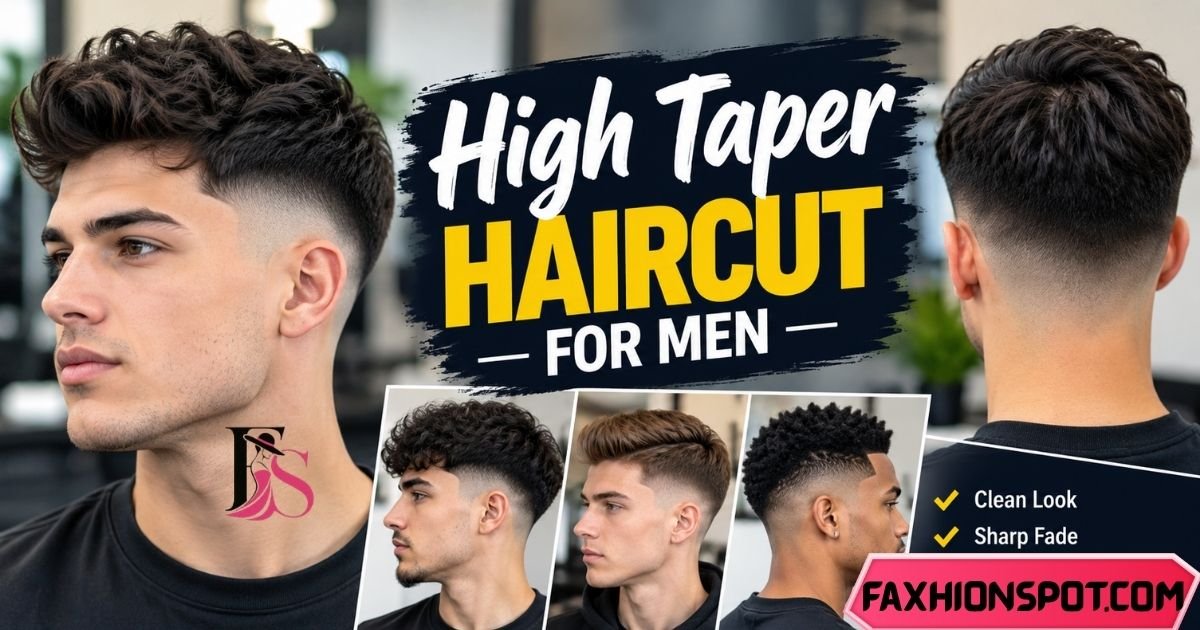
A high taper haircut is one of the easiest ways to create a clean, modern look while keeping enough length on top for personality.
The taper starts higher around the temples and upper sides, then gradually becomes shorter toward the sideburns and neckline. That higher placement creates more contrast than a low or mid taper without necessarily turning the entire side of the head into a skin fade.
What Is a High Taper Haircut, and Who Is It Best For?
A high taper haircut gradually removes length from the sides and back, with the blend beginning relatively high near the temples or upper side area. The hair does not simply stop at one length; it transitions through progressively shorter lengths to create a smooth perimeter.
The important point is placement. A low taper keeps most of the side weight intact, while a high taper removes more weight around the upper sides. This gives the top greater visual prominence.
It is particularly useful for men who want:
- Strong contrast between the top and sides
- A sharper temple area
- Less bulk around thick hair
- A modern silhouette
- Flexible styling on top
- A haircut that can be adapted to professional or casual settings
The final result depends heavily on the top length, hair density, natural growth pattern, and how aggressively the barber creates the blend.
High Taper Haircut vs High Taper Fade: What’s the Difference?
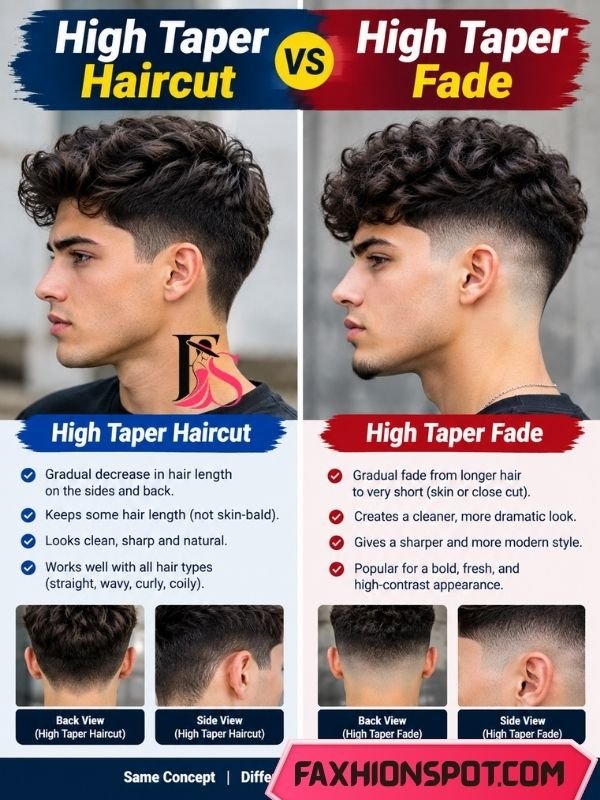
The terms taper and fade are often used interchangeably in everyday barber conversations, but they can describe slightly different finishes.
A traditional taper generally preserves more hair around the sides and neckline and gradually reduces the length toward the edges. A fade usually creates a more noticeable transition and can reach extremely short or skin-level hair.
That distinction matters because saying only “high taper fade” may produce different results depending on the barber.
If you want to keep visible weight above the ears, say so clearly. If you want the shortest portion to reach the skin, ask for a skin or bald finish.
Understanding High Taper Placement: Sides, Back & All Around
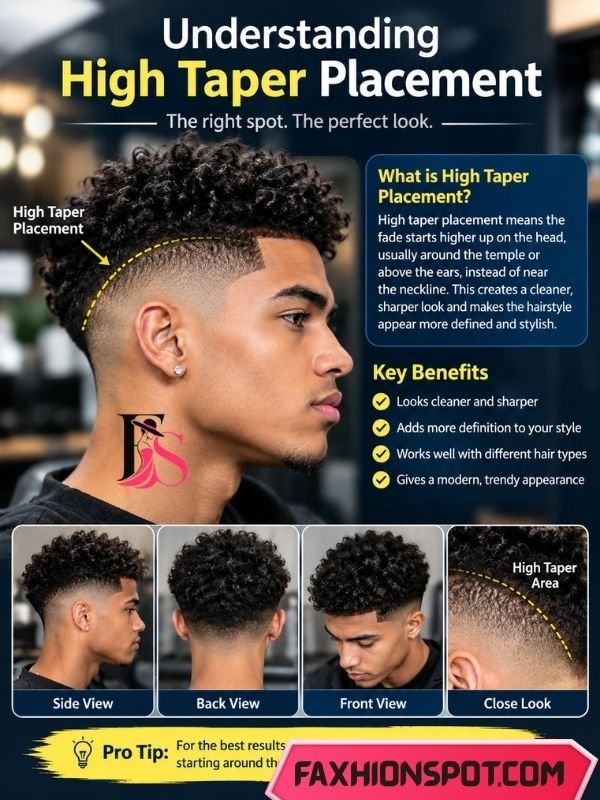
Placement determines how dramatic the haircut looks.
A high taper can be focused around the temples, sideburns, neckline, or all of those areas. Some men prefer a high temple taper but a softer neckline, while others want the same intensity around the entire perimeter.
What Does “High Taper on the Sides” Mean?
A high taper on the sides means the shortening begins higher around the temple and upper side area rather than directly beside the ear.
This exposes more of the head’s natural shape and creates stronger separation between the top and sides.
What Does “High Taper Back” Look Like?
A high taper back places the transition higher on the rear sides of the head while keeping the crown and top longer.
It can work especially well with textured tops, curls, longer hair, mullets, and styles that need a clean rear outline without completely removing the back length.
High Taper vs Other Taper Fades: Complete Comparison
Choosing between taper heights is easier when you understand what each one changes.
| Style | Blend Position | Overall Contrast | Best For |
| Low taper | Around ears and lower nape | Low | Conservative, natural looks |
| Mid taper | Around middle side area | Medium | Balanced modern styles |
| High taper | Around temples and upper sides | High | Bold contrast and volume |
| High skin fade | Very high with skin exposure | Very high | Dramatic, sharp looks |
High Taper vs Low Taper Fade
A low taper preserves more hair around the sides and usually looks softer. A high taper removes more weight higher up, making the top look fuller by comparison.
Choose low when you want subtlety. Choose high when you want visible contrast.
High Taper vs Mid Taper Fade
A mid taper sits between the two. It offers enough contrast to look modern without being as visually aggressive as a high placement.
For someone trying a taper for the first time, a mid version can be a useful middle ground.
High Taper vs High Fade (Skin Fade)
A high fade usually climbs higher and can transition all the way to bare skin. A high taper can retain more length and look less severe.
If you want your natural side hair to remain visible, explain that to your barber before the clippers come out.
35 Best High Taper Haircut Styles for Men (2026)
The best variation is the one that matches your texture, density, face shape, and daily styling habits.
High Taper Styles for Curly & Coily Hair
1. High Taper Fade Curly Top
Keep the curls full and defined on top while cleaning the temples and sideburns. This creates a strong contrast without forcing the curls into a short style.
2. High Taper Fade Afro
An afro paired with a high taper gives the silhouette sharper edges while preserving the natural volume of the top.
Keep the transition controlled rather than taking too much width away from the upper sides.
3. High Taper Fade Waves
Waves benefit from clean temple work because the pattern on top becomes the focal point.
A sharp lineup can make the look even more defined, although a natural hairline often produces a softer finish.
4. High Taper Fade Blowout
A blowout adds upward and outward volume to the top. The higher taper creates separation between that volume and the sides.
This option works particularly well for thick or naturally textured hair.
5. High Taper Fade Dreads
Dreads can be paired with a clean taper around the temples and neckline. Keep enough length around the roots to avoid making the style look disconnected.
6. High Taper Fade Fluffy Hair
Fluffy hair looks best when the taper controls the perimeter while leaving enough top length to preserve movement.
Use lightweight styling products rather than heavy pomades that flatten the texture.
7. High Taper Fade with Textured Fringe (Curly)
A curly fringe adds movement toward the forehead while the taper keeps the sides controlled.
This is especially useful if you want to highlight your natural curl pattern instead of brushing it backward.
8. High Taper Fade Black Male (Classic)
For Black men’s hair, the style can be combined with waves, curls, coils, an afro, sponge texture, or short natural hair.
The most important factor is respecting the natural density and growth direction.
High Taper Styles for Straight & Fine Hair
9. High Taper Fade Straight Hair
Straight hair makes the blend highly visible because individual strands lie relatively flat.
Keep the top textured if you want more movement, or use a clean combed style for a polished appearance.
10. High Taper Fade Side Part
A side part adds structure while the taper modernizes the classic shape.
This is a strong choice for men who need a haircut that can move between work and casual settings.
11. High Taper Fade Slick Back
Leave enough length to sweep the top backward. A matte product creates a contemporary result, while pomade produces more shine.
12. High Taper Fade Comb Over
The comb-over uses directional styling to create volume and definition.
It works particularly well when the top has moderate density and the hair naturally follows the desired direction.
13. High Taper Fade Buzz Cut
A buzz cut with a high taper keeps the overall haircut extremely simple while adding definition around the perimeter.
It is one of the lowest-maintenance choices on this list.
14. High Taper Fade Fringe (Straight)
A forward fringe balances the sharp sides with softer movement around the forehead.
Keep the front textured instead of excessively blunt if you want a contemporary finish.
15. High Taper Fade Blonde
Blonde hair can make a taper appear softer because there may be less visual contrast between hair and skin.
Texture, lighting, and density all influence how dramatic the blend appears.
High Taper Styles with Bold Statements
16. High Taper Fade Mohawk
The taper removes weight from the sides while leaving a longer central strip.
Add texture for a modern mohawk rather than relying on the extremely stiff styling associated with older versions.
17. High Taper Fade Mullet
A mullet keeps extra length toward the back while the taper cleans the temples and sides.
The result is contemporary, especially when the transition remains blended rather than disconnected.
18. High Taper Fade Pompadour
The pompadour needs height and controlled volume on top.
The taper makes that volume appear more pronounced by reducing the surrounding bulk.
19. High Taper Fade Quiff
A quiff is shorter and more flexible than a traditional pompadour.
Use a blow dryer to direct the front upward, then finish with a small amount of matte paste or clay.
20. High Taper Fade Edgar
The Edgar typically features a forward top and distinctive fringe.
Pairing it with a high taper increases the contrast and creates a sharper modern silhouette.
21. High Taper Fade with Design
A shaved line, geometric detail, or subtle pattern can be added around the tapered section.
Keep the design proportional to your haircut so it complements rather than overwhelms the style.
22. High Taper Fade Asian
Straight, thick Asian hair can carry strong structure and volume.
Ask your barber to remove excess weight without thinning the top excessively if you want a fuller appearance.
23. High Taper Fade with Beard
A beard can visually connect the haircut to the jawline.
The transition from sideburn to beard should be discussed with your barber so the two sections look intentional.
24. High Top Taper Fade
The high top keeps significant vertical volume while the sides are tapered.
This style works particularly well with dense curly or coily textures.
25. High Taper Fade Long Hair
Longer hair creates dramatic contrast against a tightly cleaned perimeter.
You can wear the top backward, forward, tied, or textured depending on its length.
High Taper Styles with Texture & Detail
26. Textured High Taper Fade
Texture makes the haircut look less uniform and more contemporary.
Point cutting, choppy layers, or controlled thinning can help create separation without destroying density.
27. Short High Taper Fade
A short top makes the taper the main feature.
This is ideal if you want a clean haircut that requires little daily styling.
28. High Taper Fade Haircut (Classic)
The classic version keeps the top moderately long and natural while creating a clean high transition around the perimeter.
It is versatile enough for everyday wear.
29. High Taper Fade Crop
A crop combines a short textured top with a forward fringe.
The taper adds definition around the sides while keeping the overall haircut easy to manage.
30. High Taper Fade with Braids
Braids can be paired with a clean tapered perimeter for a structured contrast.
The length and braid pattern determine how high the taper should sit.
31. High Taper Fade Man Bun
Long hair tied into a bun creates a striking contrast with clean tapered sides.
This option works best when the top and back have enough length to tie securely.
32. High Taper with Textured Fringe
A textured fringe is useful when you want the haircut to feel casual rather than overly polished.
Use a small amount of matte product to separate individual sections.
33. High Taper Fade Spiked
Short spikes create a youthful, energetic shape.
Avoid using too much product because excessive stiffness can make the hairstyle look dated.
34. High Taper Fade Brushed Forward
Brush the top toward the forehead and use a light styling product to maintain direction.
This variation is especially easy for straight and slightly wavy hair.
35. High Taper Business Professional
Keep the top controlled, the fringe clean, and the taper blended rather than extremely exposed.
A side part, comb-over, or neat brushed-back style can make the cut suitable for conservative workplaces.
How to Choose the Right High Taper Haircut for You
There are three major factors to consider: face shape, hair type, and lifestyle.
A haircut that looks excellent in a photograph may not behave the same way on your head. Your density, cowlicks, hairline, curl pattern, and styling time all matter.
Which Face Shape Suits a High Taper Best?
The higher the taper, the more visual attention it places on the upper portion of the head. That makes the top length and volume important for facial balance.
High Taper for Round Face
Add height and texture on top to make the face appear longer. Avoid excessive width around the sides.
High Taper for Oval Face
Oval faces are highly adaptable. Most taper heights and top styles can work well when the proportions are balanced.
High Taper for Square Face
A square face can handle strong, structured lines. A clean taper with textured or slightly longer hair on top creates a confident appearance.
High Taper for Heart-Shaped Face
Keep enough top volume to balance the forehead while avoiding excessive sharpness around the temples.
High Taper for Diamond Face
Texture and moderate top volume can soften the sharper cheekbone structure associated with a diamond face.
High Taper for Rectangular/Oblong Face
Avoid adding excessive height. A little more forward movement or fringe can help visually reduce the length of the face.
High Taper for Different Hair Types
High Taper for Straight Hair
Straight hair shows the blend clearly, so precision matters. Texture on top can prevent the hairstyle from looking too flat.
High Taper for Curly Hair
Curly hair naturally creates volume. Keep the curls defined and tell your barber how much length you want preserved.
For curly hair, cutting and styling based on the natural curl pattern is especially important. Blowout taper guides also emphasize controlling volume while preserving curl definition.
High Taper for Coily Hair (Type 4)
Coily hair can create exceptional shape and density. The taper can clean the perimeter while leaving the natural texture dominant.
High Taper for Thick Hair
This is one of the easiest textures to adapt because the taper removes unwanted side weight.
Ask your barber to remove bulk strategically instead of excessively thinning the top.
High Taper for Fine/Thin Hair
Keep the top visually dense. Avoid aggressive thinning, because removing too much weight can make fine hair appear even thinner.
How to Ask Your Barber for a High Taper Haircut
Do not rely on the haircut name alone.
The best barber consultation explains where the taper starts, how short you want the edges, how much length stays on top, and how you intend to style it.
The Golden Rule of Barber Communication
Show your barber two or three reference photographs from different angles.
Then say something like:
“I want a high taper around the temples and sides. Keep the top around three to four inches, depending on what works with my hair. I want the transition clean but not completely bald. Keep the top textured and preserve enough weight for styling. Please keep the taper from climbing too far into the crown.”
If you want skin exposure, say:
“Take the bottom of the blend down to skin, but keep the transition smooth.”
If you want a softer finish:
“Keep some visible length in the taper and avoid making it look like a high skin fade.”
The exact guard sequence can vary between clippers and barbers, so the visual result matters more than demanding one specific number.
Clipper Guard Numbers Explained: High Taper Edition
Guard numbers are useful, but they are not universal measurements because lever positions, clipper brands, hair texture, and barber technique affect the result.
| Guard | Approximate Effect | Typical Use |
| #0 / trimmer | Very short | Edging or skin-adjacent work |
| #1 | Short | Lower taper area |
| #1.5 | Transitional | Blending |
| #2 | Short-medium | Building the blend |
| #3 | Medium-short | Upper transition |
| #4 | Longer | Softening the taper |
A good barber may switch between guards, clipper-over-comb, scissors, and lever positions to remove visible lines.
Do not insist on a particular guard simply because you saw it in an online haircut guide. Explain the result you want first.
How to Style a High Taper Haircut at Home
Your styling routine should match your top texture.
Straight hair may need direction and volume. Curly hair may need hydration and curl definition. Thick hair may need weight control, while fine hair usually benefits from lightweight products.
4-Step Daily Styling Process
Step 1: Start with slightly damp hair.
Towel-dry gently instead of aggressively rubbing the hair.
Step 2: Apply the right product.
Use sea salt spray or volumizing mousse for lift, matte clay for texture, or curl cream for naturally curly hair.
Step 3: Set the direction.
Use your fingers, brush, or blow dryer to create the desired shape.
Step 4: Finish lightly.
Add a small amount of clay, paste, pomade, or hairspray only where additional control is necessary.
For textured styles, less product often looks better. The goal is separation and movement rather than making every strand rigid.
How to Maintain a High Taper Haircut
Because the taper sits higher, regrowth can become visible fairly quickly. Regular cleanup keeps the contrast intentional.
Barber Visit Frequency
For a very sharp finish, many men will benefit from visiting the barber roughly every 2 to 3 weeks.
A softer, more natural version can often be stretched longer depending on how quickly the hair grows.
The exact timing depends on hair growth rate, taper height, and how important sharp edges are to you.
Key Facts:
- Higher taper placement creates stronger contrast.
- A taper does not automatically mean a skin fade.
- Top length determines much of the haircut’s personality.
- Hair texture should influence the cutting technique.
- Reference photos are more reliable than haircut names alone.
- Fine hair should not be excessively thinned.
- Curly and coily hair should be shaped around its natural pattern.
- A high taper usually needs more frequent cleanup than a low taper.
At-Home Maintenance Between Cuts
Use a gentle shampoo and conditioner suited to your hair type.
Avoid repeatedly shaving your own taper unless you have experience doing so. One uneven line can change the entire shape.
Instead, maintain the top, wash regularly, moisturize when necessary, and keep the neckline clean if you have the tools and skill to do it safely.
What to Do If Your Taper Grows Out
Do not immediately cut the entire hairstyle shorter.
First decide whether the problem is the neckline, sideburns, temple area, or overall length. Sometimes a simple cleanup restores the haircut without sacrificing the top.
If the sides have become too heavy, ask your barber to recreate the original transition rather than starting from scratch.
Best Hair Products for High Taper Haircuts
The right product depends more on the top than on the taper itself.
Styling Products
Matte clay: Best for texture, separation, and medium-to-strong control.
Matte paste: Good for flexible everyday styles.
Pomade: Useful for slick backs, side parts, and shiny classic looks.
Sea salt spray: Adds texture and volume before blow-drying.
Curl cream: Helps curly hair maintain definition and softness.
Light hairspray: Useful when you need extra hold without adding heavy product.
Hair Care Products
Use a shampoo that does not leave your hair excessively dry. Follow with conditioner when your texture benefits from additional moisture.
For curly and coily hair, hydration is particularly important because dryness can make definition and styling more difficult.
Low Taper Fringe Haircut Guide: 12 Styles, Every Hair Type, and Exactly What to Tell Your Barber
Although the high taper is the focus of this guide, a low taper fringe is worth considering if you prefer a softer silhouette.
A low taper keeps the transition close to the ears and lower neckline while leaving more side weight. The longer fringe can fall forward, making it useful for straight, wavy, curly, and textured hair. Current hairstyle guides commonly emphasize brow-length texture, point cutting, and a low blend around the perimeter.
Popular variations include:
- Textured low taper fringe
- Choppy fringe
- Curly fringe
- Wavy fringe
- French crop fringe
- Straight fringe
- Messy fringe
- Short fringe
- Long fringe
- Side-swept fringe
- Blunt fringe
- Layered fringe
Ask your barber to keep the taper low and preserve enough front length for the fringe to fall naturally.
Blowout Taper for Curly Hair: What to Ask Your Barber + How to Style It
A blowout taper combines a tapered perimeter with volume on top. Curly hair is particularly well suited to the concept because curls can naturally create lift and fullness.
Tell your barber:
“Keep my curls full on top and create a clean taper around the temples, sideburns, and neckline. I want volume rather than a flat finish, and I don’t want the taper to remove too much of my curl density.”
For styling, apply curl cream to damp hair, use a diffuser on moderate heat, and direct the curls upward and outward.
Do not aggressively brush dry curls because that can disturb definition and create unnecessary frizz.
Blowout Taper Textured Fringe – Low, Mid & High: What to Ask For and How to Style It
A blowout taper with textured fringe combines two strong elements: volume and forward movement.
A low taper keeps the look subtle.
A mid taper creates a balanced contrast.
A high taper produces the strongest separation between the textured fringe and the sides.
For the fringe, ask for point-cut texture rather than an excessively heavy straight line. This allows the front to separate naturally and makes styling easier.
High Blowout Taper Haircut Guide: Low vs Mid vs High, Every Hair Type
The taper height should match both your texture and the amount of contrast you want.
| Blowout Taper | Visual Effect | Best For |
| Low | Soft and natural | Conservative styles |
| Mid | Balanced | Most face and hair types |
| High | Bold and dramatic | Thick, curly, or high-volume tops |
Straight hair may need a blow dryer and volumizing product to create the blowout effect. Curly and coily hair often achieves volume more naturally.
If you are uncertain, a mid placement is usually the safest starting point because it offers noticeable structure without being as dramatic as a high placement.
Frequently Asked Questions
Is a high taper good for thick hair?
Yes. It can remove excess side weight while preserving the thicker top for styling.
Is a high taper good for curly hair?
Yes. Curly hair can look especially strong with a clean tapered perimeter and defined curls on top.
How often should I get a taper?
A sharp version generally benefits from a cleanup every two to three weeks, although growth rate varies.
Is a high taper the same as a skin fade?
No. A taper can preserve more hair, while a skin fade typically blends down to bare skin.
What should I tell my barber?
Explain the taper height, desired top length, shortest finish, and styling direction, then show reference photos.
Can a high taper work with a fringe?
Yes. A textured fringe creates an effective contrast against the cleaner high sides.
Does a high taper suit a round face?
It can. Keeping some height and texture on top may create a longer-looking facial silhouette.
Can fine hair get this style?
Yes, but the barber should avoid excessive thinning and preserve as much visual density as possible.
Is a high taper professional?
It can be. A softer blend with a side part, comb-over, or controlled top is generally more office-friendly.
What is the biggest mistake to avoid?
Do not ask only for “a high taper” without explaining how high you want the blend and how much length you want to keep on top.
Final Words
The best high taper haircut is not necessarily the most dramatic one. It is the version that works with your natural texture, face shape, hair density, lifestyle, and styling ability.
With the right proportions, a high taper haircut can move easily from a clean professional look to a textured, fashion-forward style.