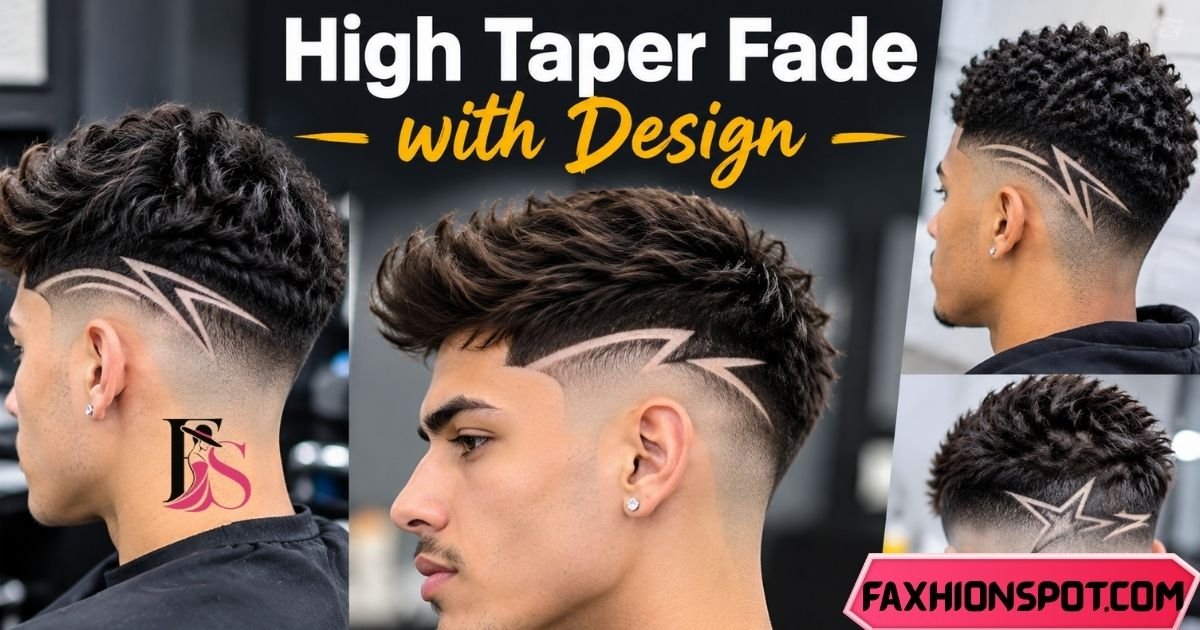
A high taper fade with design is one of the easiest ways to turn a familiar haircut into something personal.
The best part is that you do not need an extreme design to make the haircut stand out. A subtle slash, double line, curved pattern, or small geometric detail can completely change the appearance of the cut.
This guide covers 28 design ideas, the best choices for different hair types and face shapes, where to place the design, exactly what to tell your barber, how long the pattern lasts, styling advice, and common mistakes to avoid.
What Is a High Taper Fade With Design?
A high taper fade with design combines a high taper around the temples and upper side area with a shaved or razor-etched pattern. The design is usually placed within the shorter section so it stands out against the surrounding hair.
Unlike a full haircut design covering a large section of the head, a taper design is usually concentrated around the temple, side panel, or occasionally the nape.
The result depends on three main decisions:
- Taper height: Low, mid, or high
- Design complexity: Simple, geometric, or freestyle
- Top hairstyle: Fringe, curls, crop, blowout, waves, or textured volume
A high placement creates stronger contrast and makes the design more noticeable. A lower placement is generally easier to wear in professional settings.
Current haircut guides also emphasize that the design grows out faster visually than the surrounding haircut, so clean linework requires more frequent touch-ups.
Quick Overview
| Feature | What to Expect |
| Taper height | High around the upper temple area |
| Design | Razor line, geometric pattern, curve, or freestyle art |
| Top length | Short, medium, or long depending on style |
| Best textures | Straight, wavy, curly, and coily |
| Maintenance | Medium to high |
| Design lifespan | Usually around 1–2 weeks before lines soften |
| Styling options | Crop, fringe, curls, blowout, waves, textured top |
28 High Taper Fade Design Ideas
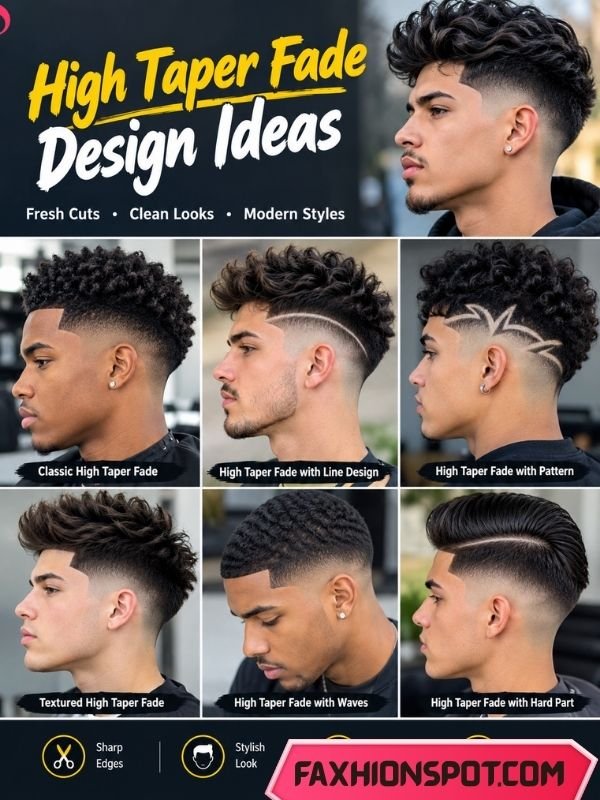
There is no single “correct” design. Your choice should reflect your hair density, face shape, personality, and how often you are willing to return to the barber.
Simple Designs
Simple designs are ideal if this is your first time experimenting with shaved patterns.
1. Single Razor Line
A single diagonal line is clean, masculine, and easy to maintain. It works especially well with a short textured top or crop.
Ask for:
“Give me a high taper with one clean diagonal razor line above the temple. Keep it thin and sharp.”
2. Double Razor Lines
Two parallel lines create more visual interest without becoming complicated.
This option looks particularly good when the lines follow the natural angle of the temple.
3. Curved Temple Line
Instead of a straight slash, ask your barber for a smooth curved line that follows the shape of your head.
It gives the haircut a softer, more artistic appearance.
4. Short Lightning Bolt
A small lightning-bolt pattern creates a youthful and energetic finish.
Keep it relatively small if you want the haircut to remain wearable at school or work.
5. V-Line Design
A small V-shaped pattern creates symmetry and works nicely with sharp lineups.
6. Parallel Short Slashes
Three or four short lines can be positioned above the ear or around the temple.
This is more noticeable than one line but still relatively simple for an experienced barber.
7. Side Part Razor Line
Combine the design with a hard-part effect.
The line can visually separate the longer top from the tapered side while creating a polished finish.
8. Temple Arrow
An arrow-shaped design directs attention toward the top of the haircut.
It pairs particularly well with a textured crop or forward fringe.
Intermediate Geometric Designs
If you want something more distinctive, geometric patterns give the barber more room to create contrast.
9. Double Curve
Two curved lines following the temple create a flowing appearance.
This design works particularly well with naturally wavy or curly hair because the curves complement the texture above.
10. Triangle Design
A small triangle etched into the faded section gives the haircut a structured, modern appearance.
Keep the triangle relatively small so the design does not overpower the hairstyle.
11. Crossed Lines
Two razor lines intersect to create an X-like pattern.
This is simple enough for regular maintenance but more distinctive than a single slash.
12. Chevron Pattern
A chevron uses angled lines to create a V-shaped visual effect.
It works especially well when the top has a clean, structured silhouette.
13. Three-Step Geometric Pattern
Ask for three progressively angled lines.
The pattern creates movement without requiring a large shaved area.
14. Diamond Detail
A small diamond placed near the temple can become the focal point of the haircut.
This design looks best when the surrounding taper is extremely clean.
15. Half-Moon Design
A curved half-moon pattern gives the side profile a smoother, more artistic finish.
It is especially useful for someone who wants something different without choosing a complex freestyle design.
16. Geometric Corner
A sharp corner made from two intersecting lines creates a minimalist architectural look.
It pairs well with a clean lineup and short top.
Advanced Freestyle Designs
Freestyle patterns require more barbering skill. Choose a barber who regularly creates razor artwork rather than assuming every fade specialist does detailed designs.
17. Abstract Wave
An abstract wave uses multiple curved lines to create movement.
It works beautifully with curly or wavy hair because the design echoes the natural texture.
18. Flame-Inspired Pattern
Curved, pointed lines can create a flame-like effect.
Keep the pattern concentrated in one area rather than spreading it across the entire side.
19. Spider-Web Pattern
Several connected lines can create a web-inspired design.
This is more intricate and requires excellent line spacing.
20. Freestyle Swoosh
A long curved swoosh can follow the shape of the taper.
It looks particularly strong when the top is left textured and slightly messy.
21. Wave-and-Line Combination
Combine a curved wave with one or two straight lines.
This creates contrast between organic and geometric shapes.
22. Layered Curve Design
Several curves positioned at different angles can make the taper appear more dimensional.
23. Abstract Geometric Art
Give your barber creative freedom while specifying the general size and location.
This is a good choice when you trust the barber’s artistic ability.
24. Lightning and Curve Combination
Mix a sharp lightning shape with a softer curve.
The contrast makes the pattern visually interesting without covering too much of the fade.
25. Freestyle Initial
A skilled barber can sometimes incorporate a single letter or symbol into the design.
Keep it simple so it remains recognizable as the hair grows.
26. Wave With Three Slashes
A flowing wave combined with three short razor cuts creates a balanced design.
27. Symmetrical Temple Art
Two coordinated patterns on both sides can create a highly polished appearance.
Symmetry requires precision, so choose your barber carefully.
28. Custom Signature Design
The final option is to let your barber create something unique based on your head shape and hairstyle.
Show several reference photos and explain the level of boldness you want rather than asking the barber to copy a design exactly.
Best Designs for Your Hair Type
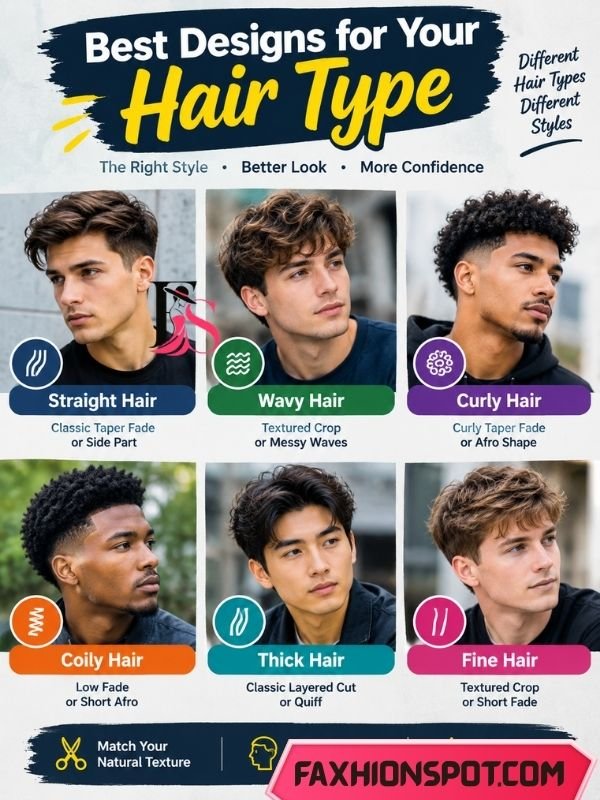
The pattern is only one part of the haircut. Your natural texture should influence both the design and the top.
Straight Hair
Straight hair creates a strong contrast against razor lines.
Good choices include:
- Single razor line
- Double line
- Geometric corner
- Side-part line
- Diamond design
- Blunt or textured fringe
A matte clay or styling paste can add separation without making the top look greasy.
Wavy Hair
Wavy hair works particularly well with curved designs because the natural movement of the hair complements rounded patterns.
Try:
- Wave design
- Double curve
- Swoosh
- Chevron
- Textured fringe
Curly Hair
Curly hair creates natural volume, so a clean taper can provide excellent contrast.
For curls, avoid overcomplicating the design. One or two strong lines often look better than a crowded pattern.
A curl cream followed by controlled diffusing can maintain definition while keeping the top full. Blowout taper guides similarly recommend preserving the natural curl pattern rather than aggressively stretching it.
Coily Hair
Coily hair offers a strong foundation for sharp designs.
Good combinations include:
- Temple line
- Double slash
- Geometric shape
- Freestyle art
- Wave-inspired design
Keep enough length on top to preserve the natural texture and avoid creating an unnecessarily thin silhouette.
Fine Hair
If your hair is fine, choose a smaller design.
A huge shaved pattern can make the surrounding hair appear thinner. A simple line or small geometric shape usually creates a better balance.
Which Design Suits Your Face Shape?
Your face shape can help determine both the taper height and design direction.
| Face Shape | Good Design Direction | Top Style |
| Oval | Almost any | Textured, fringe, curls |
| Round | Vertical or angled | Height and texture |
| Square | Sharp geometric | Crop or textured top |
| Oblong | Horizontal/curved | Fringe or moderate volume |
| Diamond | Curves or simple lines | Textured volume |
| Heart | Soft curves | Fringe or messy texture |
Round Face
A diagonal or vertical design can visually add direction and break up facial width.
Avoid making every element of the haircut extremely horizontal.
Square Face
Square faces can handle sharp geometric designs particularly well.
Try a single hard line, chevron, triangle, or angular pattern.
Oblong Face
A textured fringe can help visually reduce facial length.
A low or moderate-volume top generally works better than excessive vertical height.
Oval Face
Oval faces have the most flexibility.
You can experiment with simple lines, geometric patterns, freestyle artwork, fringe, curls, or a blowout.
How Complex Can Your Design Be?
Design complexity should match your maintenance routine.
Level 1: Minimal
Choose one or two lines.
Best for: First-timers, professionals, and low-maintenance routines.
Level 2: Moderate
Choose curves, triangles, chevrons, or multiple connected lines.
Best for: People who want a noticeable but wearable haircut.
Level 3: Advanced
Choose freestyle artwork, layered geometry, or custom symbols.
Best for: Creative personalities and people comfortable with frequent barber visits.
The more complicated the pattern, the more obvious regrowth becomes.
Where Should the Design Go?
The temple is the most common location because the tapered area provides natural contrast.
Temple
Best for:
- Razor lines
- Lightning bolts
- Curves
- Small geometric designs
Side Panel
A larger canvas for geometric or freestyle patterns.
This area is more visible from the side, so the design becomes a major part of the haircut.
Behind the Ear
A small design behind the ear can be subtle when viewed from the front.
It is a good choice if you want something distinctive without making the pattern the centerpiece.
Nape
The neckline can accommodate small symbols, curves, or simple lines.
However, designs placed here can disappear quickly as the neckline grows out.
How to Tell Your Barber What You Want
A reference photo is usually the easiest way to communicate the overall shape, but your words should clarify the details.
Instead of saying:
“Give me a cool design.”
Try:
“I want a high taper around the upper temple with a clean, gradual transition. Keep the top about three to four inches and leave enough length for texture. Add one diagonal razor line inside the taper. Keep the design thin, symmetrical, and sharp rather than making it too wide.”
If you want a more advanced design:
“I want a high taper with a freestyle geometric design around the temple. Keep the design contained inside the tapered area and make the lines clean but not overly thick. Leave the top textured with enough length for volume.”
Barber Checklist
Before the clippers start, confirm:
- Where the taper should begin.
- How short you want the sides.
- How much length should remain on top.
- Exactly where the design should sit.
- Whether the design should be subtle or bold.
- Whether you want a lineup.
- How much texture you want on top.
- How often you are willing to maintain the cut.
Current barber guides consistently recommend describing the taper height, top length, placement, and desired finish instead of relying only on vague phrases such as “make it fresh.”
How Long Does the Design Last?
The haircut can remain wearable for several weeks, but the razor design usually loses its crisp appearance much sooner.
A practical maintenance schedule looks like this:
| Time | What Happens |
| Days 1–7 | Design looks extremely sharp |
| Days 8–14 | Fine lines begin softening |
| Weeks 2–3 | Pattern becomes less defined |
| Weeks 3–4 | Full taper usually needs refreshing |
Your hair growth rate, design thickness, and contrast all affect how long the pattern remains visible.
For a highly detailed design, a two-week cleanup can make a noticeable difference.
How to Style This Haircut
The styling routine depends on what you leave on top.
Step 1: Start With Damp Hair
Wash or lightly wet the hair and towel-dry until it is damp rather than dripping.
Step 2: Add a Pre-Styler
For straight or fine hair, use a lightweight volumizing spray or sea salt spray.
For curls, use curl cream or a lightweight leave-in product.
Step 3: Direct the Hair
For a textured top, use your fingers while blow-drying.
For a blowout, lift the roots upward and slightly backward.
For a fringe, direct the front forward.
Step 4: Finish With Matte Product
Use a small amount of matte clay, paste, or texture powder.
Avoid applying too much product because heavy buildup can flatten volume.
Step 5: Detail the Fringe
If you combine the taper with a fringe, separate individual sections using your fingertips.
A textured fringe is generally created with point-cutting and uneven lengths rather than a perfectly straight front line.
Best Top Styles to Pair With It
The sides may contain the design, but the top determines the overall personality of the haircut.
Textured Crop
A short textured crop creates a clean, modern silhouette.
Textured Fringe
A forward fringe softens the forehead and gives the design a stronger contrast.
Curly Top
Natural curls provide volume without requiring excessive styling.
Blowout
A blowout creates height and makes the taper appear more dramatic.
Quiff
A quiff gives the haircut a polished, elevated appearance.
Short Afro
A short afro combined with sharp taper work creates a strong shape.
Waves
Waves and razor designs can create an especially distinctive barbershop look.
Messy Textured Top
A deliberately messy finish creates contrast between the artistic design and relaxed top.
Related blowout-taper guides commonly recommend keeping roughly 3–5 inches on top when the goal is substantial volume, although the ideal length varies according to texture and desired shape.
Low Taper Fringe Haircut Guide: 12 Styles, Every Hair Type, and Exactly What to Tell Your Barber
If you like the idea of a textured front but want something more conservative than a high taper, a low taper fringe is worth considering.
The low version keeps the taper close to the ears and neckline while leaving more weight around the sides. This makes it more subtle and generally easier to grow out.
Popular variations include:
- Textured fringe
- Choppy fringe
- Blunt fringe
- Messy fringe
- Curly fringe
- Wavy fringe
- Side-swept fringe
- French crop fringe
- Fluffy fringe
- Short Caesar fringe
- Diagonal fringe
- Long textured fringe
What to Tell Your Barber
“Keep the taper low around the ears and neckline. Leave the top around three inches and create a textured fringe that falls naturally toward the eyebrows. Keep the sides soft rather than taking the taper too high.”
Straight and wavy hair generally makes the forward fringe easiest to shape, while curly and coily textures need dry-length consideration because shrinkage changes the finished appearance.
Blowout Taper for Curly Hair: What to Ask Your Barber + How to Style It
Curly hair is naturally suited to a blowout because curls can create height and fullness without requiring as much product as straight hair.
The main challenge is controlling shrinkage and preserving curl definition.
What to Ask Your Barber
Say:
“Keep my curls full on top and shape them while dry so you can see the natural shrinkage. Give me a clean taper around the sides and neckline without removing too much density.”
For tighter curls, keeping more length on top can help maintain a rounded silhouette.
How to Style Curly Hair
- Start with soaking-wet or very damp hair.
- Apply curl cream.
- Scrunch the curls upward.
- Use a diffuser on low heat.
- Lift the roots gently.
- Allow the hair to cool before separating curls.
- Finish with a tiny amount of lightweight product.
Do not repeatedly brush dry curls. That can disrupt definition and create unnecessary frizz.
Blowout Taper Textured Fringe – Low, Mid & High: What to Ask For and How to Style It
A blowout taper with textured fringe combines a lifted crown with a forward-moving, piecey fringe.
The crown generally moves upward and slightly backward while the front falls toward the forehead. That difference gives the hairstyle its distinctive shape.
Low Blowout Taper With Fringe
The low version keeps the taper subtle.
Ask for:
“Keep the taper low around the ears and neckline. Leave the top long enough for volume and create a textured fringe that falls naturally forward.”
Best for professional environments and first-time blowout wearers.
Mid Blowout Taper With Fringe
The mid version provides more contrast without becoming as aggressive as a high taper.
Ask for:
“Give me a mid blowout taper around the temple, leave three to five inches on top, and create a textured fringe with separated pieces.”
The mid height is frequently presented as the balanced option because it offers more contrast than low while avoiding the maximum separation of high.
High Blowout Taper With Fringe
The high version is the boldest.
Ask for:
“Take the taper higher around the upper temple, but keep the transition smooth. Leave enough length on top for a full blowout and keep the fringe textured rather than blunt.”
This is best for someone who likes a noticeable haircut and does not mind more frequent maintenance.
High Blowout Taper Haircut Guide: Low vs Mid vs High, Every Hair Type
The height of the taper changes the amount of contrast, not necessarily the basic top hairstyle.
| Height | Placement | Appearance | Maintenance |
| Low | Near ears and neckline | Soft | Lower |
| Mid | Around temple | Balanced | Moderate |
| High | Upper temple | Bold | Higher |
A low taper keeps more side coverage and grows out more gently. A mid taper gives balanced contrast. A high taper exposes more of the side and creates the strongest visual separation.
Straight Hair
Use a volumizing pre-styler and blow-dry against the natural direction of growth to create lift.
Wavy Hair
Take advantage of the natural wave instead of forcing the hair completely straight.
Sea salt spray can enhance texture when used lightly.
Curly Hair
Use a diffuser rather than aggressively brushing curls with a round brush.
Coily Hair
Preserve enough top length to show the natural coil pattern and use curl-focused products to maintain definition.
Mistakes to Avoid With This Cut
Even a talented barber can struggle if the haircut is poorly communicated.
1. Choosing a Design That Is Too Large
Large designs require more space and can overpower the hairstyle.
2. Ignoring Hair Growth
A razor pattern that looks perfect on day one will soften as the hair grows.
3. Choosing an Inexperienced Barber
Complex freestyle work requires more than basic fading ability.
4. Taking the Taper Too High
If you wanted a conservative cut, an overly high taper can remove too much side weight.
5. Using Too Much Product
Heavy wax or gel can destroy the natural texture that makes the top attractive.
6. Copying a Design Without Considering Your Head Shape
A pattern that works on one person’s temple may not sit correctly on another person’s head.
7. Forgetting the Top
The razor pattern should complement the top hairstyle, not compete with it.
8. Asking for “Whatever Looks Good”
Be specific about the taper height, top length, design size, and desired level of boldness.
9. Skipping the Reference Photo
A reference image can eliminate a lot of uncertainty.
10. Waiting Too Long for a Touch-Up
Once the design loses its definition, even a good haircut can look unfinished.
Frequently Asked Questions
Is a high taper fade with design good for thick hair?
Yes. Thick hair provides strong contrast between the full top, tapered sides, and razor pattern.
Can straight hair get this haircut?
Absolutely. Straight hair often makes razor designs particularly visible because of the clean contrast.
Can curly hair have a razor design?
Yes. A sharp taper and simple razor pattern pair especially well with naturally curly or coily hair.
How often should I refresh the design?
For crisp linework, a touch-up every one to two weeks is usually more practical than waiting for the entire haircut to grow out.
Is a razor design permanent?
No. It is shaved into the hair and gradually disappears as the hair grows.
Does a high taper make your face look longer?
It can create a taller, more exposed silhouette, especially when paired with substantial volume on top.
What is better for a round face: low or high taper?
A higher taper with controlled vertical volume can add visual height, while a textured fringe can help balance facial width.
Is a low taper better for professional environments?
Usually, yes. A low taper preserves more side coverage and creates a softer overall appearance.
How long should the top be?
For textured styles, around 2–4 inches can work well; blowout styles often need more length, commonly around 3–5 inches depending on texture.
What product should I use?
Matte clay, paste, texture powder, sea salt spray, or curl cream can work depending on your hair type and desired finish.
Can I style the haircut without a blow dryer?
Yes. A natural textured finish can work, although a blow dryer makes it easier to create volume and direction.
Should the design match on both sides?
Not necessarily. Symmetrical designs look polished, while asymmetrical freestyle patterns can feel more creative.
Final Words
A great haircut design is not simply about adding a razor line. The best result comes from matching the taper height, design complexity, top length, natural texture, and face shape.
The right design should feel like an extension of your hairstyle—not something randomly added to it. With thoughtful placement and regular touch-ups, you can create a sharp, personalized look that stands out without becoming difficult to wear.
2 thoughts on “High Taper Fade with Design: 28 Razor-Cut Styles to Show Your Barber”