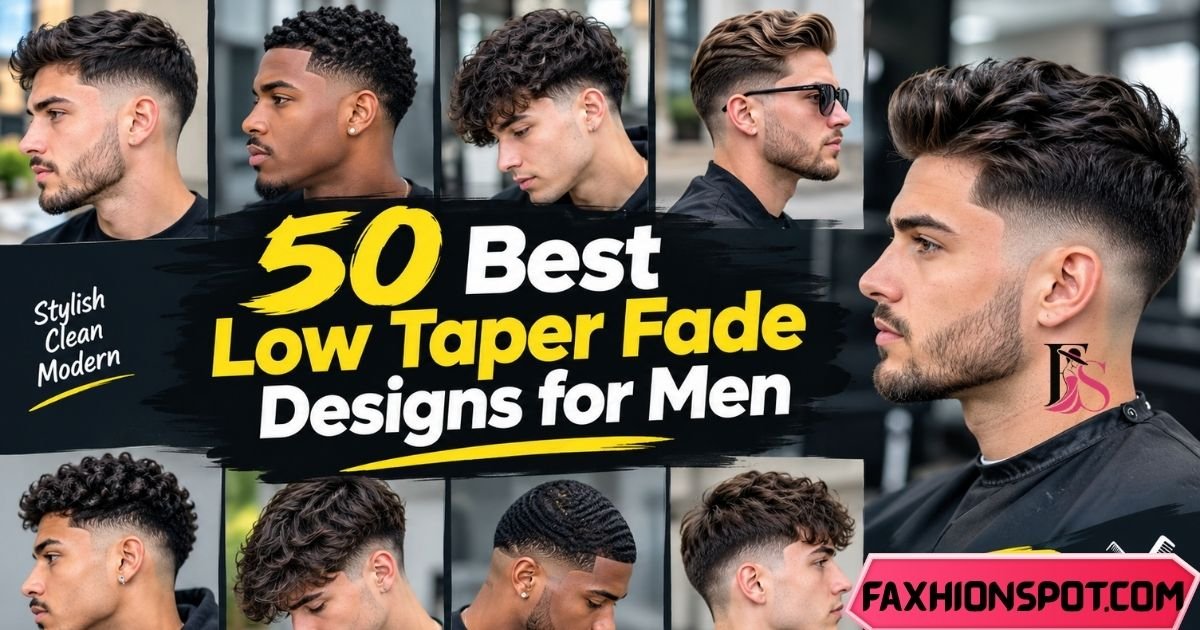
A sharp fade is nice. A sharp fade with a custom design carved into it? That’s the difference between a haircut and a statement.
Low taper fade designs have quietly become one of the most requested combinations at barbershops in 2026, and it’s easy to see why — they keep the subtle, professional-friendly shape of a low taper while adding just enough personality to stand out.
Whether you want a single clean line above the ear, a bold freestyle pattern on the side, or a small subtle cut that only shows up when the light hits it right, this guide breaks down the 50 best low taper fade design ideas for men, organized by placement, hair type, and style.
What Is a Low Taper Fade Design for Men and How Long Does It Last?
A low taper fade design is a haircut that pairs a gradual, low-starting fade — beginning just above the ears and around the neckline — with a pattern, line, or motif cut into the faded section using clippers, a T-outliner, or a straight razor. The fade stays close to the head, and the design sits inside it as the finishing detail.
Most low taper fade designs hold their crisp lines for 7 to 10 days. After that, natural hair regrowth starts to soften the edges, and the pattern gradually blurs into the fade around it. Guys who want their design razor-sharp for a wedding, event, or photoshoot should book their appointment 1–2 days beforehand, not the same morning, so any redness or irritation has time to settle.
What Is a Low Taper Fade Design?
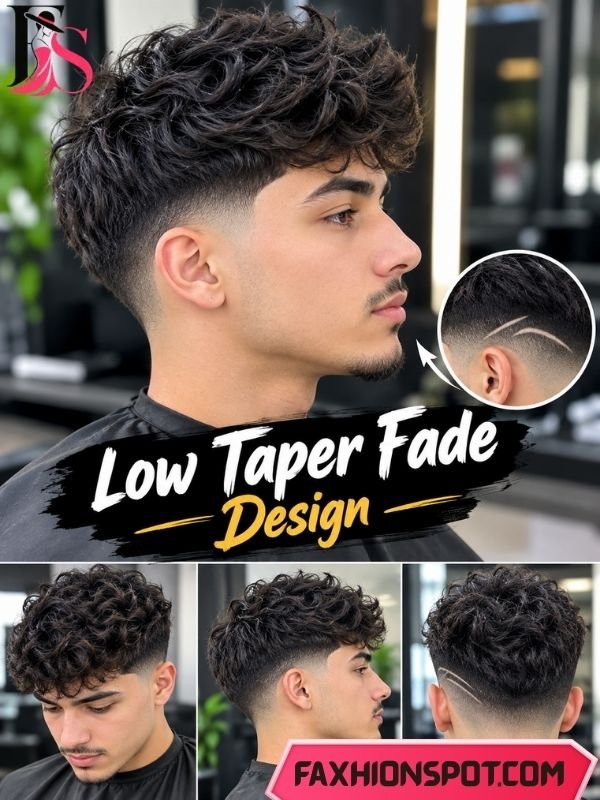
At its core, a low taper fade is a men’s haircut where the hair gradually gets shorter as it moves down toward the ears and neckline, without shaving all the way to the skin. The “taper” refers to that smooth, gradual shortening, while the “fade” describes how the hairline blends without a harsh, visible line.
Add a “design” to that foundation, and you get a low taper fade design — the same subtle fade, but with an intentional pattern shaved into the tapered zone. Designs can be as simple as:
- A single straight or curved line above the ear
- A double or triple line combo
- A geometric shape or star
- A freestyle pattern with no fixed template
- Initials, small symbols, or a name
Because the low taper keeps things close to the head and understated, it gives designs a clean canvas to sit on without overwhelming the overall look.
Low Taper Fade Men vs. Skin Fade: Which Is Better for Designs?
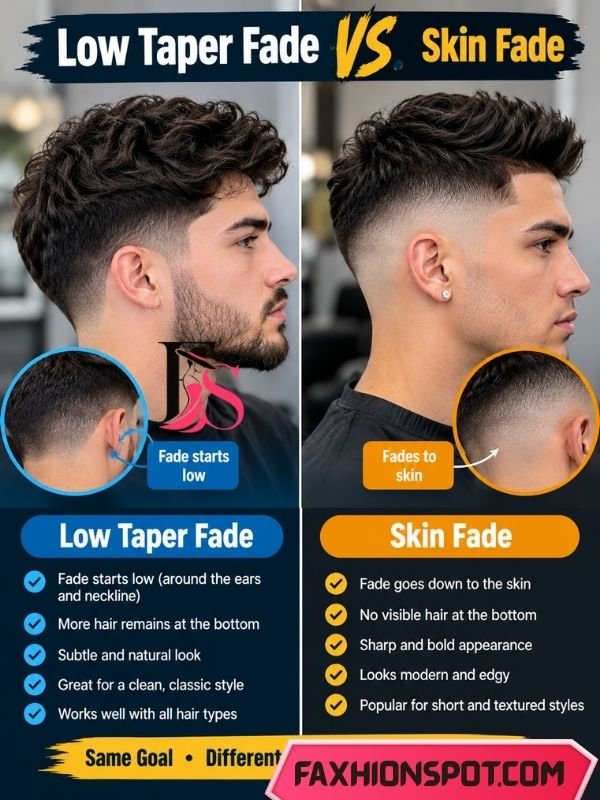
This is one of the most common questions guys ask before booking a design cut. Both a low taper and a low skin fade can carry a design, but they produce noticeably different results.
| Feature | Low Taper Fade | Skin Fade |
| Fade endpoint | Short hair, not bald | Fades down to bare skin |
| Contrast level | Subtle, low-key | High, sharp contrast |
| Best for | Work, school, everyday wear | Statement looks, nights out |
| Design visibility | Softer, blends into hair | Bold, stands out sharply |
| Regrowth maintenance | Every 3–4 weeks | Every 2–3 weeks |
| First-timer friendly | Yes | Moderate |
If this is your first time getting a design, a low taper fade is the safer, more forgiving starting point. It’s subtle enough for office environments and still holds a design cleanly. A skin fade makes any design pop harder and grow out more visibly, which some guys love and others find high-maintenance. Neither option is objectively “better” — it comes down to how loud you want the design to read.
50 Best Low Taper Fade Designs for Men (2026 Gallery)
Below are 50 of the best low taper fade design ideas, grouped by where the pattern sits and what kind of hair it works best on.
Back Low Taper Fade Designs
Designs placed at the back of the head, around the nape, are ideal for guys who want a detail that peeks through when their hair moves or when they’re seen from behind.
- Curved line following the natural neckline curve
- Small triangle cut just above the nape
- Zigzag pattern across the lower back section
- Double parallel lines framing the neckline
- Star motif centered at the nape
- Crosshatch grid pattern for texture contrast
- Arrow design pointing toward the crown
- Wave pattern mimicking hair texture
- Diamond shape sitting just below the occipital bone
- Minimalist dot pattern for a subtle back accent
Side Low Taper Fade Designs Men
The side is the most popular placement for a reason — it’s visible, versatile, and easy for a barber to keep crisp between visits.
- Single line above the ear, angled slightly back
- Double line combo running parallel toward the temple
- Lightning bolt cutting through the fade
- Geometric triangle stack
- Spiral or swirl pattern near the temple
- Sunburst design radiating from a center point
- Bold X-pattern crossing the tapered zone
- Thin curved line hugging the hairline
- Checkerboard block pattern
- Feathered line fading into the taper gradually
Freestyle Low Taper Fade Designs
Freestyle designs skip the templates entirely, letting the barber improvise based on your hair growth pattern and head shape.
- Abstract flowing lines with no repeating pattern
- Custom initials blended into the fade
- Tribal-inspired freehand pattern
- Random shape cluster for an artistic look
- Asymmetrical design running from ear to temple
- Nature-inspired freehand leaf or vine motif
- Freestyle dots and dashes combo
- Split-level pattern mixing thick and thin lines
- Custom symbol representing a personal detail
- Full freehand mural covering the entire tapered side
Edgar Cut with Low Taper Fade Designs
The Edgar cut — a blunt, straight-across fringe with tapered sides — pairs especially well with a design, since the fringe draws the eye up and the design adds detail lower down.
- Edgar cut with a single side line design
- Edgar cut with a double-line temple accent
- Edgar cut paired with a geometric side pattern
- Edgar cut with a subtle curved nape line
- Edgar cut with a bold freestyle side design
Small & Subtle Low Taper Fade Designs
Not every guy wants a loud pattern. These smaller, quieter designs suit office jobs, formal settings, or anyone who prefers understated detail.
- Thin single line, barely visible
- Tiny star tucked behind the ear
- Micro dot cluster
- Faint curved accent along the hairline
- Small initial hidden near the nape
Low Taper Fade Designs by Hair Type
Hair type changes how sharp a design looks and how long it holds up, so it’s worth matching the design to your natural texture.
Low Taper Fade Designs for Curly Hair
Curly hair adds natural volume on top, which contrasts beautifully with a crisp design underneath. Simple, bold lines tend to read more clearly through curls than intricate freestyle work, since the curl pattern can soften fine detail faster.
- Single bold line design with curly top
- Double-line combo under voluminous curls
- Small geometric shape paired with a curly fringe
Low Taper Fade Designs for Straight Hair
Straight hair highlights precision, so even fine lines and detailed patterns stay sharp and easy to read.
- Fine single-line design with a straight side part
- Detailed geometric pattern under a textured crop
Low Taper Fade Designs for Wavy Hair
Wavy hair sits between curly and straight, giving designs a slightly textured backdrop that works well with medium-bold patterns.
- Curved line design following the wave direction
- Freestyle pattern paired with a tousled wavy top
Low Taper Fade Designs for Afro-Textured Hair
Afro-textured hair holds bold, thick-lined designs exceptionally well, since the dense texture on top creates strong contrast with the sharp lines below.
- Bold geometric side design under a low-cut afro
- Thick double-line pattern with twisted top sections
- Freehand tribal-style pattern with natural afro texture on top
How Are Low Taper Fade Designs Created? (Step-by-Step)
A clean low taper fade design isn’t rushed — it’s built in layers. Here’s the general process most barbers follow:
- Consultation and sketch – The barber discusses placement, size, and complexity, sometimes sketching the design lightly with a pencil or trimmer first.
- Cut the base taper – The overall low taper fade is completed first, blending from longer hair on top down to shorter hair above the ears and neckline.
- Mark the design outline – Using a fine-line trimmer or T-outliner, the barber outlines the pattern directly onto the faded section.
- Carve the design – The outlined areas are shaved down to the skin (or very close to it) using a T-outliner or straight razor, creating contrast against the surrounding faded hair.
- Clean up edges – Excess stray hairs are trimmed, and the neckline and hairline are sharpened for a crisp finish.
- Final blend check – The barber blends the edges of the design into the fade so the pattern looks intentional rather than harsh or disconnected.
How to Ask Your Barber for a Low Taper Fade Design
Miscommunication is the number one reason a design comes out wrong. Being specific saves you a disappointing cut.
- Bring a reference photo, even if it’s not an exact match — it gives your barber a starting point.
- Specify the fade height clearly: “low taper, starting just above the ears.”
- Describe the design placement: side, back, or both.
- Mention size and complexity: “a small, simple line” versus “a bold freestyle pattern.”
- Ask about maintenance: how often you’ll need to come back to keep the design crisp.
Example script: “I want a low taper fade, keep it low, just above the ears. Add a double-line design on the side at the temple. Keep the neckline clean and squared, and leave the top textured.”
Best Styling Products for Low Taper Fade Designs
The right product keeps the top of your haircut looking intentional, which makes the design underneath stand out even more.
For Curly Hair
- Curl-defining cream to control frizz without weighing curls down
- Light hold gel for definition without stiffness
For Straight Hair
- Matte clay for texture and separation
- Light pomade for shine without heaviness
For Wavy Hair
- Sea-salt or texture spray for natural, tousled movement
- Lightweight matte cream for hold without flattening waves
For Afro-Textured Hair
- Moisturizing twist cream or gel for twists and coils
- Edge control for a sharp, defined hairline around the design
How to Maintain a Low Taper Fade Design
- Book touch-up appointments every 2–3 weeks to keep the design crisp before regrowth blurs it.
- Avoid heavy oils or pomades directly on the shaved design lines — they can make edges look less defined.
- Use a soft brush to keep the faded area free of product buildup and lint.
- Protect the design at night with a silk or satin cap to reduce friction and frizz.
- Ask your barber to only “clean up” the design between full haircuts if it’s still holding its shape well.
Click Here To Read Another Topic
Low Taper Fade Design Mistakes to Avoid
- Choosing an overly complicated pattern — intricate designs grow out and lose clarity faster than simple lines.
- Skipping the consultation — walking in without discussing placement often leads to a design you didn’t actually want.
- Waiting too long between touch-ups — regrowth blurs even the sharpest design within two to three weeks.
- Using heavy products on the design zone — this dulls contrast and makes lines look messy.
- Picking a design that doesn’t match your hair type — fine detail can disappear into thick, curly, or afro-textured hair.
Frequently Asked Questions
How long does a low taper fade design last before it needs a touch-up?
Most designs stay sharp for 7–10 days before regrowth starts softening the lines.
Is a low taper fade design good for the office?
Yes — especially small, subtle designs, since the low taper keeps the overall look understated.
Does a low taper fade design work with all hair types?
Yes, though bold, simple lines usually work best on curly and afro-textured hair, while fine detail suits straight hair.
How much does a low taper fade design typically cost?
Pricing varies by barber and design complexity, but expect to pay more than a standard fade due to the extra detailing time.
Can I add a design to an existing low taper fade without a full haircut?
Yes, many barbers can carve a design into an existing fade during a quick touch-up visit.
Is a low taper fade design better than a skin fade design?
Neither is “better” — a low taper gives a subtler look, while a skin fade makes the design pop with higher contrast.
Final Thoughts
Low taper fade designs give you the best of both worlds: a clean, professional-friendly haircut with room for personal style underneath.
Whether you go for a single subtle line, a bold freestyle pattern, or something tailored to your specific hair type, the key is matching the design’s complexity to how often you’re willing to maintain it.
Bring a clear reference to your next barber visit, communicate the placement and size you want, and you’ll walk out with a design that actually holds up week to week.