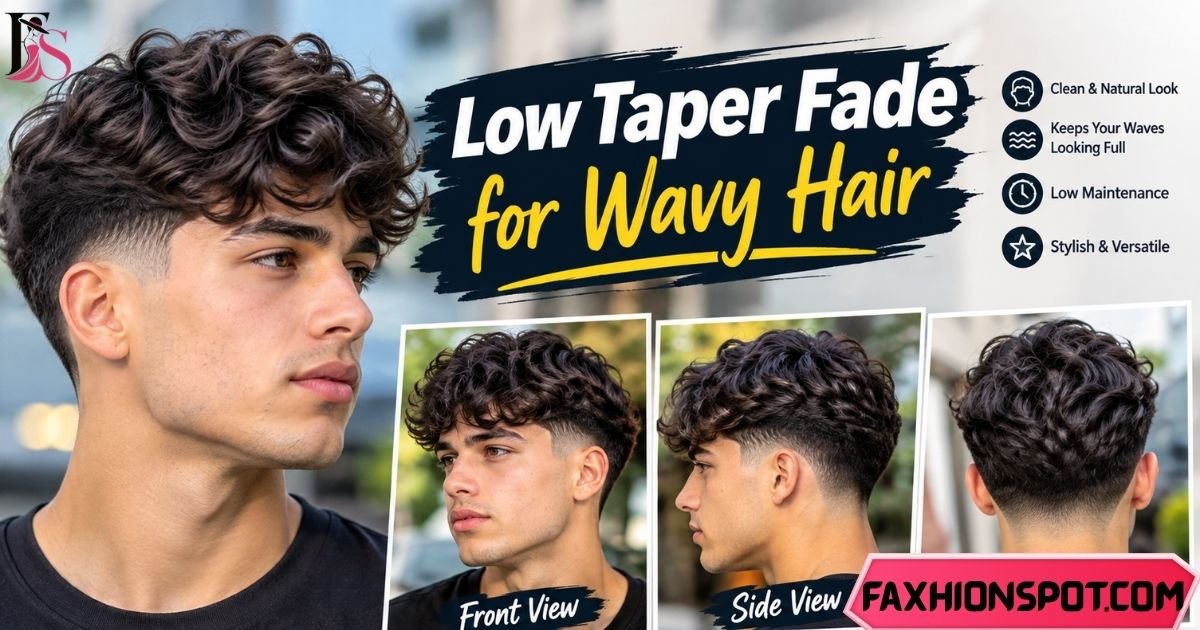
Natural waves already give men texture, movement, and volume. The right haircut simply gives that texture a cleaner frame. Low taper fade for wavy hair is especially useful because it keeps the sides and neckline neat without taking away the character of the waves on top.
In 2026, men are moving toward haircuts that look polished without appearing overly styled. A low taper fits that approach perfectly. It can be paired with a messy fringe, slick back, quiff, middle part, mullet, crop, or longer flowing layers.
This guide covers 25 modern styles, wave types, face-shape recommendations, barber instructions, styling tips, products, maintenance, and common mistakes so you can choose a cut that works with your natural texture.
What Is a Low Taper Fade for Wavy Hair, and Which Wave Type Does It Suit Best?
A low taper fade for wavy hair gradually shortens the hair around the temples, sideburns, and neckline while leaving more length and texture through the top.
The key advantage is restraint. Instead of pushing the fade high into the sides, the barber keeps the transition low. This allows the natural wave pattern to remain the visual focus.
It can work with all three common Type 2 patterns:
- 2A: Loose, soft waves with relatively low volume.
- 2B: More defined S-shaped waves with noticeable texture.
- 2C: Strong waves that can approach loose curls and usually have more volume.
Type 2A often benefits from additional texture and volume. Type 2B generally gives the haircut a naturally defined finish. Type 2C may require more weight control because the sides and top can become bulky.
What Is a Low Taper Fade for Wavy Hair?
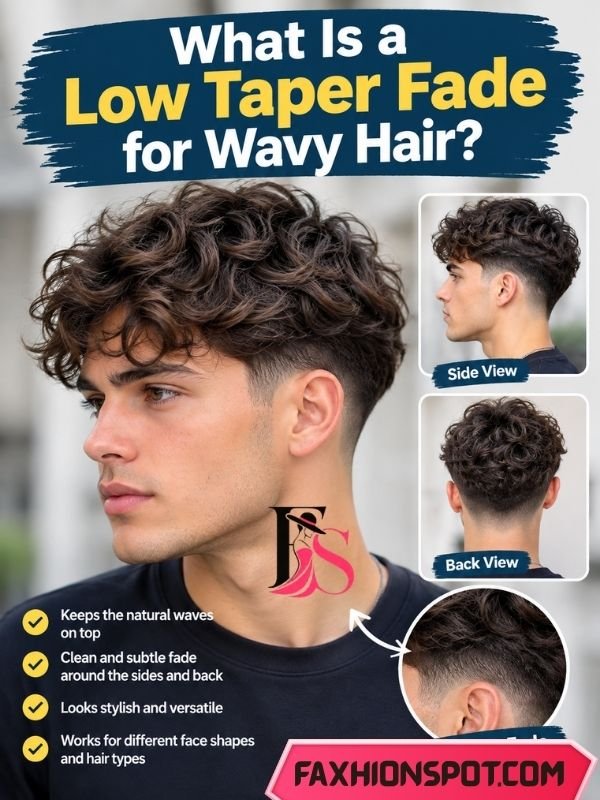
A low taper fade for wavy hair begins close to the ears and neckline rather than high on the sides of the head. The hair gradually becomes shorter as it approaches the natural hairline.
Unlike a bald or skin fade, a traditional low taper does not necessarily expose the scalp completely. The result is a softer transition that works particularly well with textured hair.
The top can remain anywhere from short and textured to several inches long. The ideal length depends on your wave pattern, density, face shape, and preferred hairstyle.
Low Taper vs. Mid Taper vs. High Fade vs. Skin Fade: Which Is Best for Wavy Hair?
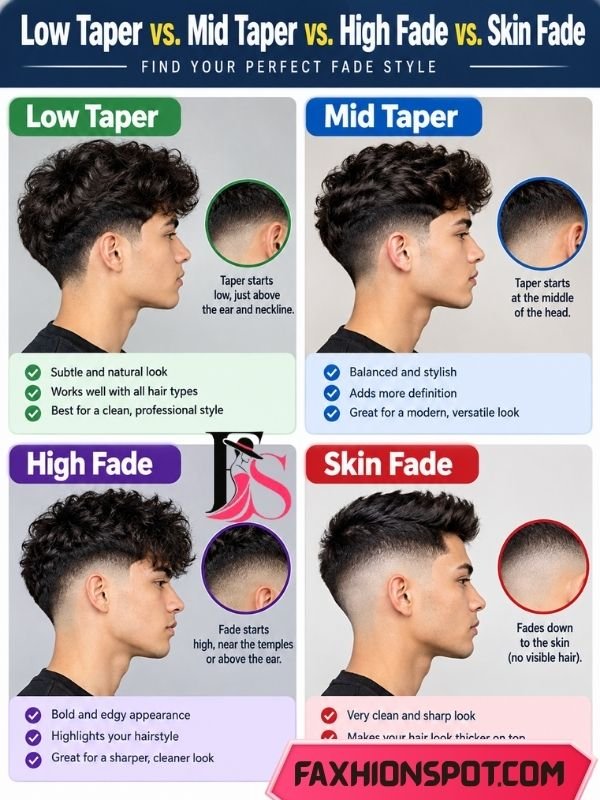
Each fade height creates a different balance between the textured top and the sides.
| Haircut | Fade Position | Overall Look | Best For |
| Low taper | Around temples and neckline | Subtle and natural | Most wavy textures |
| Mid taper | Higher around the sides | More defined | Medium to thick waves |
| High fade | Much higher on sides | Strong contrast | Bold textured styles |
| Skin fade | Very short to skin | Sharp and dramatic | High-contrast looks |
A low taper leaves the greatest amount of surrounding hair intact. A mid or high fade removes more bulk and produces stronger contrast. A skin fade takes the shortest approach and requires more frequent upkeep to retain its crisp appearance.
For men who want their waves to remain the main feature, keeping the transition low is often a straightforward way to preserve that balance.
Why a Low Taper Fade Works So Well for Wavy Hair (Types 2A, 2B, and 2C)
Wavy hair naturally creates dimension. Instead of needing an elaborate cut to add movement, the texture itself provides much of the visual interest.
A low taper works because it creates contrast without overwhelming that texture. The sides look organized while the top remains free to bend, wave, sweep, or flow naturally.
For 2A hair, a textured top or quiff can create extra volume. For 2B hair, a fringe, middle part, or messy style can emphasize the natural S-pattern. For 2C hair, longer layers can help distribute bulk while maintaining definition.
The general principle is simple: work with the wave pattern rather than fighting it.
25 Best Low Taper Fade Styles for Wavy Hair (2026)
Here are 25 variations ranging from short and practical to longer, more expressive looks.
1. Classic Wavy Low Taper Fade
The classic version keeps moderate length on top and a clean, gradual taper around the temples and neckline. The waves remain natural instead of being heavily sculpted.
It is an easy starting point if you want a versatile haircut suitable for school, work, casual outfits, and formal occasions.
2. Messy Tousled Wavy Low Taper
This variation lets the waves move in different directions for a relaxed, effortless appearance. The top is usually point-cut or lightly layered rather than blunt.
A small amount of lightweight styling cream can enhance separation without making the hair look stiff.
3. Short Wavy Low Taper Fade
Short waves are practical for men who want minimal morning styling. The top remains long enough to reveal texture while the sides and neckline receive a neat taper.
This option is particularly useful for active lifestyles because the haircut dries quickly and does not require much product.
4. Wavy Blowout Taper
A wavy blowout adds lift and volume through the top while the taper controls the perimeter.
Use a diffuser or blow dryer on low heat to lift the roots. Avoid excessive heat because it can make wavy hair dry and frizzy.
5. Wavy Slick Back Taper
The slick back combines natural wave movement with a controlled direction toward the back.
Instead of using a heavy wet-look gel, try a lightweight styling cream or flexible pomade. This allows some texture to remain visible.
6. Low Taper Mullet for Wavy Hair
A wavy mullet keeps additional length toward the back while the taper cleans the temples and neckline.
The natural wave makes the transition between the shorter sides and longer back look less rigid. It is a stronger fashion choice for men who want a noticeable silhouette.
7. Low Taper Fade for Long Wavy Hair
Longer waves create movement that can be enhanced with layers. The taper simply cleans the edges without sacrificing the length that makes the hairstyle distinctive.
This is a good option when you want to keep growing your hair while still having a polished perimeter.
8. Textured Fringe with Low Taper
A wavy fringe falls naturally toward the forehead. The clean taper around the sides prevents the overall style from appearing overly heavy.
A textured fringe can also visually reduce the appearance of a tall forehead because the hair moves forward rather than away from the face.
9. Side Part Wavy Low Taper
The side part gives naturally wavy hair a more structured appearance. A defined part separates the fuller top from the shorter side.
This is one of the easier options to adapt for professional environments because it can be styled neatly without eliminating the natural texture.
10. Middle Part Wavy Low Taper
A middle part works particularly well when the waves naturally separate around the forehead.
Keep enough length around the front so the hair can fall on both sides. Light layers can prevent the middle section from becoming too heavy.
11. Wavy Quiff with Low Taper
The wavy quiff pushes the front upward and slightly backward while retaining texture.
Blow-dry the front away from the face and finish with a lightweight matte product. Avoid excessive product because too much weight can flatten the waves.
12. Wavy Pompadour with Low Taper
A pompadour requires more volume at the front than most everyday wavy styles.
The taper creates a clean foundation while the longer top is lifted and shaped. This works particularly well for thick 2B and 2C textures.
13. Wavy Bro Flow with Low Taper
The bro flow keeps the hair longer and allows the waves to move backward naturally.
The taper mainly cleans the area around the ears and neck. This is a useful choice for men who want a relaxed appearance without completely committing to a short haircut.
14. Disconnected Undercut with Wavy Top
A disconnected undercut creates a much stronger separation between the long, wavy top and short sides.
Unlike a gradual fade, the transition is intentionally more obvious. This makes it a better choice for someone who wants contrast rather than a subtle haircut.
15. Hard Part Wavy Low Taper
A hard part adds a precise shaved or closely defined line to a wavy hairstyle.
The contrast between the sharp part and soft natural texture creates a modern look. Ask your barber to place the line according to your natural growth direction rather than forcing an unnatural part.
16. Textured Crop with Low Taper
The textured crop keeps the top relatively short while allowing the wave pattern to create separation.
It is practical, quick to style, and works especially well for men who prefer a low-maintenance haircut.
17. Wavy Comb-Over with Low Taper
A comb-over does not have to look stiff. With naturally wavy hair, the top can be swept sideways while retaining movement.
Use a wide-tooth comb or your fingers instead of brushing aggressively. This helps preserve the wave pattern.
18. Wavy Faux Hawk with Low Taper
The faux hawk directs the central portion of the hair upward while keeping the sides more controlled.
Waves add natural texture to the center, making it possible to create height without an extremely rigid finish.
19. Highlighted Wavy Low Taper
Subtle highlights can emphasize the bends and curves of wavy hair.
The color should complement the natural base rather than overwhelm it. A skilled colorist can place highlights where they catch the most movement.
20. Wavy Drop Fade
A drop fade curves downward behind the ear rather than maintaining a straight fade line.
This creates a more sculpted shape at the back of the head. It is useful for men who want a stronger fade design while still keeping the wavy top prominent.
21. Wavy Side Sweep with Low Taper
The side sweep is softer than a formal side part. The hair moves diagonally across the forehead while the waves create natural separation.
This style requires little precision and can look better slightly imperfect.
22. Layered Wavy Low Taper
Layers can reduce excess weight and help different sections of wavy hair move independently.
This is particularly useful for thick 2B or 2C hair. Ask the barber to remove weight strategically rather than aggressively thinning the entire top.
23. Wavy Line-Up with Low Taper
A line-up gives the front hairline and temples a more defined appearance.
Keep the line-up natural. Overly sharp or artificially squared edges can make a textured haircut look disconnected from the wearer’s natural hairline.
24. Wavy Pompadour Crop with Low Taper
This hybrid combines the compact shape of a crop with added height toward the front.
It works well when you want visible texture but do not want the length required for a full pompadour.
25. Natural Wavy Flow with Low Taper
The natural flow is all about allowing your hair to behave naturally.
The barber cleans the edges and removes unnecessary bulk while preserving the natural direction of the waves. For many men, this is the easiest style to maintain because the haircut does not depend on perfect daily styling.
Which Low Taper Fade Style Suits Your Face Shape?
Your face shape can help determine how much volume, length, and movement you should keep on top.
| Face Shape | Styles to Consider | Styling Direction |
| Oval | Almost all variations | Keep proportions balanced |
| Round | Quiff, faux hawk, side sweep | Add height |
| Square | Crop, slick back, classic waves | Keep structure balanced |
| Oblong | Fringe, middle part, layered flow | Avoid excessive height |
| Heart | Fringe, side sweep, textured crop | Add balanced side volume |
| Diamond | Flow, fringe, layered waves | Soften prominent cheekbones |
For a round face, some height on top can create a longer visual profile. For an oblong face, excessive height may have the opposite effect, making the face appear longer.
The best approach is to combine face shape with hair density and natural growth direction rather than following a face-shape rule blindly.
How to Ask Your Barber for a Low Taper Fade on Wavy Hair
Clear communication is more important than simply saying the name of the haircut.
Tell your barber:
“Keep my natural wave pattern on top. I want a low taper around the temples, sideburns, and neckline. Keep the transition subtle and don’t take the fade too high.”
Then specify the top length you want.
For a more detailed request, say:
“Leave enough length on top for my waves to form naturally. Remove bulk only where necessary, keep the front textured, and make the neckline clean without taking the taper too high.”
Bring two or three reference photos showing the front, side, and back. Different barbers can interpret terms such as “low,” “mid,” and “taper” slightly differently, so photographs reduce confusion.
Also tell your barber whether you normally air-dry, diffuse, brush, or use styling products. Your everyday routine affects how much length and weight should remain.
How to Style a Low Taper Fade on Wavy Hair (5-Minute Morning Routine)
A simple routine can bring out natural texture without creating a crunchy finish.
Step 1: Start With Damp Hair
After washing or refreshing your hair, gently squeeze out excess water. Do not aggressively rub the hair with a towel.
Step 2: Apply a Lightweight Product
Use a small amount of mousse, curl cream, sea salt spray, or lightweight styling cream depending on your texture.
Start with less product. You can always add more.
Step 3: Scrunch the Waves
Use your palms and fingers to gently scrunch upward. This encourages the natural wave pattern without disturbing it too much.
Step 4: Air-Dry or Diffuse
If you have time, allow the hair to air-dry. For faster results, use a diffuser on low heat and low airflow.
Step 5: Finish With Minimal Touching
Once the hair is dry, avoid repeatedly brushing or running your fingers through it. Excessive touching can separate the wave pattern and create frizz.
A good wavy-hair routine generally emphasizes lightweight products and minimal manipulation.
Best Products for a Low Taper Fade on Wavy Hair
The right product depends on how fine, thick, dry, or oily your hair is.
| Product | Best Use | Finish |
| Sea salt spray | Added texture and volume | Matte/textured |
| Lightweight mousse | Definition and lift | Soft |
| Wave or curl cream | Moisture and definition | Natural |
| Matte clay | Structure and separation | Matte |
| Light pomade | Slick styles | Low to medium shine |
| Leave-in conditioner | Dry or coarse waves | Soft/moisturized |
Fine 2A hair can become flat when overloaded with cream or pomade. Thicker 2C hair may need more moisture and controlled hold.
Heavy gel is not automatically wrong, but using too much can make waves look stiff. The goal is usually to enhance the texture rather than hide it.
Low Taper Fade Wavy Hair Maintenance Guide
The haircut remains attractive when both the taper and the natural texture are maintained.
Keep the sides and neckline clean, but avoid cutting the top too frequently if you are trying to preserve length.
Wash according to your scalp and hair needs. Condition regularly, and avoid rough towel drying. If your waves become dry or frizzy, reassess product buildup, heat exposure, and how often you manipulate the hair.
How Often Should You Get a Low Taper Fade Trimmed?
Most men can schedule a cleanup approximately every 2 to 4 weeks, depending on how quickly their hair grows and how sharp they want the taper to remain.
A full haircut may not be necessary every time. A quick temple, sideburn, and neckline cleanup can extend the appearance of the style.
Weekly Wavy Hair Care Routine
A practical weekly routine can look like this:
- Shampoo according to your scalp’s needs.
- Condition whenever you wash.
- Use a lightweight leave-in product if your hair is dry.
- Avoid brushing waves aggressively when dry.
- Deep-condition occasionally if your hair feels rough or dehydrated.
- Clean styling buildup before adding more products.
- Use low heat when diffusing.
Your exact routine should change with your hair’s response. If it becomes greasy, reduce heavy products. If it becomes dry and rough, increase conditioning and reduce heat.
How to Adapt Your Wavy Low Taper Fade for Different Climates
Climate can change how your waves behave.
Humid weather: Use lightweight anti-frizz products and avoid excessive touching.
Dry weather: Add moisture with conditioner or a lightweight leave-in product.
Hot weather: Shorten the top slightly if you want easier maintenance, while keeping enough length for the wave pattern.
Cold weather: Reduce excessive washing if your hair and scalp become dry, and protect the hair from harsh environmental conditions.
Click Here To Read Another Topic
Common Mistakes to Avoid with a Low Taper Fade on Wavy Hair
Several mistakes can make an otherwise good haircut look unbalanced.
1. Taking the Fade Too High
A high transition can remove too much of the hair surrounding your natural waves.
2. Cutting the Top Too Short
If your waves need length to form, cutting them excessively short can make the hair appear almost straight.
3. Over-Thinning the Hair
Too much thinning can disrupt the natural shape and make some wavy hair look uneven or frizzy.
4. Using Too Much Product
Heavy products can weigh down waves, particularly Type 2A hair.
5. Brushing Dry Waves
Aggressive dry brushing can separate the wave pattern and increase frizz.
6. Ignoring the Hairline
A good taper should complement your natural hairline. An overly aggressive line-up can look unnatural as it grows out.
7. Copying a Style Without Considering Your Texture
A hairstyle photographed on thick 2C waves may not look identical on fine 2A hair. Your barber should adapt the reference to your actual density and growth pattern.
Frequently Asked Questions
Is a low taper good for wavy hair?
Yes. A low taper fade for wavy hair keeps the sides tidy while preserving natural movement and texture on top.
Is a low taper better than a mid taper for wavy hair?
It depends on the desired contrast, hair density, and personal style. A low taper gives a softer transition, while a mid taper removes more side bulk.
What wave type works best with a low taper?
Types 2A, 2B, and 2C can all work well. The top length and styling method should change according to the strength of the wave.
How long should wavy hair be for a low taper?
There is no single required length. The top can be short, medium, or long as long as enough length remains for your natural texture to appear.
Does a low taper make wavy hair look thicker?
It can create the appearance of greater top density by keeping the sides shorter, creating visual contrast with the fuller wavy top.
Can thin wavy hair get a low taper?
Yes. A textured top with a conservative taper can work well, although excessive thinning should generally be avoided.
Can thick wavy hair get a low taper?
Yes. Strategic layering and weight removal can make thick waves easier to manage while the taper keeps the perimeter clean.
How often should I maintain my taper?
A cleanup every 2 to 4 weeks is common, although individual growth rates vary.
Should I use sea salt spray on wavy hair?
Sea salt spray can add texture and volume, but too much may leave some hair feeling dry. Start with a small amount.
Can I style a wavy taper without a blow dryer?
Absolutely. Air-drying with a small amount of lightweight styling product can produce a natural finish.
Is a skin fade good for wavy hair?
A skin fade can work, but it creates much stronger contrast and removes more hair around the sides than a low taper.
Should I show my barber a picture?
Yes. A front, side, and back reference can communicate the desired fade height and top length more clearly than the haircut name alone.
What is the easiest wavy taper style to maintain?
A classic wavy top, natural flow, or short textured crop generally requires less daily styling than a pompadour or elaborate blowout.
Conclusion
A low taper fade for wavy hair gives you a useful balance between clean edges and natural texture. Instead of forcing waves into a rigid shape, the haircut lets your natural movement become the main feature while the temples, sideburns, and neckline stay controlled.
For the best result, show your barber clear reference photos, explain how you normally style your hair, and ask them to preserve your natural wave pattern.