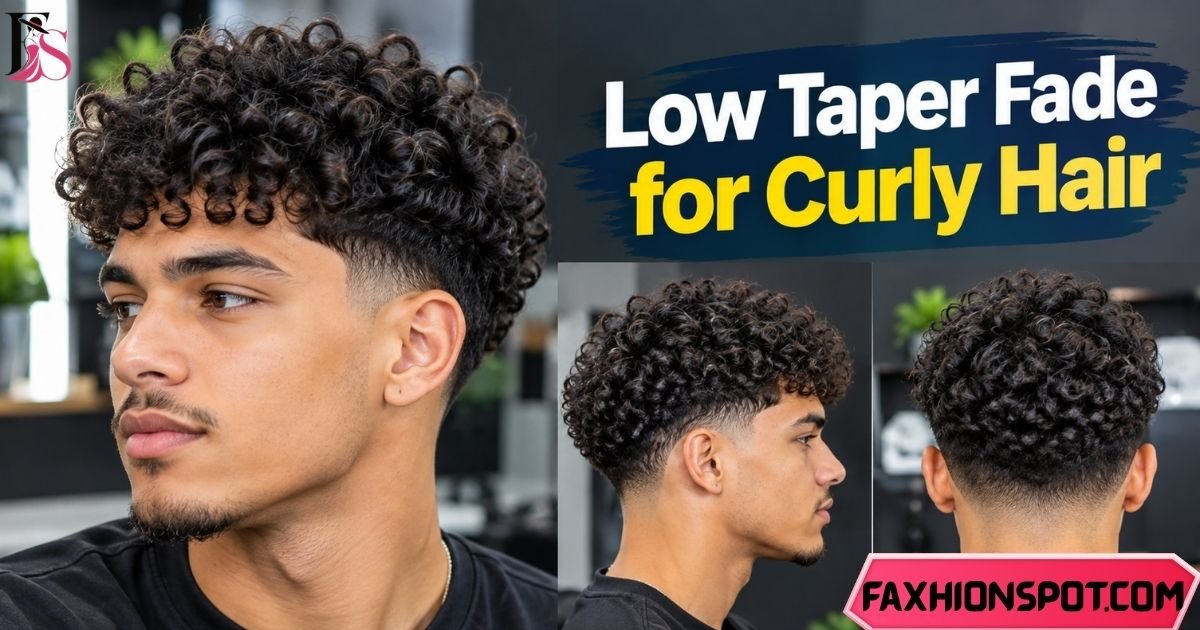
Curly hair already has natural texture, volume, and movement, so the right haircut should enhance those features instead of hiding them.
A low taper fade for curly hair keeps the curls longer and fuller on top while gradually shortening the hair around the ears, sideburns, and neckline. The result is a clean outline without removing too much of the natural shape.
Whether you prefer short curls, a longer curly fringe, or a fuller textured top, this guide explains how to choose the right length, communicate with your barber, style the cut, and maintain it.
What Is a Low Taper Fade for Curly Hair?
A low taper fade gradually reduces hair length around the sideburns, ears, and neckline, while most of the hair above that area remains fuller. Unlike a high fade, it does not remove a large section of hair from the sides.
For curly hair, this distinction matters. Keeping more density around the upper sides allows the natural curl pattern to blend into the shorter perimeter instead of creating an abrupt contrast.
The basic structure looks like this:
| Area | Typical approach |
| Top | Keep natural curls and desired length |
| Temples | Gradual taper |
| Sideburns | Clean, controlled blend |
| Around ears | Shorter transition |
| Neckline | Gradual taper and clean finish |
The exact guard numbers depend on your hair density, curl pattern, and the finish you want. A skilled barber should adjust the blend rather than relying on one fixed measurement.
Why Is a Low Taper Fade Perfect for Curly Hair?
The biggest advantage is balance. Curly hair provides volume naturally, while the taper removes excess bulk around areas that can look untidy as the hair grows.
It also gives you flexibility. You can wear the curls naturally, define them with cream or gel, create a fringe, add a line-up, or keep the top relatively short.
Other advantages include:
- Preserves natural curl texture
- Keeps the ears and neckline neat
- Works with different curl patterns
- Creates a clean but not overly aggressive appearance
- Can be adapted for school and office settings
- Allows different top lengths
- Grows out more subtly than some higher fades
Low Taper Fade for Different Curl Types
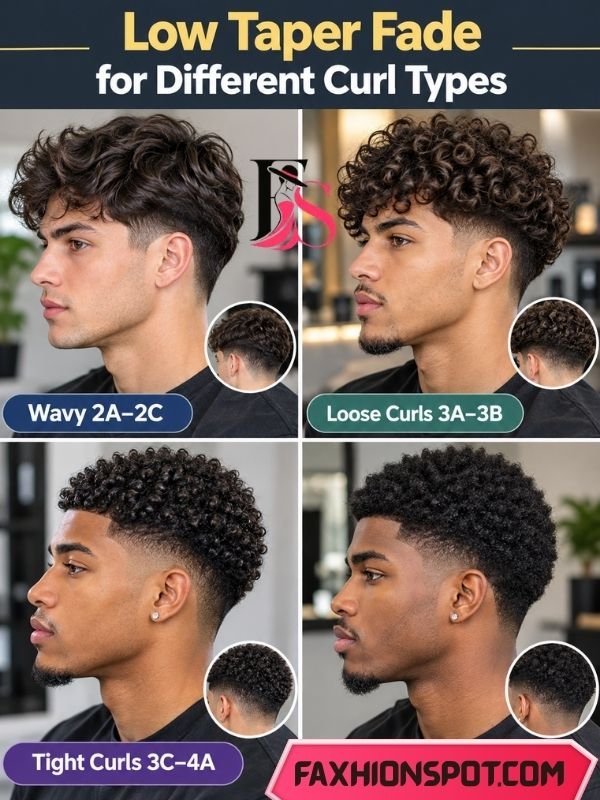
Your curl pattern should influence both the top length and how aggressively the sides are blended. Curly hair also shrinks as it dries, so the length you see immediately after washing may not be the length you see when it is completely dry.
Wavy Hair (Type 2A–2C)
Wavy hair has a looser pattern and generally benefits from a softer taper. Keeping moderate length on top helps the waves remain visible instead of making the haircut look overly flat.
For Type 2A to 2C hair, ask for a gradual blend and avoid taking too much weight from the upper sides. A light styling cream can enhance movement without making the hair greasy.
Loose Curls (Type 3A–3B)
Type 3A and 3B curls have more visible spirals and usually respond well to a medium-length top. This gives the curls enough room to form defined ringlets.
A curl cream or lightweight gel can help maintain definition. Avoid brushing the hair when it is completely dry because that can separate curl clumps and increase frizz.
Tight Curls (Type 3C–4A)
Tight curls shrink considerably, so communicate your desired finished length carefully. Your barber may leave more length than you initially expect because the curls contract when dry.
A low taper creates a noticeable contrast between the structured perimeter and dense curls above it. Moisture is especially important because dry curls can lose definition and become more difficult to manage.
Coily Hair (Type 4B–4C)
Coily hair can create substantial volume and a strong silhouette. The taper can clean up the edges while leaving the main body of the hair intact.
Moisturizing products, gentle detangling, and protective styling habits can help reduce dryness and breakage. A wash-and-go, twist-out, sponge-defined texture, or natural coily shape can all work with this haircut.
Best Length for Curls on Top
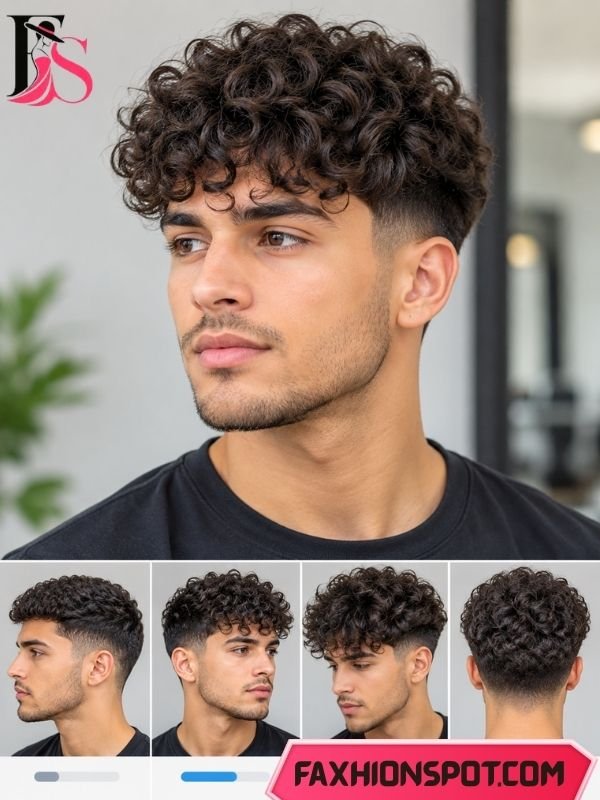
There is no single perfect length. Your curl pattern, density, face shape, and preferred styling routine should determine how much hair stays on top.
| Top length | Overall effect | Best for |
| Short | Clean and easy | Tight schedules, defined curls |
| Medium | Balanced volume | Most curl patterns |
| Long | Fuller and more expressive | Strong curl definition and volume |
Short Curls
Short curls are easy to control and can make the taper look particularly clean. This option is useful if you want a professional haircut that requires little morning styling.
A small amount of curl cream may be enough to bring out definition.
Medium-Length Curls
Medium curls offer the most flexibility. You have enough length for visible texture without creating excessive weight.
This length works particularly well for defined curls, textured fringes, and natural volume. It is also easier to reshape when you want to change your style.
Long Curls
Long curls create the most volume and movement. They can be worn forward, pushed upward, parted, or allowed to fall naturally.
The main consideration is maintenance. Longer curls need more attention to moisture, detangling, and shape. Your barber should also understand how much the curls shrink after drying.
Low Taper Fade vs Low Fade vs Regular Taper
These terms are sometimes used interchangeably, but they describe different approaches to removing length.
| Style | Where the transition focuses | Overall appearance |
| Low taper fade | Lower perimeter | Subtle and controlled |
| Low fade | Lower sides with a broader fade | More visible contrast |
| Regular taper | Sideburns and neckline | Traditional and softer |
Low Taper Fade
The low taper concentrates the shortening around the sideburns, temples, ears, and neckline. Most of the side density remains intact.
For curly hair, this can preserve a fuller silhouette while still giving the haircut a sharp outline.
Best Option for Curly Hair
The right option depends on how much contrast and maintenance you want. A low taper is useful when you want to preserve curl volume, while a broader low fade creates a more noticeable transition.
Think about your daily routine before choosing. Someone who wants natural volume may prefer keeping more side density, while someone who wants a sharper contrast may request a more extensive fade.
Low Fade
A low fade generally removes more hair from the sides than a subtle taper. The transition is still positioned relatively low, but the faded area can be broader.
This can work well with thick curls when you want the top to stand out more strongly.
Shorter and Bolder
A shorter fade creates stronger contrast between the top and sides. It can make curls appear fuller because the surrounding hair is considerably shorter.
The tradeoff is that the grow-out can become more noticeable, particularly if you request a very close finish.
Regular Taper
A regular taper is generally more conservative. Instead of creating a pronounced faded area, the barber gradually shortens the sideburns and neckline.
It is a practical choice for men who want a traditional haircut with natural curly texture rather than a dramatic fade.
Face Shapes That Suit a Low Taper Fade
A haircut should work with your overall proportions rather than following a rigid face-shape rule. Current barber guides commonly recommend adjusting the amount of top volume according to face shape.
Round Face
A round face can benefit from some controlled height on top. Keeping the sides relatively neat can also prevent the haircut from appearing wider.
Avoid excessive horizontal volume if you want a more elongated visual shape.
Adds Balance
The taper can reduce bulk near the lower sides while allowing the top to provide structure. With curls, the key is controlling volume rather than eliminating it.
Oval Face
Oval faces are highly adaptable to different top lengths. Short curls, medium curls, fringes, and longer textured styles can all be adjusted around the natural proportions.
You can usually focus more on curl preference than trying to correct the face shape.
Square Face
Square faces have naturally defined jaw and forehead proportions. A curly top can soften the overall appearance, while the taper keeps the sides organized.
Medium curls often provide a good balance between definition and volume.
Long Face
If your face is longer, avoid adding excessive height to the top. A short or medium curly length can maintain proportion without visually extending the face further.
A little more controlled width can sometimes create a more balanced appearance.
What to Tell Your Barber
Clear communication can make a bigger difference than knowing complicated haircut terminology.
Try this:
“I want a low taper around the sideburns, ears, and neckline. Keep the curls on top and preserve most of the side weight. I want a gradual, clean blend rather than a high fade.”
Then specify:
- How much length you want on top.
- Whether you want a natural or sharp hairline.
- Whether you want the taper to reach the skin.
- Whether you want a curly fringe or defined shape.
- Whether you want the neckline natural or cleaned up.
- How much volume you want to preserve.
If possible, show your barber two or three reference photos taken from different angles.
How to Style a Low Taper Fade
The styling routine depends on your curl pattern, but the basic process is simple.
- Start with clean, damp hair.
- Apply a small amount of leave-in conditioner or curl cream.
- Distribute the product with your fingers.
- Scrunch the curls upward.
- Let the hair air-dry or use a diffuser on low heat.
- Avoid touching the curls repeatedly while they dry.
- Finish with a small amount of lightweight product if extra hold is needed.
For tighter curls, you may prefer a leave-in conditioner followed by a defining product. For looser waves, using too much product can flatten the natural movement.
A diffuser can help enhance curl shape and volume when used carefully.
Washing and Hair Care Tips
A clean taper will not compensate for dry, poorly maintained curls. Your top hair needs its own care routine.
- Use a moisturizing shampoo appropriate for your hair type.
- Condition regularly.
- Avoid washing curly hair excessively if it becomes dry.
- Detangle gently, preferably when the hair is damp.
- Avoid brushing dry curls.
- Use a microfiber towel or soft T-shirt instead of aggressively rubbing the hair.
- Apply leave-in conditioner when your curls need additional moisture.
- Protect the hair while sleeping if your texture benefits from it.
For Type 4 textures, consistent moisture and gentle handling are particularly important because coily strands can be more vulnerable to dryness and breakage.
How Often to Get a Trim?
The taper usually needs refreshing before the curls on top need a major haircut.
For a consistently sharp outline, many haircut guides suggest a refresh roughly every 2 to 3 weeks, although the ideal schedule depends on how quickly your hair grows and how clean you want the edges to look.
If you prefer a softer, more natural appearance, you can stretch appointments longer.
- 2–3 weeks: Crisp taper and edges
- 3–4 weeks: Balanced, slightly grown-out appearance
- 4–6 weeks: More relaxed look with less frequent barber visits
The curly top itself may only need reshaping or trimming when the ends become uneven or the overall shape loses definition.
Mistakes to Avoid
Even a good haircut can look disappointing if the cut does not match your curl pattern.
Taking too much off the sides: Removing excessive side weight can make dense curls look disconnected from the taper.
Going too high: A high transition changes the character of the haircut and removes more natural volume.
Cutting curls without considering shrinkage: Tight curls can appear much shorter after drying.
Overloading with product: Heavy gels and creams can weigh down loose curls and make them appear greasy.
Brushing dry curls: This can separate curl clumps and increase frizz.
Ignoring the neckline: The taper is partly defined by a clean, controlled neckline.
Using only one reference photo: Front views do not always show how the taper should look around the ears and back.
Trying to copy someone else’s exact length: Curl density, shrinkage, and head shape vary from person to person.
Final Thoughts
A well-planned low taper fade for curly hair gives men a practical way to combine natural texture with a clean haircut. The main idea is simple: keep the curls as the visual focus while gradually reducing length around the lower perimeter.
Your curl type should determine the top length and styling routine, while your face shape can guide how much volume you keep. Short curls are easier to maintain, medium curls offer versatility, and long curls provide more dramatic texture.
The best result comes from communicating clearly with your barber. Explain where you want the taper, how much curl length you want to preserve, and whether you prefer a natural or sharper finish. With the right balance, the haircut can work for casual settings, school, offices, and everyday grooming.
Frequently Asked Questions
Is a low taper fade good for curly hair?
Yes. It keeps natural curls and volume on top while cleaning up the sideburns, ears, and neckline.
Is it low maintenance?
It can be relatively easy to maintain, especially with short or medium curls and a simple curl-care routine.
Does it work with thick curly hair?
Yes. The taper can remove unwanted perimeter bulk while leaving enough density on top for natural curl volume.
Is it suitable for school and office?
Yes. A subtle taper with controlled curls can create a neat appearance suitable for many school and workplace environments.
How long does it stay fresh?
The outline usually looks sharp for around two to three weeks, although growth rate and preferred level of neatness vary.