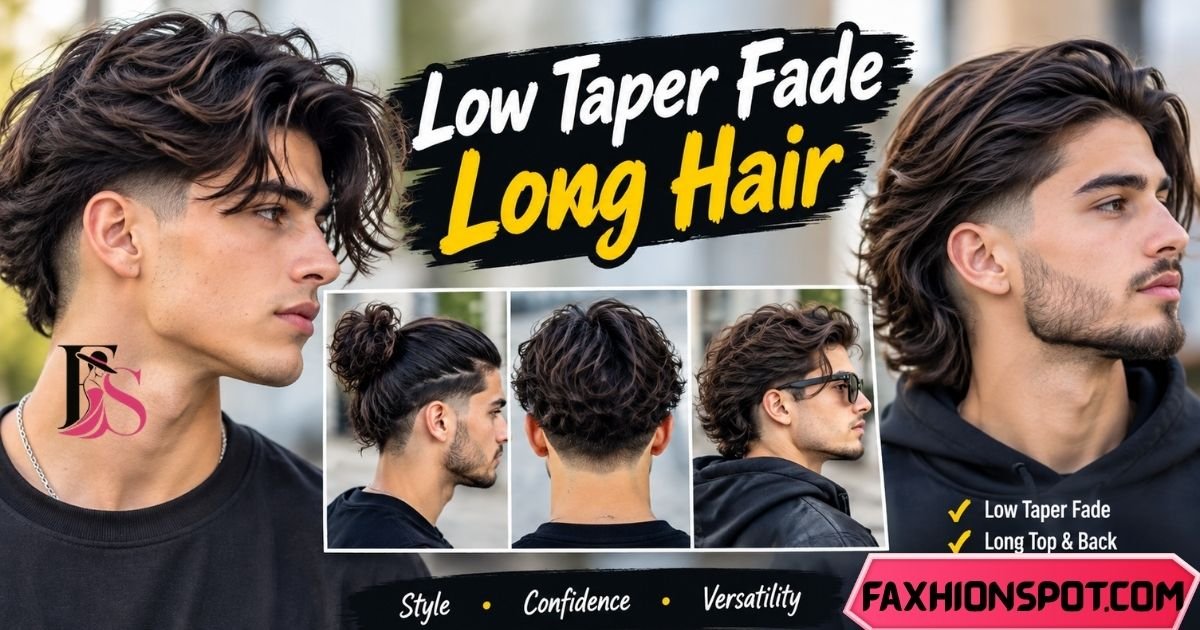
Long hair gives men plenty of freedom, but it can sometimes look bulky around the ears, sideburns, and neckline.
carefully placed low taper fade long hair cut solves that problem without sacrificing the length that makes the hairstyle distinctive. Instead of taking the fade high into the sides, the barber keeps the transition close to the natural hairline.
In this guide, you will find 35 style ideas, face-shape recommendations, hair-type advice, barber instructions, styling routines, product suggestions, maintenance tips, and professional grooming advice for 2026.
What Is a Low Taper Fade with Long Hair, and Who Does It Work Best For?
A low taper fade long hair haircut combines longer hair on top with a gradual taper around the sideburns, ears, and lower neckline. The top and back can remain substantially longer, allowing the wearer to preserve movement and natural texture.
It works especially well for men who want the appearance of long hair without letting the edges become untidy. Straight, wavy, curly, coily, thick, and fine hair can all work when the taper is adjusted to the individual’s density and growth pattern.
The key is restraint. A low taper should clean the perimeter rather than remove so much side weight that the haircut stops looking long.
What Is a Low Taper Fade with Long Hair?
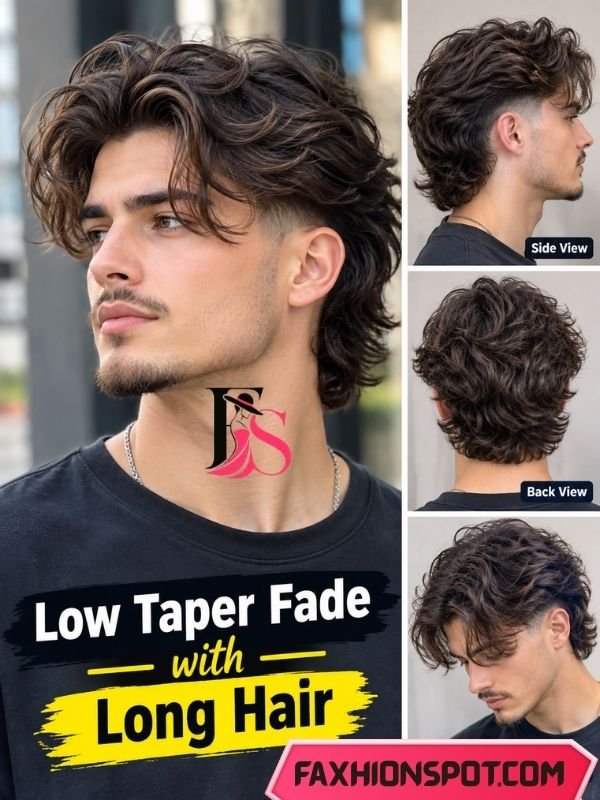
A low taper fade long hair style keeps most of the hair’s length while gradually shortening the area closest to the ears and neckline. The transition is intentionally low, so the longer top remains the main visual feature.
Unlike an aggressive high fade, this approach leaves more natural coverage around the sides. That makes it particularly useful for men who want a modern haircut without a dramatic change to their long hairstyle.
How Is a Low Taper Fade Different from a Regular Taper?
A regular taper gradually shortens hair around specific areas, but a fade usually creates a more noticeable transition toward very short hair.
| Feature | Low Taper Fade | Regular Taper |
| Placement | Very low around ears and neckline | Usually controlled around edges |
| Contrast | Subtle to moderate | Usually softer |
| Top length | Can remain very long | Can be short or long |
| Overall look | Modern and clean | Natural and classic |
| Best feature | Preserves long-hair shape | Conservative edge cleanup |
For long hairstyles, the low version often provides enough definition without visually cutting the sides away.
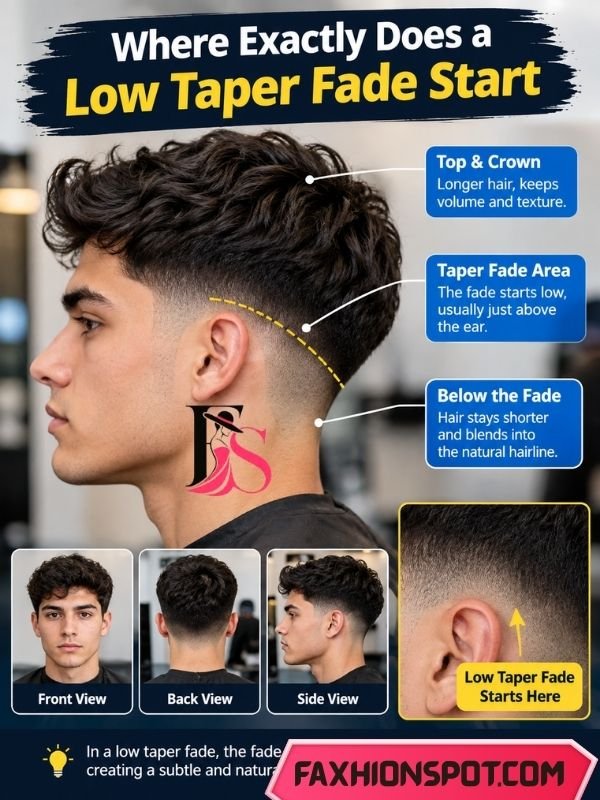
Where Exactly Does a Low Taper Fade Start?
A low taper normally begins close to the sideburns, around the ears, and along the lower neckline. The exact height depends on head shape, hair density, and the look you want.
For a longer hairstyle, ask the barber to keep the transition low and preserve visible weight above it. This prevents the cut from becoming an unintended mid or high fade.
Why Is the Low Taper Fade Long Hair So Popular in 2026?
The appeal comes from versatility. Men can maintain substantial length while getting a cleaner perimeter. Current hairstyle guides also show strong interest in natural texture, flow, curtains, buns, wolf cuts, mullets, and longer textured tops.
Another reason is adaptability. A low taper can be changed without completely changing the identity of the hairstyle. The same base can become a slick back for a formal event, a loose flow for everyday wear, or a bun when the hair needs to stay away from the face.
It is also easier to personalize than a one-size-fits-all haircut. Your barber can adjust the taper height, neckline, side weight, layering, and texture according to your hair.
35 Best Low Taper Fade Long Hair Styles for Men
These 35 options cover classic, tied, textured, retro, cultural, and modern looks. Choose the version that matches your natural texture and the amount of styling you are willing to do.
Classic Long Hair Styles
1. Long Hair with Low Taper Fade (The Classic)
This is the simplest low taper fade long hair option. Keep the top and back long while cleaning the sideburns and lower neckline.
It is ideal for men who want a natural appearance with a sharper outline. Minimal product is needed because the length itself provides the shape.
2. Low Taper Fade with Long Slicked Back Hair
Brush the longer hair backward for a refined, confident finish. A lightweight pomade or styling cream can control flyaways without making the hair look stiff.
This works particularly well with straight or thick hair.
3. Low Taper Fade with Long Wavy Hair
Long waves create movement while the low taper keeps the perimeter controlled. Avoid over-thinning the sides because natural wave patterns often need weight to maintain their shape.
Sea salt spray or lightweight mousse can enhance texture without making the hair crunchy.
4. Low Taper Fade with Long Straight Hair
Straight hair creates a clean contrast between the smooth top and tapered edges. It can be worn loose, center-parted, side-swept, or brushed backward.
A light serum can add shine, while a volumizing mousse helps prevent fine straight hair from looking flat.
5. Low Taper Fade with Long Curly Hair
Curly hair makes the top the centerpiece of the haircut. The taper cleans the perimeter while leaving the curls full and expressive.
Use curl cream or leave-in conditioner and avoid aggressively brushing dry curls. Maintaining moisture is especially important for longer curly hair.
Tied & Pinned Up Styles
6. Low Taper Fade with Man Bun
A man bun paired with a low taper fade long hair cut creates a strong contrast between the clean lower perimeter and the tied length.
A low bun looks relaxed, while a higher bun creates a more athletic appearance. Keep the taper subtle so the bun remains the dominant feature.
7. Low Taper Fade with Half-Up Long Hair
Pull the upper section backward and leave the lower lengths loose. This creates volume without putting all the hair into a bun.
It is particularly effective with wavy or layered hair because the loose portion adds movement.
8. Low Taper Fade with Slick Back Bun
This is the polished version of the man bun. Brush the hair backward before tying it, then use a small amount of styling cream to control loose strands.
The clean taper around the ears and neckline makes the style look deliberate rather than messy.
Parted & Framed Styles
9. Low Taper Fade with Curtain Hair
Curtains create a soft frame around the face. The low taper keeps the lower sides neat while allowing the center-parted length to remain full.
This option works particularly well with straight and naturally wavy hair.
10. Low Taper Fade with Center-Parted Long Hair
A center part distributes volume evenly on both sides of the face. It is a strong choice for oval and heart-shaped faces, although the length and volume should be adjusted to individual proportions.
Use a light styling cream rather than heavy gel for a natural finish.
11. Low Taper Fade with Side Part
A side part creates a more traditional silhouette. Keep enough length to sweep the hair naturally rather than forcing a sharp part.
This is one of the easiest long hairstyles to adapt for work or formal occasions.
12. Low Taper Fade with Long Fringe
A long fringe can be worn forward, swept across the forehead, or split into curtains. The taper keeps the sides from competing with the front.
For a round face, a longer side-swept fringe can help create a more elongated visual effect.
Volume & Statement Styles
13. Low Taper Fade with Long Pompadour
The long pompadour adds height at the front and volume through the top. It requires more styling than most options in this guide.
Use a blow dryer and round brush to create lift before applying a moderate-hold styling product.
14. Low Taper Fade with Quiff
A long quiff provides height without requiring the full volume of a pompadour. It works best when the top has enough length to sweep upward and backward.
A matte paste can create texture while keeping the finish modern.
15. Low Taper Fade with Messy Long Hair
This option is intentionally relaxed. Layers and natural movement create an effortless appearance while the taper keeps the edges clean.
It is particularly good for thick, wavy, or textured hair.
16. Low Taper Fade with Blowout Long Hair
A blowout creates volume around the top and sides while maintaining a clean lower perimeter. Use a round brush or vent brush with controlled airflow.
This look is best for medium-to-thick hair that can hold volume.
Retro & Bold Styles
17. Low Taper Fade with Mullet
A tapered mullet preserves length toward the back while keeping the sideburn and ear area clean. It gives long hair a more rebellious shape.
Wavy and textured hair can make the transition appear especially natural.
18. Low Taper Fade with Curtain Mullet
Combine a center part with longer back length for a modern curtain mullet. The result has a strong retro influence without looking like an exact throwback.
Layering is important because it prevents the back from becoming one heavy block.
19. Low Taper Fade with Comb Over
A long comb over uses the length on top to create a controlled side-swept shape. It is one of the more conservative options in the collection.
Use a lightweight pomade for straight hair or a styling cream for naturally wavy hair.
20. Low Taper Fade with Long Wolf Cut
The wolf cut combines shaggy layers, movement, and volume. Pairing it with a low taper gives the lower edges a cleaner finish without removing the layered personality.
This is a strong choice for medium-to-thick hair with natural movement.
Textured & Cultural Styles
21. Low Taper Fade with Braided Top
Long braids can be combined with a clean taper around the perimeter. The exact design depends on hair length, density, and braid type.
Tell your barber to preserve enough hair around the areas needed for your preferred braid pattern.
22. Low Taper Fade with Twist Out Top
A twist-out creates defined texture and volume. The taper can clean the lower sides while the textured top remains full.
Moisture and careful nighttime protection help preserve the finished pattern.
23. Low Taper Fade with Long Afro-Textured Hair
Long afro-textured hair can create a striking silhouette when the lower perimeter is carefully tapered. The goal should be definition without removing the natural fullness.
A barber experienced with coils and textured hair is especially valuable for this version.
2026 Trending Styles
24. Low Taper Fade with Two-Block Cut
The two-block shape keeps more length in the upper section while creating a distinct shorter lower area. A low taper can soften the perimeter.
This works especially well with straight or slightly wavy hair.
25. Low Taper Fade with Fluffy Long Top
A fluffy top emphasizes natural volume and softness. Use a lightweight volumizing mousse and avoid heavy products that collapse the hair.
It is particularly useful for medium-density straight or wavy hair.
26. Low Taper Fade with Textured Long Top
Texture can be created through strategic layering and styling rather than aggressive thinning. This gives the hair movement while retaining density.
Ask your barber to preserve the length and remove only unnecessary bulk.
27. Low Taper Fade with Ponytail
A ponytail keeps long hair practical while the taper cleans the areas around the ears and neck.
It is a useful option for men who need their hair secured during work, exercise, or outdoor activities.
28. Low Taper Fade with Beach Waves
Beach waves provide a relaxed, casual appearance. Sea salt spray can enhance natural wave patterns, while a low taper keeps the perimeter polished.
Avoid applying too much salt spray if your hair already feels dry.
29. Low Taper Fade with Long Side Swept Hair
Sweep the longer hair diagonally across the forehead or toward one side. This adds asymmetry and can help balance facial proportions.
A lightweight cream is usually enough for natural movement.
30. Low Taper Fade with Long Shag Cut
The long shag uses multiple layers to create movement throughout the hair. The taper adds a cleaner foundation underneath.
This is especially attractive on wavy and thick hair.
31. Low Taper Fade for Coily Long Hair
Coily hair benefits from a taper that respects the natural curl pattern. Keep the upper section full and use the taper primarily to define the perimeter.
Avoid unnecessary thinning because it can disturb the shape of the coils.
32. Low Taper Fade with Flow Hairstyle
A long flow moves backward and around the sides rather than being tightly controlled. The taper cleans the lowest areas while preserving the relaxed silhouette.
This is excellent for medium-thick straight or wavy hair.
33. Low Taper Fade with Long Faux Hawk
A long faux hawk creates height through the center without shaving the sides dramatically. The low taper makes the style easier to wear outside of special occasions.
Texturizing paste can help create separation.
34. Low Taper Fade with Sleek Long Top
This version focuses on smoothness and shine. Brush the top backward or into a clean side part and use a lightweight finishing product.
It is an excellent option for dinners, weddings, business events, and formal occasions.
35. Low Taper Fade with Long Natural Texture
Let your natural hair pattern determine the final shape. Straight hair can fall naturally, waves can remain loose, and curls or coils can retain their definition.
This is one of the lowest-maintenance ways to enjoy long hair while keeping the edges clean.
Which Low Taper Fade Long Hair Style Suits Your Face Shape?
Face shape should guide the amount of volume, direction, and framing rather than dictate one rigid haircut.
What Hairstyle Works Best for Oval Face Shape?
Oval faces can handle almost every variation, including curtains, slick backs, flow styles, long layers, and textured tops.
What Hairstyle Works Best for a Square Face Shape?
Soft waves, layered long hair, curtains, and textured styles can balance strong jawlines. Avoid making every line excessively sharp.
What Hairstyle Works Best for a Round Face Shape?
Choose height and vertical movement. A quiff, long side sweep, textured top, or lifted flow can visually lengthen the face.
What Hairstyle Works Best for a Heart Face Shape?
Long fringe, curtains, layered waves, and side-swept styles can add visual balance around the lower half of the face.
What Hairstyle Works Best for Diamond Face Shape?
Layered flow, side-swept hair, textured fringe, and medium-volume styles can complement prominent cheekbones.
What Hairstyle Works Best for a Long or Oblong Face Shape?
Avoid excessive height. Long layers, curtains, waves, and side volume can make the overall proportions look more balanced.
How Does the Low Taper Fade Work for Different Hair Types?
The best result comes from working with natural texture rather than trying to force every hair type into the same shape.
Low Taper Fade Long Hair for Straight Hair
Straight hair gives you maximum styling flexibility. Slick backs, center parts, curtains, side parts, flow hairstyles, and sleek tops are all easy to create.
Fine straight hair may benefit from volumizing mousse or thickening spray, while thick straight hair may need texture or layering to reduce heaviness.
Low Taper Fade Long Hair for Curly Hair
Curly hair should be shaped according to its curl pattern. Leave enough length for the curls to form properly after drying because shrinkage can make wet hair appear considerably longer.
Use leave-in conditioner and curl cream to maintain definition and reduce frizz.
Low Taper Fade Long Hair for Coily or Afro-Textured Hair
Coily hair can create excellent contrast against a tapered perimeter. The barber should understand shrinkage, density, curl direction, and how the hair behaves when dry.
A wide-tooth comb, moisturizing conditioner, leave-in product, and appropriate styling cream can support healthy definition.
Low Taper Fade Long Hair for Fine or Thin Hair
The taper can make fine hair look cleaner without removing much from the top. Avoid excessive thinning because it can make already-fine hair appear less dense.
Lightweight volumizing products and root-directed blow-drying can add fullness.
What Should You Tell Your Barber for a Long-Hair Low-Taper Fade?
Communication is one of the most important parts of getting the desired result. Current barber guides consistently recommend specifying what should stay long as well as where the taper should stop.
What Is the Exact Script to Ask for This Cut?
Use this simple script:
“Keep my top and back long. I want a low taper around the sideburns, ears, and lower neckline. Keep the transition low and leave enough weight above it so the haircut still looks long. Please preserve my natural texture and do not over-thin the top.”
If you want a skin-close finish, say so. Otherwise, ask for a softer taper.
Which Clipper Guard Sizes Are Used for a Low Taper Fade?
There is no universal guard sequence because barbers adjust the blend to hair density and the desired finish. A barber may use multiple guards, trimmers, and shears to create a seamless transition.
For long hair, the important instruction is usually the taper’s height rather than requesting one specific guard number.
What Reference Photos Should You Bring to the Barber?
Bring two or three photos showing the front, side, and back whenever possible. Choose examples with hair texture and density similar to yours.
Also tell the barber what you do not want, such as a high fade, exposed scalp, excessive thinning, or a short side panel.
When Is the Best Time to Book a Barber Appointment?
Book when the taper has grown enough to lose its clean outline but before the perimeter becomes heavily overgrown. Many men’s grooming guides suggest roughly three to five weeks for edge maintenance, depending on how quickly the hair grows and how precise you want the finish.
How to Pair a Low Taper Fade Long Hair and a Beard
A beard can make the haircut appear more complete by connecting the clean sideburn area with facial hair.
The most important detail is proportion. A heavy beard with very soft long hair creates a different impression than a short boxed beard paired with a sleek style.
Which Beard Style Complements a Low Taper Fade with Long Hair?
A short boxed beard, medium natural beard, or carefully blended stubble can all work.
For a polished appearance, ask the barber to blend the sideburn gradually into the beard rather than creating an abrupt disconnect.
How to Style Low Taper Fade Long Hair: Step-by-Step
Your routine should depend on texture. Heavy styling products are rarely necessary for every day.
How to Style Long Straight Hair with a Low Taper Fade
- Wash and condition according to your hair’s needs.
- Pat dry instead of aggressively rubbing.
- Apply heat protectant if blow-drying.
- Direct the hair backward, sideways, or into a part.
- Add a small amount of cream, clay, or pomade.
- Finish with light hairspray if extra hold is necessary.
How to Style Long Wavy Hair with a Low Taper Fade
- Apply leave-in conditioner to damp hair.
- Add sea salt spray or lightweight mousse.
- Scrunch upward to encourage the wave pattern.
- Air-dry or use a diffuser on low heat.
- Separate the waves gently with your fingers once dry.
Current style guides commonly recommend lightweight products for waves because heavy products can flatten natural movement.
How to Style Long Curly Hair with a Low Taper Fade
- Start with damp hair.
- Apply leave-in conditioner.
- Work curl cream through the lengths.
- Scrunch rather than brushing the curls.
- Diffuse on low heat or air-dry.
- Avoid touching the curls repeatedly while they dry.
Best Products for Low Taper Fade Long Hair
The right product depends on your texture and desired finish.
| Hair Type | Useful Product | Main Purpose |
| Straight | Styling cream | Control and softness |
| Fine | Volumizing mousse | Root lift |
| Wavy | Sea salt spray | Texture and movement |
| Curly | Curl cream | Definition |
| Coily | Leave-in conditioner | Moisture |
| Thick | Matte paste | Control and separation |
| Sleek styles | Light pomade | Shine and hold |
Do not automatically choose the strongest product. Long hair generally looks better when it can move naturally.
How to Maintain a Low Taper Fade with Long Hair
Maintenance has two parts: keeping the taper clean and keeping the longer hair healthy.
Regular conditioning, gentle drying, occasional trimming, and avoiding excessive heat can help the lengths stay manageable.
How Often Should You Get a Low Taper Fade with Long Hair?
For a crisp perimeter, many men can schedule a taper cleanup every three to five weeks. If you prefer a softer, more natural grow-out, you can wait longer. Some long-hair styles need only occasional shape maintenance.
At-Home Maintenance Tips Between Barber Visits
- Wash according to your scalp and hair type.
- Condition the longer sections regularly.
- Use a wide-tooth comb for curls and coils.
- Avoid brushing curly hair when it is completely dry.
- Protect the hair from excessive heat.
- Keep the neckline reasonably clean if you are comfortable doing so.
- Avoid repeatedly pulling long hair into extremely tight styles.
- Trim damaged ends when necessary.
Common Mistakes to Avoid with a Low Taper Fade Long Hair
The biggest mistake is treating long hair as though it were a short haircut.
What Are the Most Common Mistakes Men Make with This Haircut?
Taking the taper too high: This can turn the intended low taper into a mid or high fade.
Removing too much side weight: Long hairstyles often need side weight to maintain their shape.
Over-thinning the top: Excessive thinning can make long or fine hair look sparse.
Ignoring natural texture: Curly, wavy, and coily hair should be cut with its dry behavior in mind.
Using too much product: Heavy wax or gel can make long hair greasy, stiff, or flat.
Copying a photo exactly: Your density, face shape, hairline, and growth pattern may differ from the model.
Is the low-taper fade with long hair suitable for professional settings?
Yes. The style can be professional when the perimeter is clean and the top is controlled. The key is choosing a restrained variation rather than an extremely disconnected or exaggerated design.
How to Style Low Taper Fade Long Hair for Different Occasions
Office: Choose a side part, controlled flow, or sleek brushed-back style.
Wedding: Try a polished slick back, elegant center part, or neat bun.
Casual weekend: Let waves, curls, or natural texture remain loose.
Date night: Use a textured side sweep or soft slick back.
Gym: Tie the length into a ponytail or bun.
Creative environment: Experiment with a wolf cut, mullet, textured fringe, or long faux hawk.
The Low Taper Fade Long Hair in 2026: History, Culture & Modern Influence
The modern taper belongs to a broader history of men’s grooming in which barbers have used graduated lengths to create cleaner outlines and controlled silhouettes. Contemporary versions combine that traditional barbering principle with longer, more expressive hairstyles.
In 2026, the trend is less about one exact haircut and more about customization. Search results increasingly show long flows, natural waves, curls, wolf cuts, mullets, buns, curtains, and textured tops paired with subtle perimeter work.
This reflects a larger shift toward keeping natural hair texture visible instead of forcing every style into a highly polished finish.
Low Taper Fade vs. Mid Taper Fade with Long Hair: Which Is Better?
The right choice depends on how much contrast you want.
| Feature | Low Taper | Mid Taper |
| Starting point | Near ears and lower neckline | Higher around the sides |
| Contrast | Subtle | More noticeable |
| Long-hair preservation | Excellent | Moderate |
| Professional appearance | Very versatile | Depends on styling |
| Natural grow-out | Usually softer | More visible |
| Best for | Long, flowing styles | Stronger structured looks |
Choose the low option if your priority is preserving the long-hair silhouette. Choose a mid taper if you want more visible separation between the sides and top.
Click Here To Read Another Topic
Expert Barber Tips for the Perfect Low Taper Fade Long Hair
The best result comes from treating the haircut as a complete shape rather than simply adding a fade to long hair.
What Do Professional Barbers Recommend for This Style?
A strong barber brief should communicate four things:
- Where the taper should start
- How much top length must remain
- How the natural texture should be preserved
- What finish you want around the neckline and sideburns
Tell your barber if you want a natural neckline or a sharper outline. Also explain whether you plan to wear the hair loose, tied, parted, curly, or slicked back.
For textured hair, ask the barber to avoid excessive thinning. For straight hair, discuss layering if the length feels too heavy.
Most importantly, show a reference photo and explain the parts you like. A picture alone cannot tell your barber your desired taper height or maintenance preference.
Frequently Asked Questions
Is a low taper good with long hair?
Yes. It cleans the perimeter while allowing the top and back to retain substantial length.
How long should hair be for this haircut?
There is no fixed minimum, but enough length is needed to create the long hairstyle you want. Your barber can adapt the taper to your existing length.
Is a low taper better than a mid taper for long hair?
A low taper is usually better when you want maximum length and a subtle transition, while a mid taper creates more visible contrast.
Does a low taper work with curly hair?
Yes. It can clean the edges while allowing curls to remain full and defined.
Can thin hair get a low taper?
Yes. Keeping the taper low and avoiding excessive thinning can help fine hair maintain visual density.
How often should I maintain the taper?
A common maintenance range is around three to five weeks, depending on growth speed and how sharp you want the edges.
Can I wear a man bun with this haircut?
Absolutely. A man bun is one of the easiest ways to make long hair practical while keeping the tapered perimeter visible.
Is the style professional?
Yes. A conservative taper with a controlled side part, slick back, or natural flow can work well in many professional environments.
Does a beard work with long hair and a taper?
Yes. A short boxed beard, natural beard, or stubble can complement the haircut when the sideburn transition is blended properly.
Can I style it without heat?
Yes. Air-drying, lightweight styling cream, sea salt spray, curl cream, or natural texture can produce excellent results without daily heat.
Is this haircut high maintenance?
The long hair itself requires care, but the low taper is relatively easy to maintain. A periodic edge cleanup keeps the perimeter fresh.
Can a low taper work with a wolf cut?
Yes. The taper cleans the lower edges while the wolf cut’s layers preserve volume and movement.
Does it work with straight hair?
Yes. Straight hair is particularly versatile and can be styled into curtains, slick backs, flow cuts, side parts, or textured tops.
Is a low taper the same as a low fade?
Not always. A taper usually focuses more narrowly on the perimeter, while a low fade can create a broader faded section on the sides.
Final Thoughts
A well-designed low taper fade long hair haircut gives men the freedom to keep length without allowing the perimeter to become unstructured. The style can be subtle, professional, textured, retro, athletic, or highly expressive depending on how the longer hair is shaped.
Before your next appointment, bring clear reference photos and tell your barber exactly how low you want the taper. Most importantly, make it clear that the goal is to preserve the long top while cleaning the edges. With the right balance, this haircut can remain versatile, modern, and wearable throughout 2026.